|
DTC |
Diagnostic item |
|
P0420 |
Catalyst System Efficiency Below Threshold
(Bank 1) |
DESCRIPTION
The catalyst's
efficiency is demonstrated in its ability to oxidize CO and HC emissions.
The Engine Control Module (ECM) compares the output signals of the front
and rear oxygen sensors to determine whether the output of the rear sensor
is beginning to match the output of the front oxygen sensor. As the
catalyst wears, the rear oxygen sensor's signal trace begins to match the
front oxygen sensor's signal trace. That is because the catalyst becomes
saturated with oxygen and cannot use the oxygen to convert HC and CO into
H2O and CO2 with the same efficiency as when it was new. A completely worn
catalyst shows a 100% match between front and rear sensor outputs.
FAILURE CONDITIONS
The efficiency
of the catalytic converter is measured by comparing the activity of the
front and rear oxygen sensors. The ECM will set a code and the Malfunction
Indicator Lamp (MIL) will turn on if the front and rear oxygen sensor
signals match more than 60% of the time in two of four 170 second
monitoring periods during two driving cycles. The measurements are taken
when the following conditions are met:
| a. |
The ECM is operating in closed
loop. |
| b. |
The engine speed is between 1800 and 3200
PRM. |
| c. |
The catalyst temperature is above 702°F
(372°C). |
| d. |
The canister purge function is greater than
0.9. |
| e. |
The vehicle is not shifting
gears. |
| f. |
The engine load is between 1.4 milliseconds
and 4.5 milliseconds. |
This code
indicates that the catalytic converter has been found to have a low
efficiency according to the readings of the front and rear oxygen
sensors.
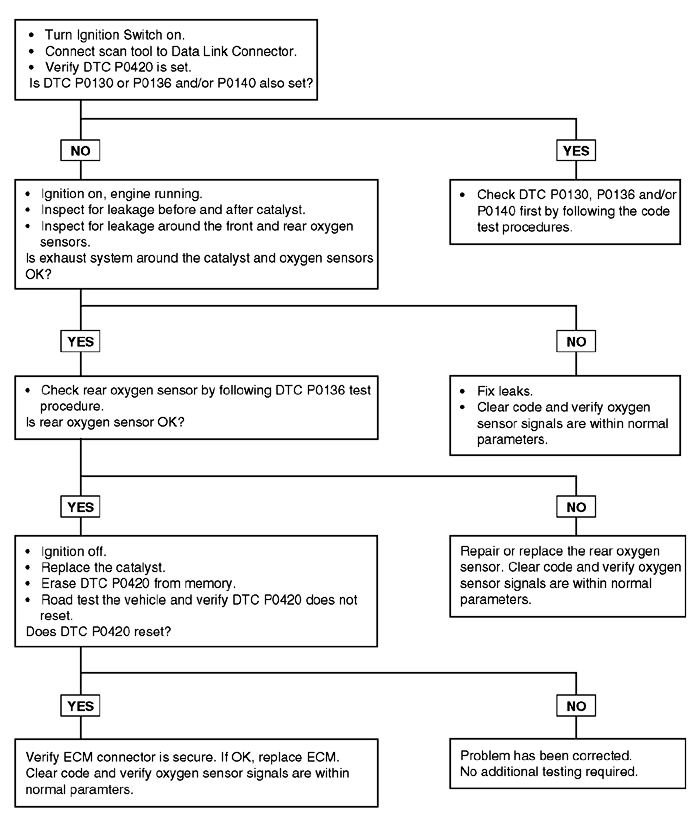
TEST PROCEDURE