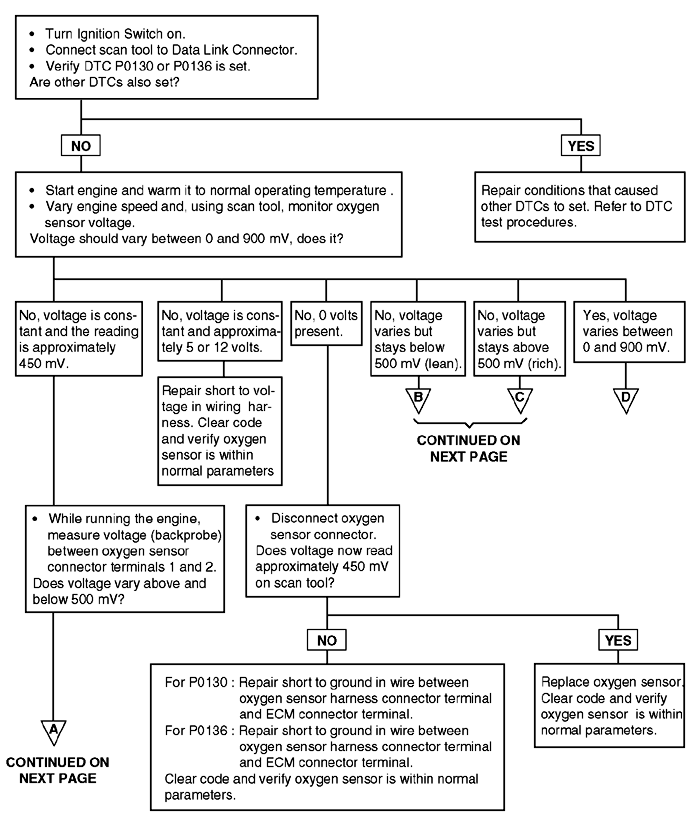
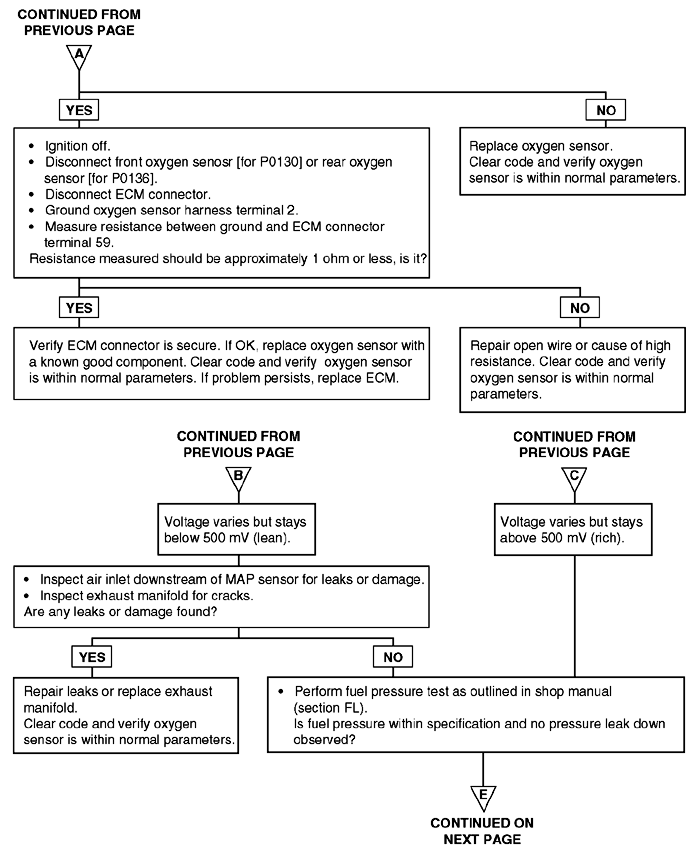
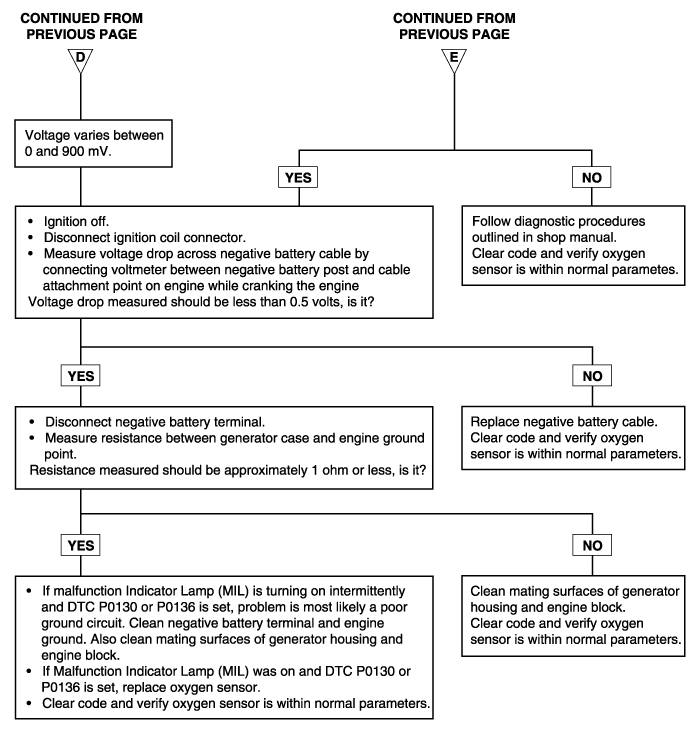
|
DTC |
Diagnostic item |
|
P0130
P0136 |
Oxygen Sensor Circuit Malfunction (Bank1,
Sensor1)
Oxygen Sensor Circuit Malfunction (Bank1,
Sensor2) |
DESCRIPTION
The Engine
Control Module (ECM) uses oxygen sensor signals to maintain the air fuel
mixture at the ratio resulting in optimum fuel economy and reduced
emissions. The amount of oxygen in the exhaust gases indicates, to the
front oxygen sensor, whether the air fuel mixture being supplied to the
engine cylinders is rich or lean. The readings of the rear oxygen sensor
are used to indicate the efficiency of the catalytic converter. The ECM
calculates catalytic converter efficiency by comparing the rear oxygen
sensor signal to the front oxygen sensor signal.
A normal
oxygen sensor signal will constantly fluctuate above and below 500 mV,
with the front oxygen sensor signal frequency of at least 5Hz at 2500 RPM.
Due to the effect of the catalytic converter, the rear oxygen sensor
signal frequency will be lower than the front oxygen sensor signal
frequency. If the rear oxygen sensor signal coincides with the front
oxygen sensor signal a large percentage of the time, this indicates a loss
in efficiency of the catalytic converter or a malfunction within the fuel
system.
FAILURE CONDITIONS
[FOR
P0130]
After the
engine runs, the ECM checks the front oxygen sensor once per driving cycle
for 5 sec. If during two driving cycles the front oxygen sensor's output
is not between 0 millivolts and +380 millivolts while the rear oxygen
sensor's output is greater than 350 millivolts, the ECM will set a code
and the MIL will turn on. This code indicates uncharacteristic operation
of the front oxygen sensor being read by the ECM.
[FOR
P0136]
After the
system is in closed-loop operation and the engine has run for 3 minutes,
the ECM checks the rear oxygen sensor's output. If during two driving
cycles the rear oxygen sensor's output is not between 400 millivolts and
500 millivolts, the ECM will set a code and the MIL will turn on. This
code indicates an uncharacteristic reading by the rear oxygen sensor or
ECM after the engine has been warmed and run for 3 minutes.
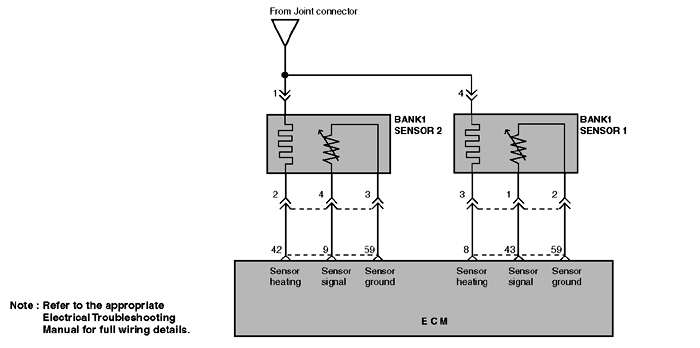
CIRCUIT DIAGRAM
TEST PROCEDURE