| EBD (Electronic Brake-force Distribution) |
The EBD system
(Electronic Brake force Distribution) as a sub-system of the ABS system is
to control the effective adhesion utilization by the rear wheels.
It further
utilizes the efficiency of highly developed ABS equipment by controlling
the slip of the rear wheels in the partial braking range.
The brake
force is moved even closer to the optimum and controlled electronically,
thus dispensing with the need for the proportioning valve.
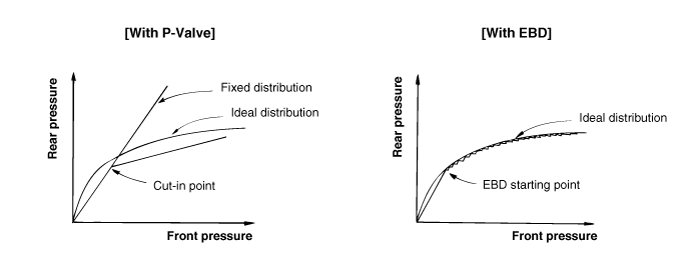
The
proportioning valve, because of a mechanical device, has limitations to
achieve an ideal brake force distribution to the rear wheels as well as to
carry out the flexible brake force distribution proportioning to the
vehicle load or weight increasing. And in the event of malfunctioning,
driver cannot notice whether it fails or not.
EBD controlled
by the ABS Control Module, calculates the slip ratio of each wheel at all
times and controls the brake pressure of the rear wheels not to exceed
that of the front wheels.
If the EBD
fails, the EBD warning lamp (Parking brake lamp) lights up.
ADVANTAGES
| a. |
Function improvement of the base-brake
system. |
| b. |
Compensation for the different friction
coefficients. |
| c. |
Elimination of the proportioning
valve. |
| d. |
Failure recognition by the warning
lamp. |
Comparison between Proportioning valve and
EBD
FAIL SAFE
|
FAIL CAUSE |
SYSTEM |
WARNING
LAMP | ||
|
ABS |
EBD |
ABS |
EBD | |
|
None |
ON |
ON |
OFF |
OFF |
|
1-Wheel speed sensor failure |
OFF |
ON |
ON |
OFF |
|
Pump malfunction |
OFF |
ON |
ON |
OFF |
|
Low voltage |
OFF |
ON |
ON |
OFF |
|
2 or more wheel speed sensor
failure
Solenoid valve failure
HECU malfunction
Other failure |
OFF |
OFF |
ON |
ON |