| REMOVAL |
| 1. |
Disconnect the ventilation hose from the
positive crankcase ventilation (PCV) valve. Remove the PCV valve
from the rocker cover and reconnect it to the ventilation
hose. |
| 2. |
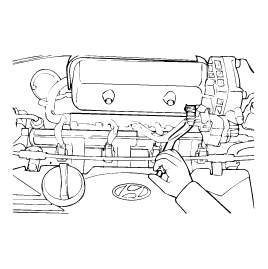
Run the engine at idle and put a finger on the
open end of the PCV valve and make sure that intake manifold vacuum
can be felt.
The plunger inside the PCV valve will move
back and forth. |
| 3. |
If vacuum is not felt, clean the PCV valve and
ventilation hose in cleaning solvent, or replace if
necessary. |
INSPECTION
| 1. |
Remove the PCV
valve. |
| 2. |
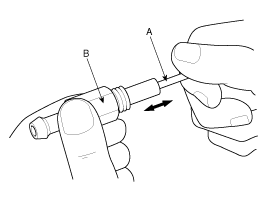
Insert a thin stick into the PCV valve from
the threaded side to check that the plunger
moves. |
| 3. |
If the plunger does not move, the PCV valve is
clogged. Clean it or replace. |
INSTALLATION
Install the
PCV valve and tighten to the specified torque.
|
PCV valve tightening torque: 8-12 Nm (80-120
kg.cm, 5.8-8.7 lb.ft) |
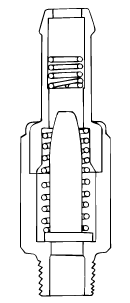
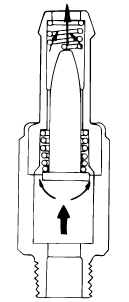
PCV VALVE OPERATING
|
Intake manifold side (No vacuum)
Rocker cover side |
Intake manifold side (High
vacuum)
Rocker cover side | ||
|
Engine condition |
Not running |
Engine condition |
Idling or decelerating |
|
PCV valve |
Not operating |
PCV valve |
Fully operating |
|
Vacuum passage |
Restricted |
Vacuum passage |
Small |
|
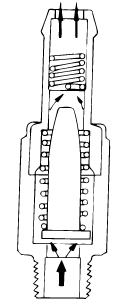
Intake manifold side (Moderate
vacuum)
Rocker cover side |
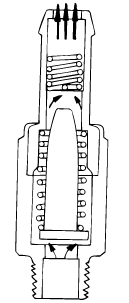
Intake manifold side (Low vacuum)
Rocker cover side | ||
|
Engine condition |
Normal operation |
Engine condition |
Accelerating and high load |
|
PCV valve |
Properly operating |
PCV valve |
Slightly operating |
|
Vacuum passage |
Large |
Vacuum passage |
Very large |