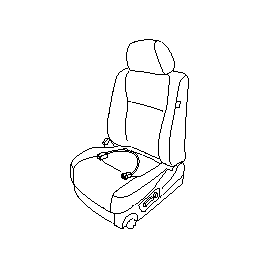
| SRSCM |
The primary purpose of
the advanced restraint control module is to discriminate between an event
that warrants restraint system deployment and an event that does not. The
advanced restraint control module must decide if and when to deploy the
restraint system pretensioners and airbags. After determining that
pretensioners and/or airbag deployment is required, the advanced restraint
control module must supply sufficient power to the pretensioners and
airbag igniters to initiate deployment. The advanced restraint control
module determines that an impact may require deployment of the
pretensioners and airbags from data obtained from buckle switches, seat
track position sensors, occupant classification system, front impact
sensors and side impact sensors in conjunction with a safing
function.
The advanced restraint
control module will not be ready to detect a crash or to activate the
restraint system devices until the signals in the advanced restraint
control module circuitry stabilize. It is possible that the advanced
restraint control module could activate the safety restraint devices in
approximately 2 seconds but is guaranteed to fully function after
prove-out is completed.
The advanced restraint
control module must perform a diagnostic routine and light a system
readiness indicator at key-on. The system must perform a continuous
diagnostic routine and provide fault annunciation through a warning lamp
indicator in the event of fault detection.
A serial diagnostic
communication interface will be used to facilitate servicing of the
advanced restraint control system.
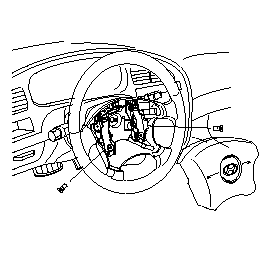
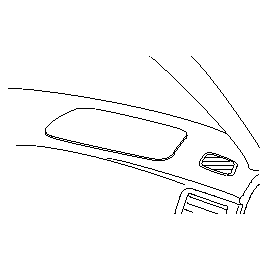
FRONT AIRBAGS
The Driver and front
passenger airbags are two stage devices. If the crash algorithm determines
that only the first stage is to be activated, the second stage will be
automatically disposed of after a programmable time in 120 milliseconds
has elapsed since the first stage deployment. The driver and front
passenger firing loops (4 total) are backed up (Back-up Power Supply) for
150ms if the battery connection is lost in a crash.
OC (OCCUPANT CLASSIFICATION) SYSTEM
In contrast to the
initial one-stage airbag systems, newer restraint systems involve complex
logic to select, or alternatively suppress, various levels of safety
system deployment.
Inherent to an Advanced
Restraint System is the ability to discern information regarding passenger
occupancy. It is intended that these inputs be provided through the OCS.
The objective of such safety system is to reduce the risk and level of
injuries by automatically adapting the airbag(s) and seat belt
pretensioner to the driving status of the vehicle, its occupants, and the
crash severity.
The current OCS covered
in this specification continually senses and classifies the front
passenger side seat.
SIDE IMPACT SENSOR
The Side Impact Sensors
are remote sensor that detect acceleration due to collision at their
mounting locations. The primary purpose of the Side Impact Sensors is to
provide an indication of a collision earlier than is possible from a
central mounting location. The Side Impact Sensors send acceleration data
to the central control module.
FRONT IMPACT SENSOR
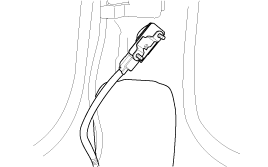
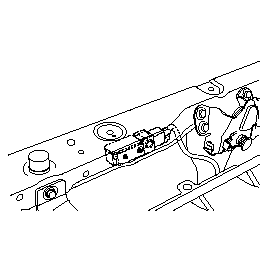
The Front Impact Sensor
is a remote sensor that provides accelerometer data to the advanced
restraint control module to determine if the severity of a frontal impact
event warrants a single-stage or dual-stage frontal airbag
deployment.
Backup power
The advanced restraint
control module must provide deployment power to the Front Impact Sensor
for a minimum of 150 ms after loss of vehicle power.
STPS (SEAT TRACK POSITION SENSOR)
The STPS operated via a
non-contacting magnetic proximity sensing device combined with a simple
electronic circuit resulting in the ability of producing two separate
& distinct logic level signals.
The STPS output signal
is altered by the proximity of a separate ferro-magnetic shunt, which is
linked via the seat track. The logic signal produced is the result of the
proximity device being activated (no shunt present) or deactivated (shunt
present).