| DESCRIPTION |
The CVVT (Continuously
Variable Valve Timing) which is installed on the exhaust camshaft controls
intake valve open and close timing in order to improve engine
performance.
The intake valve timing
is optimized by CVVT system depending on engine rpm.
This CVVT system
improves fuel efficiency and reduces NOx emissions at all levels of engine
speed, vehicle speed, and engine load by EGR effect because of valve
over-lap optimization.
The CVVT changes the
phase of the intake camshaft via oil pressure.
It changes the intake
valve timing continuously.
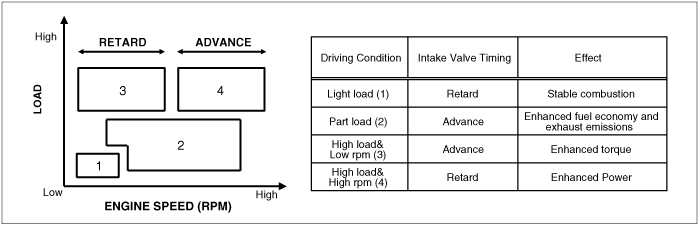
| • |
The CVVT system makes continuous intake valve
timing changes based on operating
conditions. |
| • |
Intake valve timing is optimized to allow the
engine to produce maximum power. |
| • |
Cam angle is advanced to obtain the EGR effect
and reduce pumping loss. The intake valve is closed quickly to
reduce the entry of the air/fuel mixture into the intake port and
improve the changing effect. |
| • |
Reduces the cam advance at idle, stabilizes
combustion, and reduces engine
speed. |
| • |
If a malfunction occurs, the CVVT system
control is disabled and the valve timing is fixed at the fully
retarded position. |
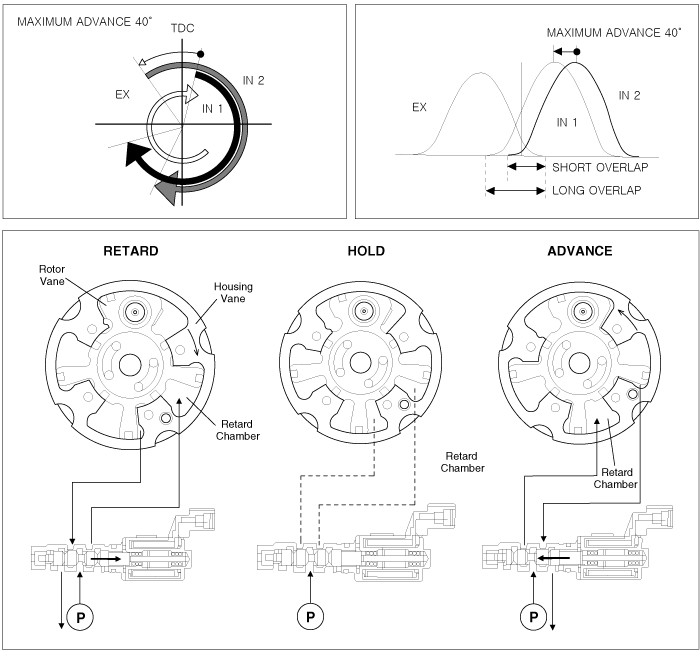
| 1. |
The above figure shows the relative operation
structures of the housing vane to the rotor
vane. |
| 2. |
If the CVVT is held a certain control angle,
to hold this state, oil is replenished as much as oil leaks from the
oil pump.
The OCV (Oil-flow Control Valve) spool
location at this time is as follows.
Oil pump → Advance
oil chamber (Little by little open the inflow side to the advance
oil chamber) → Almost close the drain side
Be sure there might be a difference in the
position according to the engine running state (rpm, oil
temperature, and oil
pressure). |