| GENERAL DESCRIPTION |
The CVVT (Continuously
Variable Valve Timing) system is installed to the chain sprocket of the
exhaust camshaft. There is no variation in valve timing of the exhaust cam
because the exhaust camshaft is driven by the timing belt. The timing of
the intake cam is varied by the relative operation the CVVT vane to the
housing. This system helps the engine decrease exhaust gases and increase
engine power and fuel economy by changing the valve open / close timing of
the intake camshaft.
| DTC DESCRIPTION |
This diagnosis checks
the camshaft position plausibility whether the expected range plus some
margin is not violated that might be caused by a wrong engine repair, or a
chain/belt misalignment. DTC P0016 is set when actual camshaft position is
too much retarded or advanced than full retard position or full advance
position. To continue the adjustment in such case could lead to a damage
of the engine by hitting the valves with the piston.
| DTC DETECTING CONDITION |
| Item |
Detecting
Condition |
Possible
Cause |
| DTC
Strategy |
● Check
Camshaft Signal Switching |
●
Abnormal installation of camshaft ● Abnormal installation of crankshaft ● Abnormal installation of tone wheel |
| Enable
Conditions |
● 6V <
Battery voltage < 16V ● Check CVVT control state to determine thd.(Full retard position or Control) | |
| Threshold
Value |
● Camshaft
switching out of 109 ~ 141° CRK in full retard position, 70° ~ 140°
CRK during CVVT control | |
| Diagnostic
Time |
● 8
Sec. |
| MONITOR DTC STATUS |
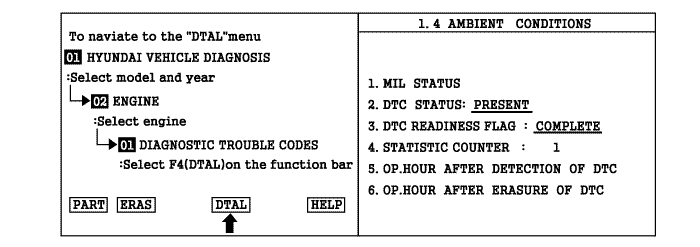
| 1. |
Connect scan tool and select "Diagnostic
Trouble Codes(DTCs)" mode |
| 2. |
Press F4(DTAL) to select DTC information from
the DTCs menu |
| 3. |
Confirm that "DTC Readiness Flag" indicates
"Complete". If not, drive the vehicle within conditions noted in the
freeze frame data or enable
conditions |
| 4. |
Read "DTC Status" parameter
|
| 5. |
Is parameter displayed "History(Not Present)
fault"?
▶ Fault is intermittent caused by poor contact
in the sensor’s and/or PCM’s connector or was repaired and PCM
memory was not cleared. Thoroughly check connectors for looseness,
poor connection, bending, corrosion, contamination, deterioration,
or damage. Repair or replace as necessary and then go to
"Verification of Vehicle Repair" procedure.
▶ Go to "Component Inspection"
procedure. |



| COMPONENT INSPECTION |
| 1. |
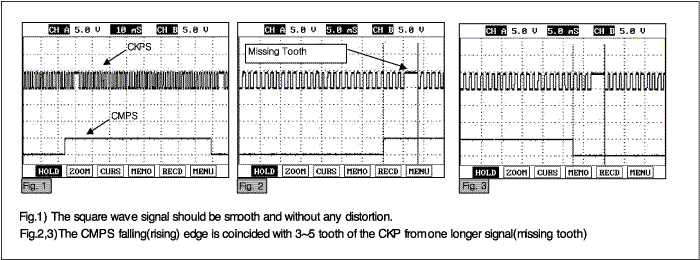
Timing Inspection
|
| VERIFICATION OF VEHICLE REPAIR |
After a repair, it is
essential to verify that the fault has been corrected.
| 1. |
Connect scan tool and select "Diagnostic
Trouble Codes(DTCs)" mode |
| 2. |
Press F4(DTAL) and confirm that "DTC Readiness
Flag" indicates "Complete". If not, drive the vehicle within
conditions noted in the freeze frame data or enable
conditions |
| 3. |
Read "DTC Status"
parameter |
| 4. |
Is parameter displayed "History(Not Present)
fault"?
▶ System performing to specification at this
time. Clear the DTC
▶ Go to the applicable troubleshooting
procedure. |