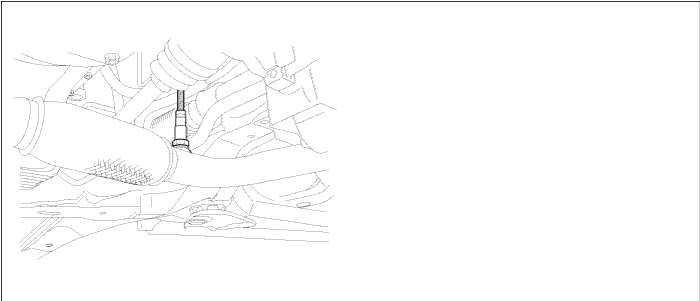
| COMPINENT LOCATION |
| GERNERAL DESCRIPTION |
The rear heated oxygen
sensor is mounted on the rear side of the Catalytic Converter (warm-up
catalytic converter) or in the rear exhaust pipe, which is able to detect
catalyst efficiency. The rear heated oxygen sensor (HO2S) produces a
voltage between 0V and 1V. This rear heated oxygen sensor is used to
estimate the oxygen storage capability. If a catalyst has good conversion
properties, the oxygen fluctuations are smoothed by the oxygen storage
capacity of the catalyst. If the conversion provided by the catalyst is
low due to aging, poisoning or misfiring, then the oxygen fluctuations are
similar to signals from the front oxygen sensor.
| DTP DESCRIPTION |
PCM sets DTC P0137 if
the PCM detects that Signal Voltage lower than the possible range of a
properly operating rear HO2S.
| DTP DETDCING CONDITION |
| Item |
Detecting
Condition |
Possible
Cause |
| DTC
Strategy |
● Voltage
range check |
●
Short to ground in signal harness ● Contact resistance in connectors ● Faulty Heated O2 Sensor(HO2S) |
| Enable
Condition |
● Catalyst
temperature model > -33°C( -27.4°F) ● Lambda regulation active ● Lambda controller is not on the limit ● Catalyst purge after fuel cut off is not active ● No relevant failure ● 10V < Battery voltage < 16V | |
| Threshold
Value |
● Downstream
O2 Sensor voltage < 0.02V & sensor element resistance <
30Ω | |
| Diagnostic
Time |
● 30
sec. |
| MONITOR DTC STATUS |
| 1. |
Connect scan tool and select "Diagnostic
Trouble Codes(DTCs)" mode. |
| 2. |
Press F4(DTAL) to select DTC information from
the DTCs menu. |
| 3. |
Confirm that "DTC Readiness Flag" indicates
"Complete". If not, drive the vehicle within conditions noted in the
freeze frame data or enable
conditions. |
| 4. |
Read "DTC Status" parameter.
|
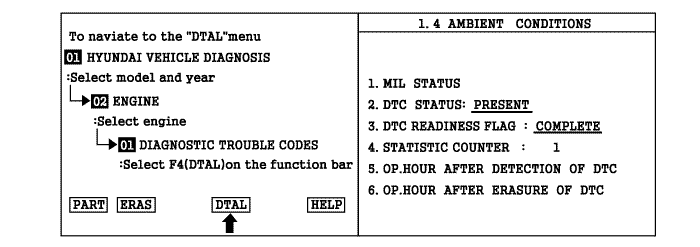
| 5. |
Is parameter displayed "History(Not Present)
fault"?
▶ Fault is intermittent caused by poor contact
in the sensor’s and/or PCM’s connector or was repaired and PCM
memory was not cleared. Thoroughly check connectors for loose or
poor connection, bending, corrosion, contamination, deterioration,
or damage. Repair or replace as necessary and go to "Verification of
Vehicle Repair" procedure.
▶ Go to next step as
below. |



| TERMINAL & CONNECTOR INSPECTION |
| 1. |
Many malfunctions in the electrical system are
caused by poor harness(es) and terminals. Faults can also be caused
by interference from other electrical systems, and mechanical or
chemical damage. |
| 2. |
Thoroughly check connectors for looseness,
poor connection, bending, corrosion, contamination, deterioration,
or damage. |
| 3. |
Has a problem been found?
▶ Repair as necessary and go to "Verification
of Vehicle Repair" procedure.
▶ Go to "Signal Circuit Inspection"
procedure. |
| SIGNAL CIRCUIT INSPECTION |
| 1. |
Ignition
"OFF" |
| 2. |
Disconnect HO2S
connector. |
| 3. |
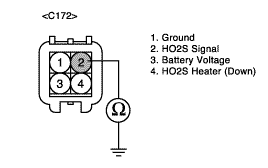
Measure resistance between terminal 2 of the
sensor harness connector and chassis ground.
|
| 4. |
Is resistance within the
specification?
▶ Go to "Component Inspection"
procedure.
▶ Repair open in the ground circuit and go to
"Verification of Vehicle Repair"
procedure. |
| COMPONENT INSPECTION |
| 1. |
Warm up the engine to normal operating
temperature and check that HO2S signal is
active. |
| 2. |
Connect Scantool and monitor the "O2 SNSR
VOLT.(B1/S2)" parameter on the Scantool data list.
|
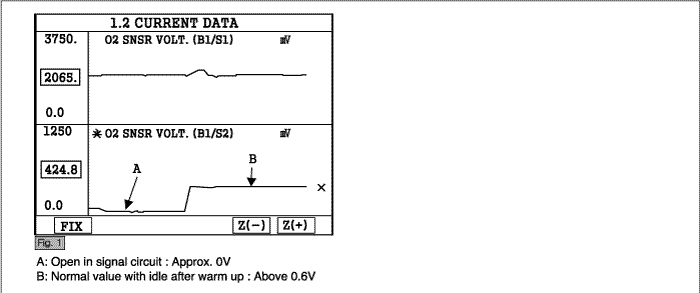
| 3. |
Is sensor data near the specified
value?
▶ Check for poor connection between PCM and
component: backed out terminal, improper mating, broken locks or
poor terminal to wire connection. Repair as necessary and go to
"Verification of Vehicle Repair" procedure.
▶ Check HO2S for contamination, deterioration,
or damage. Substitute with a known-good HO2S and check for proper
operation. If the problem is corrected, replace HO2S and then go to
"Verification of Vehicle Repair"
procedure. |
| VERIFICATION OF VEHICLE REPAIR |
After a repair, it is
essential to verify that the fault has been corrected.
| 1. |
Connect scan tool and select "Diagnostic
Trouble Codes(DTCs)" mode. |
| 2. |
Press F4(DTAL) and confirm that "DTC Readiness
Flag" indicates "Complete". If not, drive the vehicle within
conditions noted in the freeze frame data or enable
conditions. |
| 3. |
Read "DTC Status"
parameter. |
| 4. |
Is parameter displayed "History(Not Present)
fault"?
▶ System performing to specification at this
time. Clear the DTC
▶ Go to the applicable troubleshooting
procedure. |
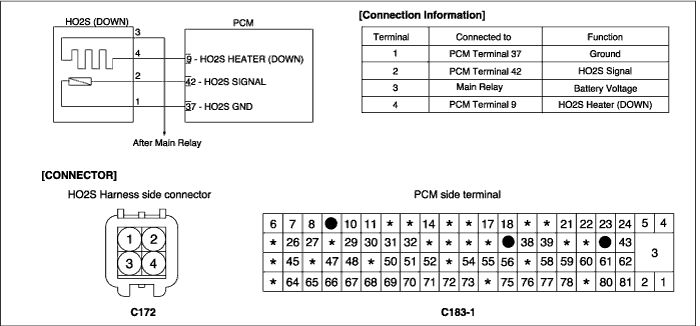
| SCHEMATIC DIGRAM |