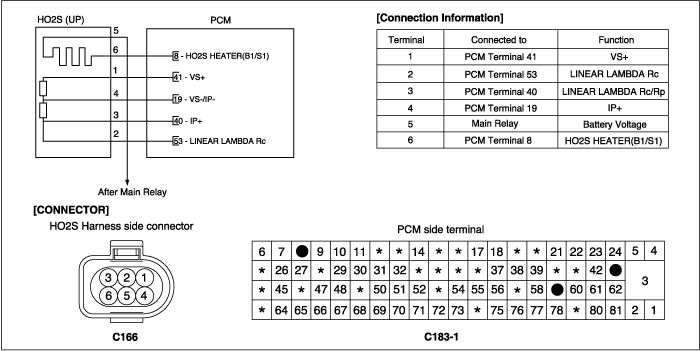
| COMPONENT LOCATION |
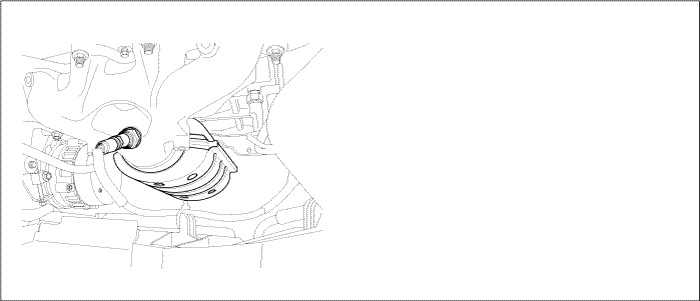
| GENERAL DESCRIPTION |
The linear O2 sensor is
mounted on the front side of the Catalytic Converter (warm-up catalytic
converter) or in the front exhaust pipe. It detects a wide range of
air/fuel ratios in the exhaust gas from the rich to lean regions. This
linear O2 sensor produces a current that corresponds to a specific
air/fuel ratio. The PCM monitors this signal and determines whether the
air/fuel mixture is rich or lean. The PCM constantly monitors the linear
O2 sensor and increases or decreases the fuel injection duration using
this signal. This is called closed-loop fuel control
operation.
| DTC DESCRIPTION |
The PCM monitors front
HO2S tip temperature and signal at the same time to check open ciurit of
Pumping Current Circuit (PCM PIN No. 19). The PCM sets DTC P2237 if front
O2 tip temerature is higher than the predetermined threshold and front
HO2S signal stuck is detected. If the same error code is set in the next
driving cycle, the PCM illuminates the MIL.
| DTC DETECTING CONDITION |
| Item |
Detecting
Condition |
Possible
Cause |
| DTC
Strategy |
● Open circuit
check of front HO2S circuit |
●
Contact resistance in connectors ● Open or Short to ground in HO2S circuit ● Front HO2S |
| Enable
Conditions |
● No relevant
failure | |
| Threshold
Value |
● 0.9941 <
Lambda < 1.0059 | |
| Diagnostic
Time |
● Approx. 1300
sec. |
| MONITOR DTC STATUS |
If any DTCs relating to HO2S are present, DO
ALL REPAIRS associated with those codes before proceeding with this
troubleshooting tree. |

| 1. |
Connect scan tool and select "Diagnostic
Trouble Codes(DTCs)" mode |
| 2. |
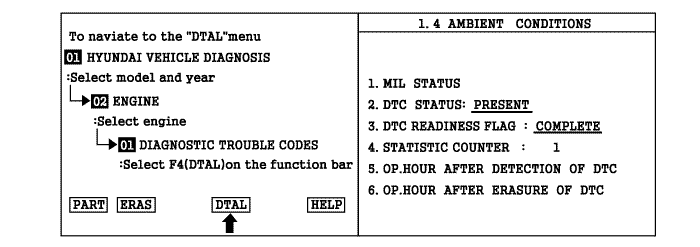
Press F4(DTAL) to select DTC information from
the DTCs menu |
| 3. |
Confirm that "DTC Readiness Flag" indicates
"Complete". If not, drive the vehicle within conditions noted in the
freeze frame data or enable
conditions |
| 4. |
Read "DTC Status" parameter
|
| 5. |
Is parameter displayed "History(Not Present)
fault"?
▶ Fault is intermittent caused by poor contact
in the sensor’s and/or PCM’s connector or was repaired and PCM
memory was not cleared. Thoroughly check connectors for looseness,
poor connection, bending, corrosion, contamination, deterioration,
or damage. Repair or replace as necessary and then go to
"Verification of Vehicle Repair" procedure.
▶ Go to next step as
below. |


PUMPING CURRENT CIRCUIT INSPECTION
| 1. |
Ignition
"OFF" |
| 2. |
Disconnect HO2S and PCM
connectors. |
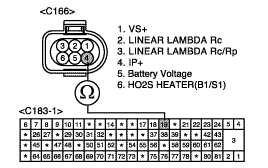
| 3. |
Measure resistance between terminals 4 of the
sensor harness connector and 19 of the PCM harness
connector
|
| 4. |
Is resistance within the
specification?
▶ Go to "Terminal and Connector Inspection"
procedure
▶ Repair as necessary and go to "Verification
of Vehicle Repair" procedure |
| TERMINAL AND CONNECTOR INSPECTION |
| 1. |
Many malfunctions in the electrical system are
caused by poor harness(es) and terminals. Faults can also be caused
by interference from other electrical systems, and mechanical or
chemical damage. |
| 2. |
Thoroughly check connectors for looseness,
poor connection, bending, corrosion, contamination, deterioration,
or damage. |
| 3. |
Has a problem been found?
▶ Repair as necessary and go to "Verification
of Vehicle Repair" procedure
▶ Go to "Component Inspection"
procedure |
| COMPONENT INSPECTION |
| 1. |
Visually/physically inspect following
items:
▶ Visually/physically inspect the front HO2S
for contamination, deterioration, or damage.
▶ Inspect the front HO2S for any silicon
contamination. This contamination will be indicated by a white
powdery coating and this will result in a but false voltage
signal
▶ If contamination is evident on the HO2S,
replace contaminated sensor and go to next
step. |
| 2. |
Warm up the engine to normal operating
temperature and check that HO2S signal is
active. |
| 3. |
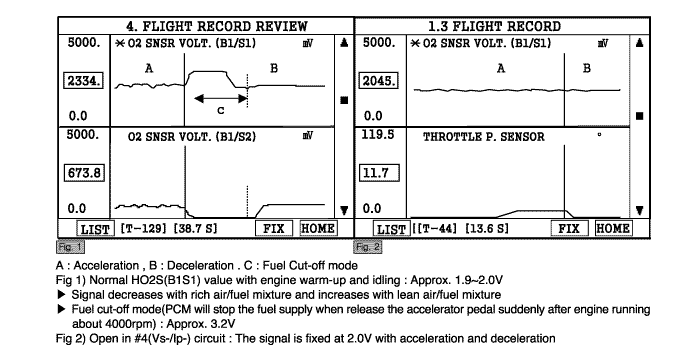
Connect Scantool and monitor the "O2 SNSR
VOLT.(B1/S1)" parameter on the Scantool data list.
|
| 4. |
Is sensor data near the specified
value?
▶ Check for poor connection between PCM and
component: backed out terminal, improper mating, broken locks or
poor terminal to wire connection. Repair as necessary and go to
"Verification of Vehicle Repair" procedure
▶ Check HO2S for contamination, deterioration,
or damage. Substitute with a known-good HO2S and check for proper
operation. If the problem is corrected, replace HO2S and then go to
"Verification of Vehicle Repair"
procedure |
| VERIFICATION OF VEHICLE REPAIR |
After a repair, it is
essential to verify that the fault has been corrected.
| 1. |
Connect scan tool and select "Diagnostic
Trouble Codes(DTCs)" mode |
| 2. |
Press F4(DTAL) and confirm that "DTC Readiness
Flag" indicates "Complete". If not, drive the vehicle within
conditions noted in the freeze frame data or enable
conditions. |
| 3. |
Read "DTC Status"
parameter |
| 4. |
Is parameter displayed "History(Not Present)
fault"?
▶ System performing to specification at this
time. Clear the DTC
▶ Go to the applicable troubleshooting
procedure |
| SCHEMATIC DIAGRAM |