| TROUBLESHOOTING |
To begin a successful
diagnosis, fill out the questions.
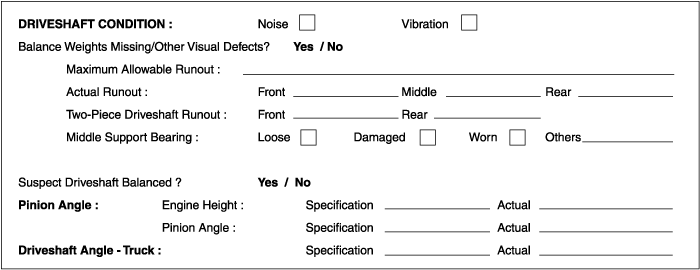
Once the concern is
narrowed down to a symptom/condition, proceed to condition and Symptom
Categories below.
Condition and Symptom
Categories.
Operation Condition
Vehicle is moving
Depends more one how the
vehicle is operated
| 1. |
Speed related
- Related to vehicle speed
|
| 2. |
Acceleration
- Light/moderate acceleration
|
| 3. |
Cruising speeds
- Driveline vibration. Go to
Troubleshooting. |
| Symptom |
Cause |
Remedy (See
page) |
| Hub
howling or whine - Hub or transfer case |
Axle lubricant
low |
Check the
lubricant level. Fill the axle to specification |
| Damaged or worn
wheel bearings or axle bearings |
Check for
abnormal wheel bearing play or roughness. Refer to wheel Bearing Check in this section. See page DS-26. Adjust or Install new wheel bearings as necessary. See page DS-23 for front bearings or DS-29 for rear bearings. | |
| Driveline clunk - loud clunk when shifting from reverse
to drive |
Excessive
backlash in the axle or transmission |
Carry out a total
backlash check |
| Loosen suspension
components |
Inspect the
suspension for damage or wear. Repair or Install new components as
necessary. See page SS-27, SS-43. | |
| Broken powertrain
mounts |
Inspect the
powertrain mounts. Install new mounts as necessary. | |
| Idle speed too
high |
Check for the
correct idle speed | |
| Driveline
clunk-occurs as the vehicle starts to move forward following a
stop |
Worn driveshaft
joints with excessive play |
Inspect the
joints for a worn condition. Install a new driveshaft as necessary. See page DS-8. |
| Driveline
clunk-occurs during acceleration or from cruise to
coast/deceleration |
Damaged or worn
tripod joints |
Inspect the
joint and boot. Repair or Install a new joint as
necessary. See page DS-8. |
| Quirer-noise
from the rear hub, occurs when driving on rugged roads |
Cap seperation
from the hub bearing |
Remove the
rear hub check the hub bearing cap. Install a new cap if necessary. |
| Clicking, popping or grinding-occurs while vehicle is
turning |
Inadequate or
contaminated lubrication in the joints |
Check the
joint boots and joints for wear or damage. Repair or Install new
components as necessary. See page DS-14, 21. |
| Another component
contacting the driveshaft |
Check the
driveshafts and the are around the driveshafts. Repair as necessary. | |
| Brake
components |
Inspect the
front brakes for wear or damage. Repair as
necessary. See page BR-25. | |
| Suspension
components |
Inspect the
lower arm ball joints for wear or damage. Repair as
necessary. See page SS-33 for ball joints. | |
| Damaged or worn
wheel bearings |
Check for
abnormal wheel bearing play or roughness. Refer to wheel bearing check in this section. See page DS-26. Adjust or Install new wheel bearings as necessary. See page DS-26 for front wheel bearings. | |
| Clicking or
snapping-occurs when accelerating around a corner |
Damaged or worn
birfield joints |
Inspect the
Birfield joints and boots. Repair or Install a new joint as
necessary. See page DS-14 or 21. |
| Buzz-buzzing
noise is the same at cruise or coast/deceleration |
Damaged or worn
tires |
Check for
abnormal tire wear or damage. Install a new tire as
necessary. See page SS-63. |
| Driveline shudder-occurs during acceleration from a slow
speed or stop |
Rear axle
assembly mispositioned |
Check the
axle mounts and the rear suspension for damage or wear. Repair as
necessary. |
| Loose rear axle
bolts |
Inspect the
bolts. Tighten the bolt nuts to specification. | |
| Damaged or worn
front suspension components |
Check for a
loose stabilizer bar, damaged or loose strut/strut bushings or loose
or worn ball joints. Inspect the steering linkage for wear or
damage. Repair or Install new components as
necessary. See page SS-1. | |
| Binding the
driveshaft joint |
Inspect the
driveshaft shaft joint for worn, or damaged condition. Install a new
driveshaft assembly as necessary. Repair as necessary. See page
DS-8. | |
| Loose rear axle
bolts |
Inspect the
bolts. Tighten the bolts to specification. | |
| Driveline vibration-occurs at cruising
speeds |
Binding or
damaged driveshaft joint |
Inspect the
driveshaft joint for wear or damage. Install a new driveshaft assembly as necessary. See page DS-8. |
| Incorrect lateral
and radial tire/wheel runout |
Inspect the
tire and wheels. Measure tire runouts. Repair or Install new components as necessary. See page SS-59. | |
| Incorrectly
seated joint in the front wheel hub |
Check the
Birfield joint for correct seating into the hub. Repair as
necessary. See page DS-14, DS-21 for front joints. |