| INSPECTION |
SEALL TEST
Do not let anybody stand in front of or behind
the vehicle while this test is being carried
out. |

| 1. |
Check the automatic transmission fluid level
and temperature and the engine coolant temperature.
|
| 2. |
Check both rear wheels (left and
right). |
| 3. |
Pull the parking brake lever on, with the
brake pedal fully depressed. |
| 4. |
Start the
engine. |
| 5. |
Move the selector lever to the "D" position,
fully depress the accelerator pedal and take a reading of the
maximum engine speed at this time.
|
TORQUE CONVERTER STALL TEST JUDGEMENT
RESULTS
| 1. |
Stall speed is too high in both "D" and "R"
ranges
|
| 2. |
Stall speed is too high in "D" range
only
|
| 3. |
Stall speed is too high in "R" range
only
|
| 4. |
Stall speed too low in both "D" and "R"
ranges
|
HYDRAULIC PRESSURE TEST
| 1. |
Warm up the engine until the automatic
transaxle fluid temperature is
80~100°C. |
| 2. |
Jack up the vehicle so that the wheels are
free to turn. |
| 3. |
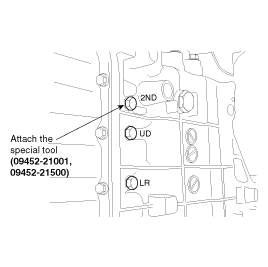
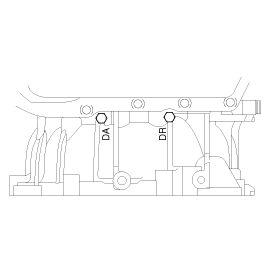
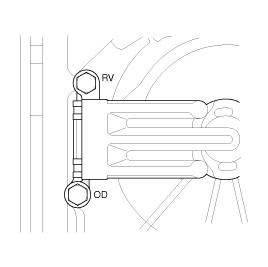
Connect the special tools oil pressure gauge
to each pressure discharge port. |
| 4. |
Measure the hydraulic pressure at each port
under the conditions given in the standard hydraulic pressure table,
and check that the measured values are within the standard value
ranges. |
| 5. |
If a value is outside the standard range,
correct the problem while referring to the hydraulic pressure test
diagnosis table.
|
STANDARD HYDRAULIC PRESSURE
TEST
| Measurement
condition |
Standard hydraulic pressure
kPa | ||||||||
| Selector lever
position |
Shift position |
Enginespeed (rpm) |
Under drive clutch pressure
(UD) |
Reverse clutch pressure
(REV) |
Overdrive clutch pressure
(OD) |
Low and reverse brake pressure
(LR) |
Second brake pressure
(2ND) |
Damper clutch apply pressure
(DA) |
Damper clutch release pressure
(DR) |
| P |
- |
2,500 |
- |
- |
- |
260 ~
340 |
- |
- |
220 ~
360 |
| R |
Reverse |
2,500 |
- |
1,270 ~
1,770 |
- |
1,270 ~
1,770 |
- |
- |
500 ~
700 |
| N |
Neutral |
- |
- |
- |
- |
260 ~
340 |
- |
- |
220 ~
360 |
| D |
1st
gear |
2,500 |
1,010 ~
1,050 |
- |
- |
1,010 ~
1,050 |
- |
- |
500 ~
700 |
| 2nd
gear |
2,500 |
1,010 ~
1,050 |
- |
- |
- |
1,010 ~
1,050 |
- |
500 ~
700 | |
| 3rd
gear |
2,500 |
780 ~
880 |
- |
780 ~
880 |
- |
- |
More than
750 |
450 ~
650 | |
| 4th
gear |
2,500 |
- |
- |
780 ~
880 |
- |
780 ~
880 |
More than
750 |
450 ~
650 | |
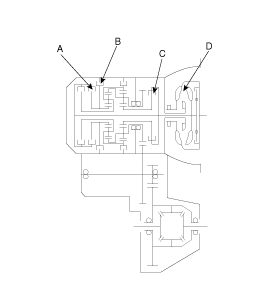
OIL SEAL LOCATION
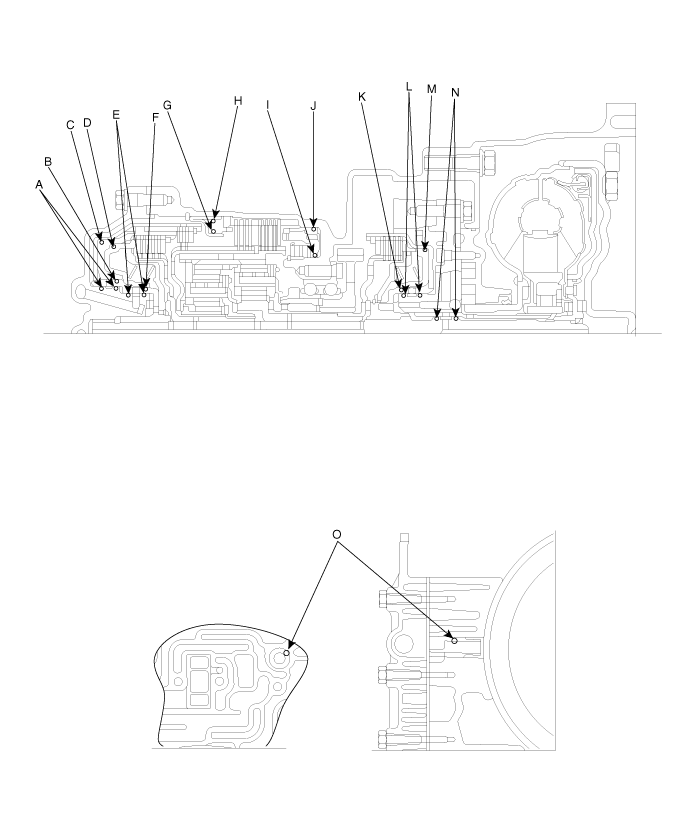
HYDRAULIC PRESSURE TEST DIAGNOSIS TABLE
| Trouble symptom |
Probable cause |
| All
hydraulic pressures are high |
Incorrect
transmission control cable adjustment |
| Malfunction of
the regulator valve | |
| All
hydraulic pressures are low |
Incorrect
transmission control cable adjustment |
| Malfunction of
the oil pump | |
| Clogged oil
filter | |
| Clogged oil
cooler | |
| Malfunction of
the regulator valve | |
| Malfunction of
the relief valve | |
| Incorrect
valve body installation | |
| Hydraulic pressure is abnormal in "R" range
only |
Malfunction of
the regulator valve |
| Clogged
orifice | |
| Incorrect
valve body installation | |
| Hydraulic pressure is abnormal in "3" or "4" range
only |
Malfunction of
the regulator valve |
| Clogged
orifice | |
| Incorrect
valve body installation | |
| Malfunction of
the overdrive solenoid valve | |
| Malfunction of
the overdrive pressure control valve | |
| Malfunction of
the regulator valve | |
| Malfunction of
the switch valve | |
| Clogged
orifice | |
| Incorrect
valve body installation | |
| Only
underdrive hydraulic pressure is abnormal |
Malfunction of
the oil seal K |
| Malfunction of
the oil seal L | |
| Malfunction of
the oil seal M | |
| Malfunction of
the underdrive solenoid valve | |
| Malfunction of
the underdrive pressure control valve | |
| Malfunction of
check ball | |
| Clogged
orifice | |
| Incorrect
valve body installation | |
| Only
reverse clutch hydraulic pressure is abnormal |
Malfunction of
the oil seal A |
| Malfunction of
the oil seal B | |
| Malfunction of
the oil seal C | |
| Clogged
orifice | |
| Incorrect
valve body installation | |
| Only
overdrive hydraulic pressure is abnormal |
Malfunction of
the oil seal D |
| Malfunction of
the oil seal E | |
| Malfunction of
the oil seal F | |
| Malfunction of
the overdrive solenoid valve | |
| Malfunction of
the overdrive pressure control valve | |
| Malfunction
check ball | |
| Clogged
orifice | |
| Incorrect
valve body installation | |
| Only
low and reverse hydraulic pressure is abnormal |
Malfunction of
the oil seal I |
| Malfunction of
the oil seal J | |
| Malfunction of
the low and reverse solenoid valve | |
| Malfunction of
the low and reverse pressure control valve | |
| Malfunction of
the switch valve | |
| Malfunction of
the fail safe valve A | |
| Malfunction of
check ball | |
| Clogged
orifice | |
| Incorrect
valve body installation | |
| Only
second hydraulic pressure is abnormal |
Malfunction of
the oil seal G |
| Malfunction of
the oil seal H | |
| Malfunction of
the oil seal O | |
| Malfunction of
the second solenoid valve | |
| Malfunction of
the second pressure control valve | |
| Malfunction of
the fail safe valve B | |
| Clogged
orifice | |
| Incorrect
valve body installation | |
| Only
reverse clutch hydraulic pressure is abnormal |
Malfunction of
the oil cooler |
| Malfunction of
the oil seal N | |
| Malfunction of
the damper clutch control solenoid valve | |
| Malfunction of
the damper clutch control valve | |
| Malfunction of
the torque converter pressure control valve | |
| Clogged
orifice | |
| Pressure applied to non operating element |
Incorrect
valve body installation |
| Incorrect
transmission control cable adjustment | |
| Malfunction of
the manual valve | |
| Malfunction of
check ball | |
| Incorrect
valve body installation |