| INSPECT FOR LEAKAGE OF
REFRIGERANT |
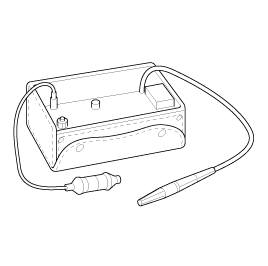
Always conduct a leak
test with an electronic leak detector whenever leakage or refrigerant is
suspected and when conducting service operations which are accompanied by
disassembly or loosening or connection fittings.
|
In order to use the leak detector properly,
read the manual supplied by the
manufacturer. |
| 1. |
Check the torque on the connection fittings
and, if too loose, tighten to the proper torque. Check for gas
leakage with a leak detector. |
| 2. |
If leakage continues even after the fitting
has been tightened, discharge the refrigerant from the system,
disconnect the fittings, and check their seating faces for damage.
Always replace, even if the damage is
slight. |
| 3. |
Check the compressor oil and add oil if
required. |
| 4. |
Charge the system and recheck for gas leaks.
If no leaks are found, evacuate and charge the system
again.
|
A/C SYSTEM TESTS
| •
|
Air conditioning refrigerant or
lubricant vapor can irritate your eyes, nose, or
throat. |
| •
|
Be careful when connecting service
equipment. |
| •
|
Do not breathe refrigerant or
vapor. | |
| •
|
Compressed air mixed with R-134a forms a
combustible vapor. |
| •
|
The vapor can burn or explode causing
serious injury. |
| •
|
Never use compressed air to pressure
test R-134a service equipment or vehicle air conditioning
systems. | |
| 1. |
Connect a R-134a refrigerant
recover/recycling/charging station to the high-pressure service port
and the low-pressure service port, following the equipment
manufacturer's instructions. |
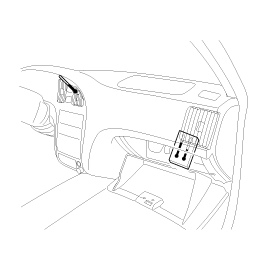
| 2. |
Insert a thermometer in the center
vent.
Determine the relative humidity and air
temperature.
|
| 3. |
Test conditions :
| A. |
Avoid direct
sunlight. |
| D. |
Set the temperature control dial on MAX
COOL, the mode control switch on VENT and the recirculation
control switch on
RECIRCULATE. |
| E. |
Turn the A/C switch on and the fan
switch on MAX. |
| F. |
Run the engine at 1,500
rpm. |
| G. |
No driver or passengers in
vehicle. | |
| 4. |
After running the air conditioning for 10
minutes under the above test conditions, read the delivery
temperature from the thermometer in the dash vent, the intake
temperature near the blower unit behind the glove box and the high
and low system pressure from the A/C
gauges. |
REFRIGERANT RECOVERY
| •
|
Air conditioning refrigerant or
lubricant vapor can irritate your eyes, nose, or
throat. |
| •
|
Be careful when connecting service
equipment. |
| •
|
Do not breathe refrigerant or
vapor. | |
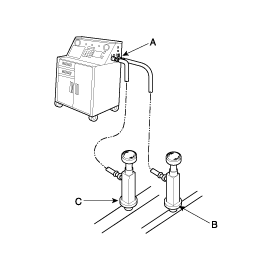
| 1. |
Connect a R-134a refrigerant
recovery/recycling/charging station (A) to the high-pressure service
port (B) and the low-pressure service port (C), as shown, following
the equipment manufacturer's instruction.
|
| 2. |
Measure the amount of refrigerant oil removed
from the A/C system after the recovery process is completed. Be sure
to put the same amount of new refrigerant oil back into the A/C
system before charging. |
SYSTEM EVACUATION
| •
|
Air conditioning refrigerant or
lubricant vapor can irritate your eyes, nose, or
throat. |
| •
|
Be careful when connecting service
equipment. |
| •
|
Do not breathe refrigerant or
vapor. | |
| 1. |
When an A/C System has been opened to the
atmosphere, such as during installation or repair, it must be
evacuated using a R-134a refrigerant recover/recycling/charging
station (If the system has been open for several days, the
receiver/dryer should be replaced, and the system should be
evacuated for several hours.) |
| 2. |
Connect a R-134a refrigerant
recovery/recycling/charging station(A) to the high-pressure service
port(B) and the low-pressure service port(C), as shown, following
the equipment manufacturer's instruction. Evacuate the
system.
|
| 3. |
If the low-pressure does not reach more than
93.3 kPa (700 mmHg, 27.6 in.Hg) in 15 minutes, there is probably a
leak in the system. Partially charge the system (see page HA-28),
and check for leaks (see page
HA-26). |
SYSTEM CHARGING
| •
|
Air conditioning refrigerant or
lubricant vapor can irritate your eyes, nose, or
throat. |
| •
|
Be careful when connecting service
equipment. |
| •
|
Do not breathe refrigerant or
vapor. | |
| 1. |
Connect a R-134a refrigerant
recover/recycling/charging station (A) to the high-pressure service
port (B) and the low-pressure service port (C), as shown, following
the equipment manufacture's instructions.
|
| 2. |
Add the same amount of new refrigerant oil to
the system that was removed during recovery. Use only FD46XG (PAG)
refrigerant oil. |
| 3. |
Charge the system with the specified amount of
R-134a refrigerant. Do not overcharge the system; the compressor
will be damaged.
Refrigerant capacity
:
Select the appropriate units of
measure for your charging station : 680 ±
25g
|
| |


