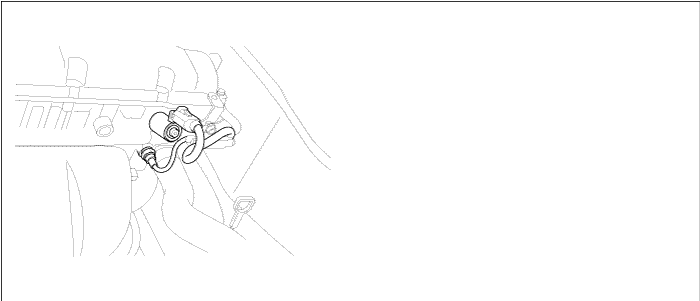
| COMPONENT LOCATION |
| GERNERAL DESCRIPTION |
The fluid of the CVVT is
the engine oil and its density changes according to the engine oil
temperature. At this time the Oil Temperature Sensor (OTS) helps
compensation against the temperature differences. The Oil Temperature
Sensor measures the engine oil temperature before the engine oil comes
into the Oil-flow Control Valve (OCV). According to the measured
temperature, the Engine Control Module (PCM) compensates the oil-flow
control valve operation time.
| DTC DESCRIPTION |
The purpose of this
diagnosis is to detect a stuck oil temperature signal or unplausibly low
,high signal. For the stuck signal detection, the PCM checks whether after
a variation of the calculated oil temperature also a variation of the
measured oil temperature is detected and sets DTC P0196 if the variation
of the measured oil temperature is lower than the threshold. For the
unplausibly high, low signal detection, the PCM compares measured engine
oil temperature with calculated oil temperature or coolant temperature and
sets DTC P0196 when one of following conditions is met.
| 1. |
Measured oil temperture is unplausibly low
when calculated oil temperature is
high. |
| 2. |
Measured oil temperature is unplausibly high
when coolant is low without any relevant
failure. |
| DTC DETECTING CONDITION |
| Item |
Detecting
Condition |
Possible Cause | ||||||
| DTC
Strategy |
Case1) |
●
Signal stuck |
● Contact resistance in connectors ● Faulty OTS | |||||
| Case2) |
●
Signal plausibility | |||||||
| Enable Conditions |
Case1) |
●
Engine coolant temperature at start <
40°C(104°F) ● No relevant failure ● 6 < Battery voltage < 16 | ||||||
| Case2) |
● No
relevant failure ● 6 < Battery voltage < 16 | |||||||
| Threshold Value |
Case1) |
●
Calculated oil temperature increase > threshold but measured oil
temperature increase < threshold(Threshold depends on Coolant
temperature at start) | ||||||
| Case2) |
●
Coolant temperature at start < 40°C(104°F) & calculated oil
temperature > 70°C(158°F) & measured oil temperature <
20°C(68°F) ● Coolant temperature < 70°C(158°F) & measured oil temperature > 100°C(212°F) | |||||||
| Diagnostic Time |
Case1) |
●10~30 minutes depending on coolant temperature at start
and drive pattern | ||||||
| Case2) |
● 15
seconds | |||||||
| MONITOR DTC STATUS |
If any codes relating to OTS are stored, do
ALL REPAIRS associated with those codes before proceeding with
further troubleshooting. |

| 1. |
Connect scan tool and select "Diagnostic
Trouble Codes(DTCs)" mode. |
| 2. |
Press F4(DTAL) to select DTC information from
the DTCs menu. |
| 3. |
Confirm that "DTC Readiness Flag" indicates
"Complete". If not, drive the vehicle within conditions noted in the
freeze frame data or enable
conditions. |
| 4. |
Read "DTC Status" parameter.
|
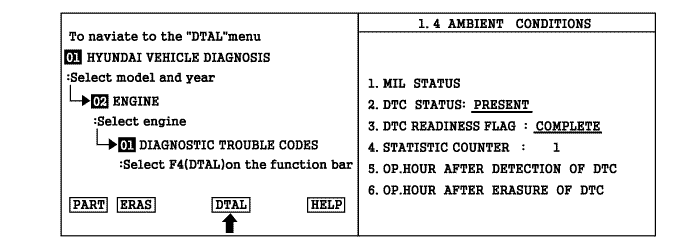
| 5. |
Is parameter displayed "History(Not Present)
fault"?
▶ Fault is intermittent caused by poor contact
in the sensor’s and/or PCM’s connector or was repaired and PCM
memory was not cleared. Thoroughly check connectors for loose or
poor connection, bending, corrosion, contamination, deterioration,
or damage. Repair or replace as necessary and go to "Verification of
Vehicle Repair" procedure.
▶ Go to next step as
below. |


| TERMINAL AND CONNECTOR INSPECTION |
| 1. |
Many malfunctions in the electrical system are
caused by poor harness(es) and terminals. Faults can also be caused
by interference from other electrical systems, and mechanical or
chemical damage. |
| 2. |
Thoroughly check connectors for looseness,
poor connection, bending, corrosion, contamination, deterioration,
or damage. |
| 3. |
Has a problem been found?
▶ Repair as necessary and go to "Verification
of Vehicle Repair" procedure
▶ Go to "Component Inspection"
procedure |
| COMPONENT INSPECTION |
| 1. |
Ignition
"OFF" |
| 2. |
Disconnect OTS
connector. |
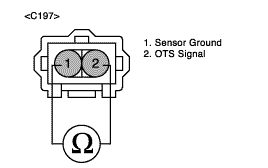
| 3. |
Measure resistance between terminals 1 and 2
of OTS connector.(Component side)
Specification
|
| 4. |
Is sensor switching properly?
▶ Check for poor connection between PCM and
component: backed out terminal, improper mating, broken locks or
poor terminal to wire connection. Repair as necessary and go to
"Verification of Vehicle Repair" procedure.
▶ Check OTS for contamination, deterioration,
or damage. Substitute with a known-good OTS and check for proper
operation. If the problem is corrected, replace OTS and then go to
"Verification of Vehicle Repair"
procedure. |
| VERIFICATION OF VEHICLE REPAIR |
After a repair, it is
essential to verify that the fault has been corrected.
| 1. |
Connect scan tool and select "Diagnostic
Trouble Codes(DTCs)" mode. |
| 2. |
Press F4(DTAL) and confirm that "DTC Readiness
Flag" indicates "Complete". If not, drive the vehicle within
conditions noted in the freeze frame data or enable
conditions. |
| 3. |
Read "DTC Status"
parameter. |
| 4. |
Is parameter displayed "History(Not Present)
fault"?
▶ System performing to specification at this
time. Clear the DTC.
▶ Go to the applicable troubleshooting
procedure. |
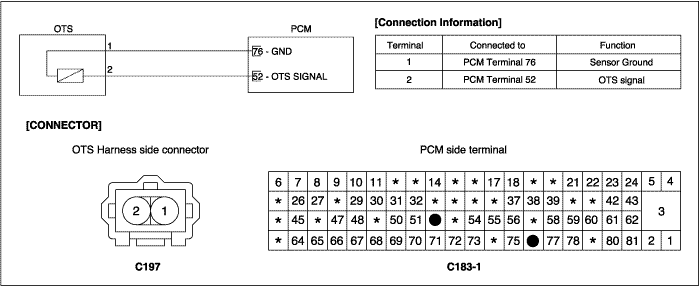
| SCHEMATIC DIGRAM |