| GENERAL DESCRIPTION |
In order to provide the
best possible combination of drivability, fuel economy, and emission
control, the PCM uses a closed loop air/fuel metering system. The PCM
monitiors the HO2S signal voltage and adjusts the fuel delivery based on
the HO2S signal voltage in closed loop fuel control. Changes in fuel
delivery will be indicated by the short-term and the long-term fuel trim
values. The ideal fuel trimvalue is around 0%. The PCMwill add fuel when
the HO2S signal is indicating a lean condition. Additional fuel is
indicated by fuel trim values that are above 0%. The PCM will reduce fuel
when the HO2S signal is indicating a rich condition. Reduction in fuel is
indicated by fuel trim values that are below 0%. The DTC relevant to fuel
trim will be set when the value reaches excessive levels because of a lean
or rich condition.
| DTC DESCRIPTION |
The PCM monitors the
trim of lambda control by the rear HO2S signal in addition to the HO2S
monitoring. The trim value calculation is based on the difference of rear
HO2S signal from desired value. The PCM sets DTC P2097 if either trim
value or the difference of rear HO2S from desired value is reached to the
minimum threshold. If the same error code is set in the next driving
cycle, the PCM illuminates the MIL.
| DTC DETECTING CONDITION |
| Item |
Detecting
Condition |
Possible
Cause | |
| DTC
Strategy |
Case1) |
● Monitoring
deviation of fuel trim control (Long term) |
●
Three Way Catalytic Converter(TWC) ● Rear HO2S |
| Case2) |
● Monitoring
deviation of fuel trim control (Short term) | ||
| Enable Conditions |
Case1) |
● No relevant
failure ● Long term fuel trim active | |
| Case2) |
● No relevant
failure ● Short term fuel trim active ● Current engine speed - Mean of engine speed < 500 rpm ● Current mass air flow - Mean of mass air flow < 400 mg/rev ● Current lambda correction mean value - Mean of lambda correction mean value < 4% | ||
| Threshold Value |
Case1) |
● Trim value
at Limits (-0.028 / 0.028) more than 60 sec. | |
| Case2) |
● Deviation at
Limits (-0.26 / 0.60) more than 10 ~ 30 sec. | ||
| Diagnostic Time |
Case1) |
● 60
sec. | |
| Case2) |
● 30
sec. | ||
| MONITOR DTC STATUS |
If any Three Way Catalyst(TWC) or O2
Sensor(B1/S2) codes are present, DO ALL REPAIRS associated with
those codes before proceeding with this troubleshooting
tree. |

| 1. |
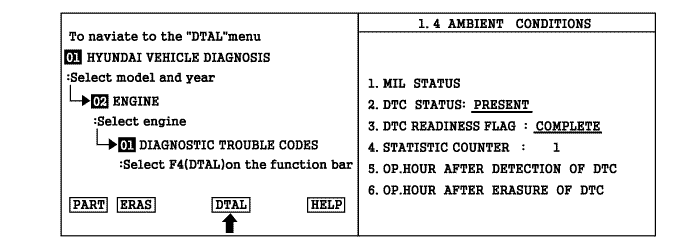
Connect scan tool and select "Diagnostic
Trouble Codes(DTCs)" mode. |
| 2. |
Press F4(DTAL) to select DTC information from
the DTCs menu. |
| 3. |
Confirm that "DTC Readiness Flag" indicates
"Complete". If not, drive the vehicle within conditions noted in the
freeze frame data or enable
conditions. |
| 4. |
Read "DTC Status" parameter.
|
| 5. |
Is parameter displayed "History(Not Present)
fault"?
▶ Fault is intermittent caused by poor contact
in the sensor’s and/or the PCM’s connector, which was repaired but
PCM memory was not cleared. Thoroughly check connectors for
looseness, poor connection, bending, corrosion, contamination,
deterioration, or damage. Repair or replace as necessary and go to
"Verification of Vehicle Repair" procedure.
▶ Go to next step as
below |


| COMPONENT INSPECTION |
| 1. |
Visually/physically inspect the air leakage in
exhaust system |
| 2. |
Visually/physically inspect the TWC and
HO2S(B1/S2) for contamination, deterioration, or
damage. |
| 3. |
Was a problem found in any of the above
areas?
▶ Replace or repair as necessary and go to
"Verification of Vehicle Repair" procedure
▶ Go to next step as
below |
| 4. |
Warm up the engine to normal operating
temperature and check that HO2S signal is
active. |
| 5. |
Connect Scantool and monitor the "O2 SNSR
VOLT.(B1/S2)" parameter on the Scantool data list.
|
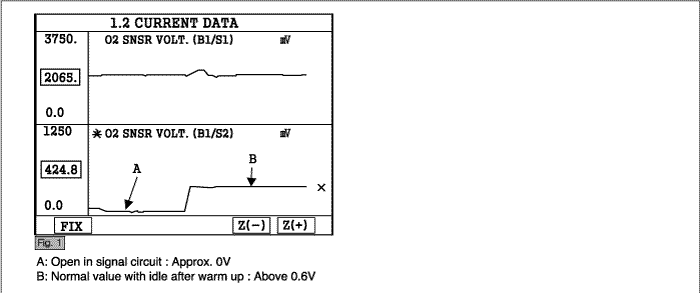
| 6. |
Is sensor data near the specified
value?
▶ Check for poor connection between PCM and
component: backed out terminal, improper mating, broken locks or
poor terminal to wire connection. Repair as necessary and go to
"Verification of Vehicle Repair" procedure
▶ Check HO2S(B1/S2) for contamination,
deterioration, or damage. Substitute with a known-good HO2S(B1/S2)
and check for proper operation. If the problem is corrected, replace
HO2S(B1/S2) and then go to "Verification of Vehicle Repair"
procedure |
| VERIFICATION OF VEHICLE REPAIR |
After a repair, it is
essential to verify that the fault has been corrected.
| 1. |
Connect scan tool and select "Diagnostic
Trouble Codes(DTCs)" mode. |
| 2. |
Press F4(DTAL) and confirm that "DTC Readiness
Flag" indicates "Complete". If not, drive the vehicle within
conditions noted in the freeze frame data or enable
conditions. |
| 3. |
Read "DTC Status"
parameter. |
| 4. |
Is parameter displayed "History(Not Present)
fault"?
▶ System performing to specification at this
time. Clear the DTC.
▶ Go to the applicable troubleshooting
procedure. |