| COMPONENT LOCATION |
| GENERAL DESCRIPTION |
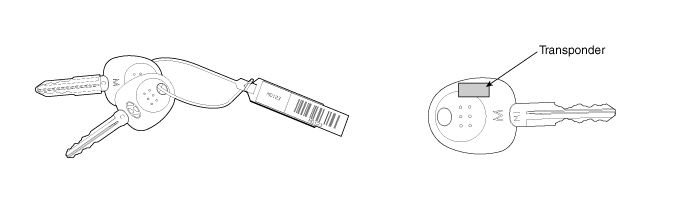
During the key teaching
procedure the transponder will be programmed with vehicle specific data.
The vehicle specific data are written into the transponder memory. The
write procedure is unique; therefore the content of transponder can never
be modified or changed. The data are a string of 9 bytes defined by
vehicle manufacturer.
The transponder memory
is split into two strings called authenticator and key password After this
programming the transponder memory is locked and the data(PIN code) cannot
be read or changed respectively. The transponder status changes from
"virgin" to "learnt". Additionally every transponder includes a unique IDE
(Identifier number) of 32 bit.
Unique means that the
IDE of all transponder is different from each other. The IDE is programmed
by the transponder manufacturer and is a read-only value. The
authenticator and the key password are not transferred from ECM to
transponder or vice versa. Only the results from the encryption algorithm
are transferred. It is almost impossible to calculate the vehicle specific
data from the encryption result.
For teaching of keys and
special purposes the ECM is connected to the tester device.
When IG is ON, the coil
supplies energy to the transponder which in turn accumulates energy in the
condenser.
Once the energy supply
from the coil has stopped, using the stored energy in the condenser, the
transponder transmits the ID CODE (stored within the ASIC).
| DTC DESCRIPTION |
The ECM sets DTC P1674
if transponder key that can't be register(TP not in the password mode or
whose transport data has been changed) is inserted for registration
procedure.
| DTC DETECTING CONDITION |
| Item |
Detecting
Condition |
Possible Cause | ||
| DTC
Strategy |
| |||
| Enable
Conditions |
| |||
| Threshold
value |
||||
| Detecting
time |
||||
| FAIL
SAFE |
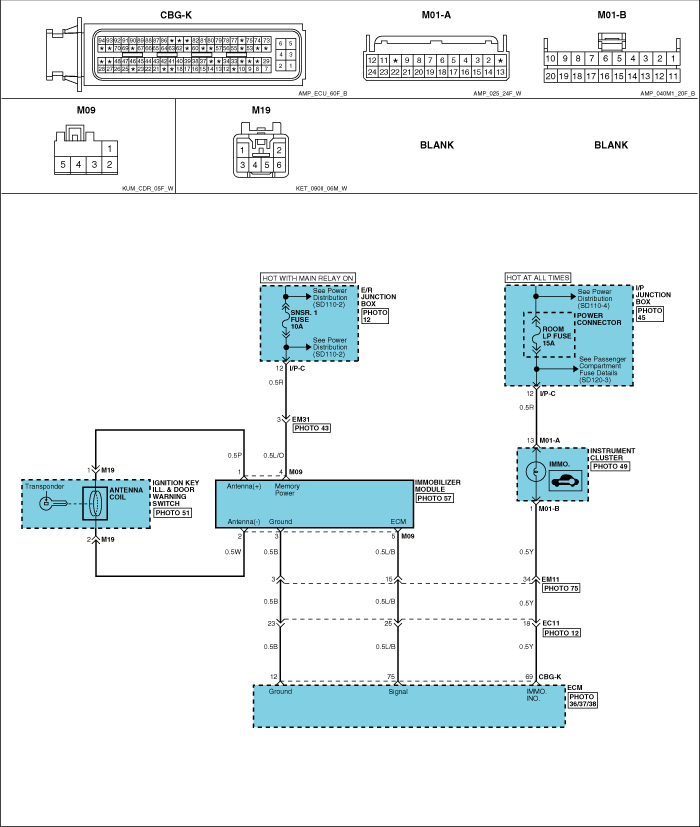
| SCHEMATIC DIAGRAM |
| COMPONENT INSPECTION |
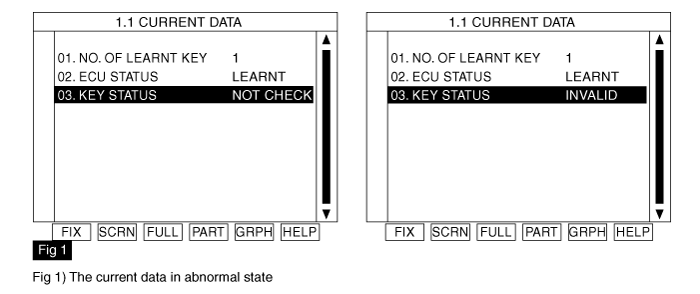
| 1. |
Check transponder status
|


| VERIFICATION OF VEHICLE REPAIR |
After a repair, it is
essential to verify that the fault has been corrected.
| 1. |
Connect scantool and selet "Diagnostic Trouble
Codes(DTCs)" mode and then clear
DTC. |
| 2. |
Operate the vehicle and monitor the DTC on the
scantool. |
| 3. |
Are any DTCs present?
Go to the applicable troubleshooting
procedure.
System is performing to specification at this
time. |