| INSPECTION |
VOLTAGE DROP TEST
PREPARATION
| 1. |
Turn the ignition switch to
"OFF."
|

| 2. |
Connect a digital voltmeter between the
generator "B" terminal and battery (+) terminal. Connect the (+)
lead wire of the voltmeter to the"B" terminal and the (-) lead wire
to the battery (+) terminal. |
CONDITIONS FOR TESTING
RESULT
| 1. |
The voltmeter should read a standard
0.2V. |
| 2. |
If the reading is above 0.2V, poor wiring
should be suspected.
Check wiring from generator 'B' terminal
through the fusible link to the battery (+) terminal.
Check for loose wiring or color change from an
overheated harness. Correct and check
again. |
| 3. |
On completion of the test, set the engine at
idle.
Then turn off the headlamps, blower motor
etc., and ignition.
|
| OUTPUT CURRENT TEST |
PREPARATION
| 1. |
Prior to the test, check the following items
and correct as necessary.
|
| 2. |
Turn the ignition switch to
"OFF". |
| 3. |
Disconnect the battery ground
cable. |
| 4. |
Disconnect the generator output wire from the
generator "B" terminal. |
| 5. |
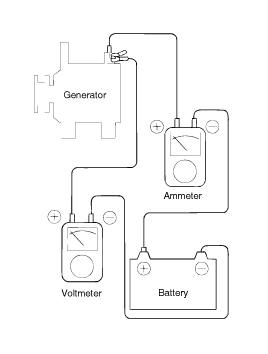
Connect a DC ammeter (0 to 100A) in series
between the "B" terminal and the disconnected output wire. Be sure
to connect the (-) lead wire ofthe ammeter to the disconnected
output wire.
|
| 6. |
Connect a voltmeter (0 to 20V) between the "B"
terminal and ground. Connect the (+) lead wire to the generator "B"
terminal and (-) lead wireto a good
ground. |
| 7. |
Attach an engine tachometer and connect the
battery ground cable. |
| 8. |
Leave the engine hood
open. |
TEST
| 1. |
Check to see that the voltmeter reads the same
value as the battery voltage. If the voltmeter reads 0V, an open
circuit in the wire between the generator "B" terminal and battery
(-) terminal, a blown fusible link or poorground is
suspected. |
| 2. |
Start the engine and turn the headlights
on. |
| 3. |
Set the headlights to high beam and the heater
blower switch to HIGH, quickly increase the engine speed to 2,500
rpm and read the maximumoutput current value indicated by the
ammeter.
|
RESULT
| 1. |
The ammeter reading must be higher than the
limit value. If it is lower but the generator output wire is in good
condition, remove the generatorfrom the vehicle and test
it.
|
| 2. |
Upon completion of the output current test,
lower the engine speed to idle and turn off the ignition
switch. |
| 3. |
Disconnect the battery ground
cable. |
| 4. |
Remove the ammeter and voltmeter and the
engine tachometer. |
| 5. |
Connect the generator output wire to the
generator "B" terminal. |
| 6. |
Connect the battery ground
cable. |
| REGULATED VOLTAGE TEST |
PREPARATION
| 1. |
Prior to the test, check the following items
and correct if necessary.
|
| 2. |
Turn ignition switch to
"OFF." |
| 3. |
Disconnect the battery ground
cable. |
| 4. |
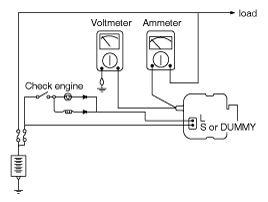
Connect a digital voltmeter between the "S(L)"
terminal of the generator and ground.
Connect the (+) lead of the voltmeter to the
"S(L)" terminal of the generator. Connect the (-) lead to a good
ground or the battery (-) terminal. |
| 5. |
Disconnect the generator output wire from the
generator "B" terminal. |
| 6. |
Connect a DC ammeter (0 to 100A) in series
between the "B" terminal and the disconnected output wire. Connect
the (-) lead wire of the ammeterto the disconnected output
wire. |
| 7. |
Attach the engine tachometer and connect the
battery ground cable. |
TEST
| 1. |
Turn on the ignition switch and check to see
that the voltmeter indicates the following value.
Voltage : Battery voltage
If it reads 0V, there is an open circuit in
the wire between the generator "S(L)" terminal and the battery and
the battery (+), or the fusible link
isblown. |
| 2. |
Start the engine. Keep all lights and
accessories off. |
| 3. |
Run the engine at a speed of about 2,500 rpm
and read the voltmeter when the generator output current drops to
10A or less. |
RESULT
| 1. |
If the voltmeter reading agrees with the
value, the voltage regulator is functioning correctly. If the
reading is other than the standard value, the voltage regulator or
the generatoris faulty. |
| 2. |
Upon completion of the test, reduce the engine
speed to idle, and turn off the ignition
switch. |
| 3. |
Disconnect the battery ground
cable. |
| 4. |
Remove the voltmeter, ammeter, and the engine
tachometer. |
| 5. |
Connect the generator output wire to the
generator "B" terminal. |
| 6. |
Reconnect the battery ground
cable. |