| REPLACEMENT |
| 1. |
Disconnect the battery ground
cable. |
| 2. |
Remove the speedometer cavble and the shift
cable. |
| 3. |
Disconnect the starter motor connector and
terminal. |
| 4. |
Remove the starter motor
assembly. |
| 5. |
Installation is the reverse order of
removal. |
| INSPECTION |
PINION GAP ADJUSTMENT
| 1. |
Disconnect the wire from the
M-terminal. |
| 2. |
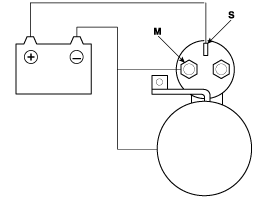
Connect a 12V battery between the S-terminal
and the M-terminal. |
| 3. |
Set the switch to "ON", and the pinion will
move out.
|

| 1. |
Check the pinion to stopper clearance (pinion
gap) with a feeler gauge. If the pinion gap is out of specification,
adjust by adding or removingwashers between the solenoid and the
front bracket. |
SOLENOID PULL-IN TEST
| 1. |
Disconnect the connector from the
M-terminal. |
| 2. |
Connect a 12V battery between the S-terminal
and M-terminal.
|
| 3. |
If the pinion moves out, the pull-in coil is
good. If it doesn't, replace the
solenoid. |
SOLENOID HOLD-IN TEST
| 1. |
Disconnect the connector from the
M-terminal. |
| 2. |
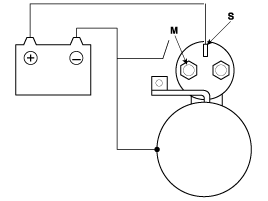
Connect a 12V battery between the S-terminal
and the body.
|
| 3. |
If the pinion remains out, everything is in
order. If the pinion moves in, the hold-in circuit is open. Replace
the magnetic switch. |
SOLENOID RETURN TEST
| 1. |
Disconnect the connector from the
M-terminal. |
| 2. |
Connect a 12V battery between the M-terminal
and the body.
|
| 3. |
Pull out the pinion and then release it. If
the pinion returns quickly to its original position, everything is
in order. If it doesn't, replace
thesolenoid |
PERFORMANCE TEST (NO-LOAD)
| 1. |
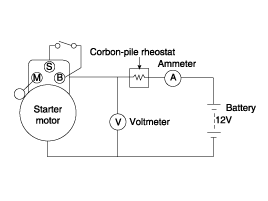
Make the no-load circuit test as
shown. |
| 2. |
After adjusting the rheostat until the battery
voltage shown on the voltmeter reads 11.5 volts, confirm that the
maximum amperage draw is within the specifications and that the
starter motor turns smoothly and
freely. |
| INSPECTION |
PINION GAP ADJUSTMENT
| 1. |
Disconnect the wire from the
M-terminal. |
| 2. |
Connect a 12V battery between the S-terminal
and the M-terminal. |
| 3. |
Set the switch to "ON", and the pinion will
move out.
|
| 1. |
Check the pinion to stopper clearance (pinion
gap) with a feeler gauge. If the pinion gap is out of specification,
adjust by adding or removingwashers between the solenoid and the
front bracket. |
SOLENOID PULL-IN TEST
| 1. |
Disconnect the connector from the
M-terminal. |
| 2. |
Connect a 12V battery between the S-terminal
and M-terminal.
|
| 3. |
If the pinion moves out, the pull-in coil is
good. If it doesn't, replace the
solenoid. |
SOLENOID HOLD-IN TEST
| 1. |
Disconnect the connector from the
M-terminal. |
| 2. |
Connect a 12V battery between the S-terminal
and the body.
|
| 3. |
If the pinion remains out, everything is in
order. If the pinion moves in, the hold-in circuit is open. Replace
the magnetic switch. |
SOLENOID RETURN TEST
| 1. |
Disconnect the connector from the
M-terminal. |
| 2. |
Connect a 12V battery between the M-terminal
and the body.
|
| 3. |
Pull out the pinion and then release it. If
the pinion returns quickly to its original position, everything is
in order. If it doesn't, replace
thesolenoid |
PERFORMANCE TEST (NO-LOAD)
| 1. |
Make the no-load circuit test as
shown. |
| 2. |
After adjusting the rheostat until the battery
voltage shown on the voltmeter reads 11.5 volts, confirm that the
maximum amperage draw is within the specifications and that the
starter motor turns smoothly and
freely. |