| INSPECTION |
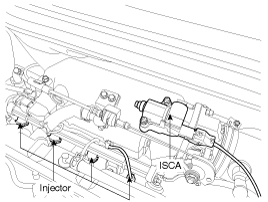
The Idle Speed Control
Actuator (ISCA) is installed on the throttle body and controls the intake
airflow that is bypassed around the throttle plate to keep constant engine
speed when the throttle valve is closed. The function of the ISCA is to
maintain idle speed according to various engine loads and conditions, and
also to provide additional air during starting. The ISCA consists of an
opening coil, a closing coil, and a permanent magnet. Based on information
from various sensors, the ECM controls both coils by grounding their
control circuits. According to the control signals from the ECM, the valve
rotor rotates to control the by pass airflow into the engine.
SPECIFICATION
| ITems |
Specification |
| Closing Coil
Resistance (Ω) |
14.6 ~ 16.2
at 20°C (68°F) |
| Opening Coil
Resistance (Ω) |
11.1 ~ 12.7
at 20°C (68°F) |
| Duty (%) |
Air Flow Rate
(㎥/h) |
| 15 |
1.0 ~
2.3 |
| 35 |
7.5 ~
12.7 |
| 70 |
43.0 ~
55.0 |
| 96 |
63.0 ~
71.0 |
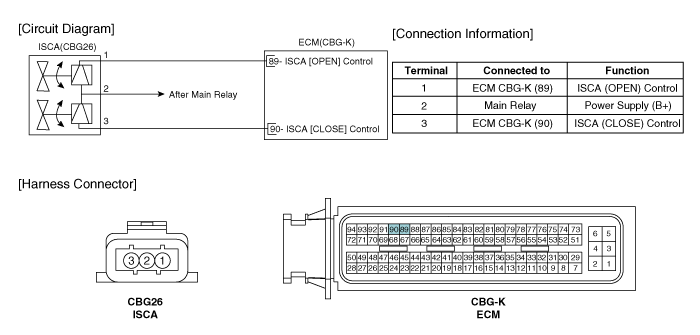
| CIRCUIT DIAGRAM |
COMPONENT INSPECTION
| 1. |
Turn ignition switch
OFF. |
| 2. |
Disconnect ISCA
connector. |
| 3. |
Measure resistance between ISCA terminals 2
and 1 [Opening Coil]. |
| 4. |
Measure resistance between ISCA terminals 2
and 3 [Closing Coil]. |
| 5. |
Check that the resistance is within the
specification.
|