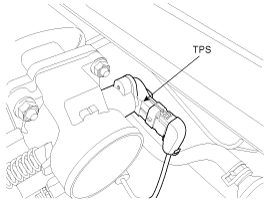
The Throttle Position
Sensor (TPS) is mounted on the throttle body and detects the opening angle
of the throttle plate. The TPS has a variable resistor (potentiometer)
whose characteristic is the resistance changing according to the throttle
angle. During acceleration, the TPS resistance between the reference 5V
and the signal terminal decreases and output voltage increases; during
deceleration, the TPS resistance increases and TPS output voltage
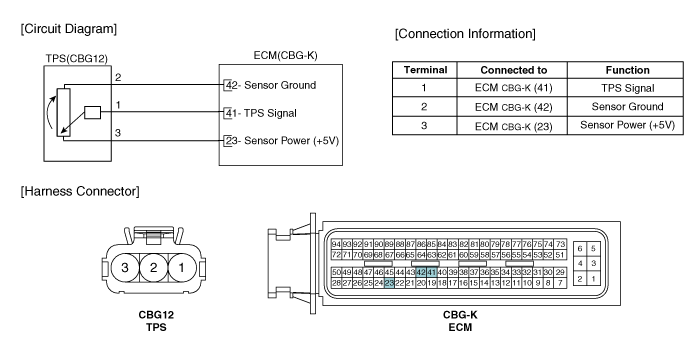
decreases. The ECM supplies a reference 5V to the TPS and the output
voltage increases directly with the opening of the throttle valve. The TPS
output voltage will vary from 0.2~0.8V at closed throttle to 4.3~4.8V at
wide-open throttle. The ECM determines operating conditions such as idle
(closed throttle), part load, acceleration/deceleration, and wide-open
throttle from the TPS. Also The ECM uses the Manifold Absolute Pressure
Sensor (MAPS) signal along with the TPS signal to adjust fuel injection
duration and ignition timing.
SPECIFICATION
Throttle Angle
|
Output Voltage
(V)
|
C.T
|
0.25 ~
0.9
|
W.O.T
|
Min.
4.0V
|
Items
|
Specification
|
Sensor
Resistance (kΩ)
|
1.6 ~ 2.4kΩ
at 20°C(68°F)
|
COMPONENT INSPECTION
| 1. |
Connect a scantool on the Data Link Connector
(DLC). |
| 2. |
Start engine and check output voltages of TPS
at C.T and W.O.T.
Specification: Refer to
SPECIFICATION.
| |
| 3. |
Turn ignition switch OFF and disconnect the
scantool from the DLC. |
| 4. |
Disconnect TPS connector and measure
resistance between TPS terminals 2 and 3
Specification: Refer to
SPECIFICATION.
| |