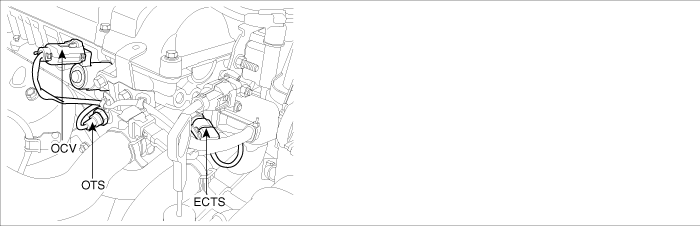
An Engine Coolant
Temperature Sensor (ECTS) monitors the temperature of the coolant. This
input is used by the ECM for engine control and as an enabling criteria
for related diagnostics. The air flow coming into the engine is
accumulated and used to determine if the engine has been driven within
conditions that would allow the engine coolant to heat up normally to the
thermostat regulating temperature. If the coolant temperature does not
reach regulating temperature of the thermostat, diagnostics that use
engine coolant temperature as enabling criteria, may not run when
expected.This DTC will set when there has been excessive time to reach a
minimum coolant temperature required for closed loop fuel
control.
The purpose of this
diagnosis is to monitor the minimum coolant temperature that enables
lambda closed loop control after start. Minimum coolant temperature to run
lambda control must be reached before the threshold time predetermined
according to intake air temperature at start. If the lambda control is not
active because of low engine coolant temperature within predetermined
minimum time after start, the ECM sets DTC P0125
Item
|
Detecting
Condition
|
Possible Cause
|
DTC
Strategy
|
| •
|
Coolant temperature too low for Lambda
regulation | |
|
Enable
Conditions
|
| •
|
Coolant temp. at start
<10°C(50°F) |
| •
|
Minimum time(-15°C : approx.200sec,
-10°C : approx.150sec, -4°C : 100sec.,25°C : 40sec.) after
start versus coolant temperature at
Start |
| •
|
6V< Battery voltage
<16V | |
Threshold
Value
|
| •
|
Thd.depends on coolant start
Temperature | |
Diagnostic
Time
|
|
MIL On
Condition
|
|
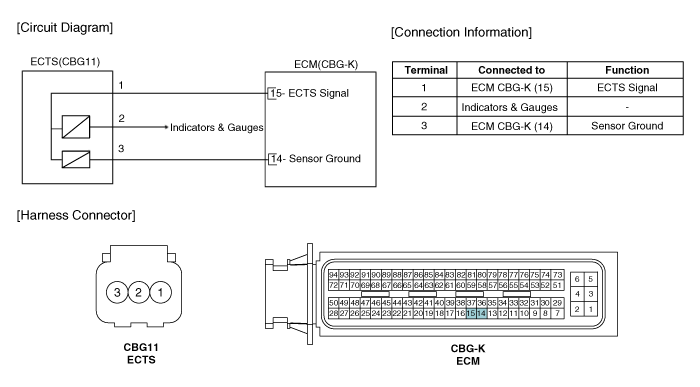
| TERMINAL AND CONNECTOR
INSPECTION |
| 1. |
Many malfunctions in the electrical system are
caused by poor harness(es) and terminals. Faults can also be caused
by interference from other electrical systems, and mechanical or
chemical damage. |
| 2. |
Thoroughly check connectors for looseness,
poor connection, bending, corrosion, contamination, deterioration,
or damage. |
| 3. |
Has a problem been found?

▶ Repair as necessary and go to "Verification
of Vehicle Repair" procedure

▶ Go to next step as
below |
| 1. |
Coolant Level Inspection
| (1) |
Check the cooling system coolant
level. |
| (2) |
Is the coolant in the reservoir at the
proper level?
▶ Go to next step as below
▶ Repair or add engine coolant as
necessary and go to "Verification of Vehicle Repair"
procedure | |
| 2. |
Thermostat Inspection
| (1) |
Check if the thermostat bypass valve is
stuck in the open position or if the correct type of
thermostat was installed. Replace thermostat as necessary and
go to "Verification of Vehicle Repair"
procedure |
| (2) |
Check the valve opening temperature of
the thermostat
Specification(Valve opening
temperature) : 80~84°C(176~183°F)
| |
| (3) |
If the opening temperature is not as
specified, Replace thermostat as necessary and go to
"Verification of Vehicle Repair" procedure.
If OK, go to next step as
below | |
| 3. |
ECT Sensor Inspection
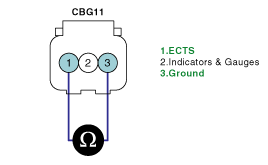
| (2) |
Disconnect ECTS
connector |
| (3) |
Measure resistance between terminals 1
and 3 of the sensor connector(Component side)
Specification :
Temp.(°C)
|
Resistance
(kΩ)
|
Temp.(°C)
|
Resistance
(kΩ)
|
-20
|
14.1 ~ 16.8
|
40
|
Approx. 1.2
|
0
|
Approx. 5.8
|
60
|
Approx. 0.6
|
20
|
2.3 ~ 2.6
|
80
|
Approx.
0.3
|
|
| (4) |
Is resistance within the
specification?
▶ Go to next step as below
▶ Check ECTS for contamination,
deterioration, or damage. Substitute with a known-good ECTS
and check for proper operation. If the problem is corrected,
replace ECTS and then go to "Verification of Vehicle Repair"
procedure | |
| VERIFICATION OF VEHICLE
REPAIR |
After a repair, it is
essential to verify that the fault has been corrected.
| 1. |
Connect scan tool and select "Diagnostic
Trouble Codes(DTCs)" mode. |
| 2. |
Press F4(DTAL) and confirm that "DTC Readiness
Flag" indicates "Complete". If not, drive the vehicle within
conditions noted in the freeze frame data or enable
conditions. |
| 3. |
Read "DTC Status"
parameter. |
| 4. |
Is parameter displayed "History(Not Present)
fault"?
▶ System performing to specification at this
time. Clear the DTC
▶ Go to the applicable troubleshooting
procedure. |
[ECTS]
Temp.(°C)
|
Resistance (kΩ)
|
Temp.(°C)
|
Resistance
(kΩ)
|
-20
|
14.1 ~
16.8
|
40
|
Approx.
1.2
|
0
|
Approx.
5.8
|
60
|
Approx.
0.6
|
20
|
2.3 ~
2.6
|
80
|
Approx.
0.3
|
[THERMOSTAT]
THERMOSTAT
|
Normal
Parameter
|
Valve
Opening Temp.
|
80~84°C
|
Valve
Closing Temp.
|
77°C
|
Full Open
Lift
|
Approx.
8mm(95°C)
|