| Component Location |

| General Description |
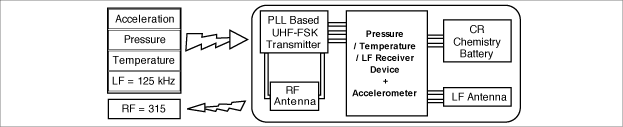
【TPMS SENSOR : Wheel Electronic (WE) sensor
unit】
Each vehicle wheel is
fitted with a Wheel Electronic (WE) sensor unit attached to the valve on
the inside of the wheel. The WE unit is powered with a self-contained
battery utilizing a high temperature rated CR (Manganese Dioxide Lithium)
chemistry. The operating voltage range for the WE module is 2.2 Vdc to 3.6
Vdc, and the operating temperature range is -40 °F to 257 °F(-40 °C ~125
°C). The WE measures tire pressure, temperature, and acceleration
periodically. The pressure, temperature, and acceleration information is
converted to digital form within the MCU inside the WE
sensor.
The WE sensor is
equipped with a Radio Frequency (RF) transmitter circuit which is used to
periodically broadcast information from inside the tire. All WE sensor
units operate on the same RF channel frequency, and each broadcast message
includes pressure and temperature data, a unique ID code, operating state
data, status information, and digital error-detection data.
The pressure measured by
the WE sensor is an absolute pressure value. The pressure measurement
range is 100 kPa to 450 kPa. The acceleration data is used within the WE
sensor to determine whether the vehicle is moving or stationary. The
acceleration status is the decision maker within the WE module that
determines if the tire is moving or stationary. This measurement is used
within the WE module to enable different operating modes depending on the
status of the acceleration value. Over the fully specified operating
temperature range, if the acceleration measurement is greater than or
equal to 20G, the WE module assumes the tire is moving.
The basic operation of
the Low Line(L/L) WE sensor is to transmit 3 frames every 3 minutes in
both stationary and rolling modes.
| DTC Description |
This DTC indicates that
the Sensor1/Sensor2/Sensor3/Sensor4 battery voltage is below 2.2Vdc. The
most likely cause is battery passing it's expected life / sensor
failure.
| DTC Detecting Condition |
| Item |
Detecting
Condition |
Possible cause | ||||||
| DTC
strategy |
|
| ||||||
| Enable conditions |
| |||||||
| Threshold value |
| |||||||
| Diagnosis
time |
|
| Monitor Scantool Data |
| 1. |
Connect 'TPMS exciter' or scantool to Data
Link Connector(DLC). |
| 2. |
Select "TPMS DIAGNOSIS"
mode. |
| 3. |
Select the "FULL" mode of "TPM DATA VALUES"
function. |
| 4. |
Monitor the parameter of "S1/S2/S3/S4 BATTERY"
on the 'TPMS exciter' or scantool.
|
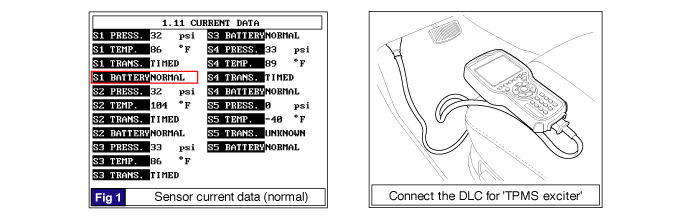
| 5. |
Is parameter within
specifications?
▶ Fault is intermittent. It has been repaired
and TPMS receiver module memory is not cleared yet.
▶ Go to "Verification of vehicle Repair"
procedure.
▶ Replace Sensor1/Sensor2/Sensor3/Sensor4 and
register sensor ID with 'TPMS exciter'.
▶ Go to "Verification of Vehicle Repair"
procedure. |


| Verification of Vehicle Repair |
After a repair, it is
essential to verify that the fault has been corrected.
| 1. |
Connect TPMS exciter or scantool and select
"Diagnostic Trouble Codes(DTCs)"
mode |
| 2. |
Using a TPMS exciter or scantool, Clear
DTC. |
| 3. |
Operate the vehicle within DTC Enable
conditions in General information. |
| 4. |
Are any DTCs present ?
▶ Go to the applicable troubleshooting
procedure.
▶ System performing to specification at this
time. |