| 1. |
Remove the rear wheel & tire.
|
Be careful not to damage to the hub
bolts when removing the rear wheel &
tire. | |
| 2. |
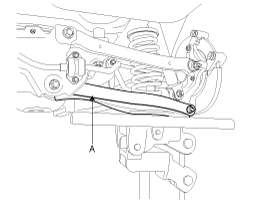
Support the lower portion of the rear lower
arm (A) with the jack.
|
| 3. |
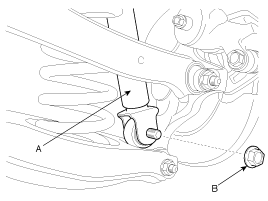
Remove the bolt & nut (B) holding the rear
shock absorber (A) to the carrier assembly.
|
| 4. |
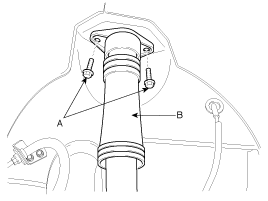
Remove the rear shock absorber (B) from the
wheel housing by loosening the mounting bolts (A).
|
| 1. |
Check the rubber parts for wear and
deterioration. |
| 2. |
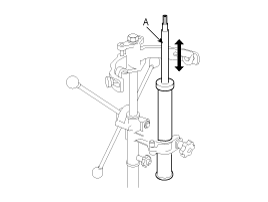
Compress and extend the piston rod (A) and
check that there is no abnormal resistance or unusual sound during
operation.
|
| 1. |
Fully extend the piston
rod. |
| 2. |
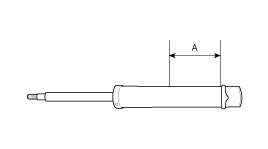
Drill a hole on the (A) section to discharge
gas from the cylinder.
|
The gas coming out is harmless, but be
careful of chips that may fly when drilling. Be sure to wear
safety goggles or eye protection when performing this
task. | |
| 1. |
Install the rear shock absorber (B) to the
wheel housing penal by tightening the bracket mounting bolts
(A).
Tightening
torque :
50 ~ 65N.m (5.0 ~ 6.5kgf.m, 36 ~
47lb-ft)
|
|
| 2. |
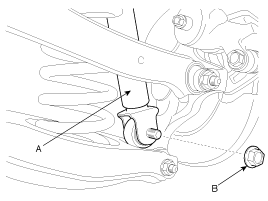
Connect the rear shock absorber (A) with the
carrier assembly and then tighten the bolt & nut
(B).
Tightening
torque :
140 ~ 160N.m (14.0 ~ 16.0kgf.m, 101 ~
116lb-ft)
|
|
| 3. |
Install the rear wheel &
tire.
Tightening
torque :
90 ~ 110N.m (9.0 ~ 11.0kgf.m, 65 ~
80lb-ft)
|
|
Be careful not to damage to the hub
bolts when installing the rear wheel&
tire. | | |
