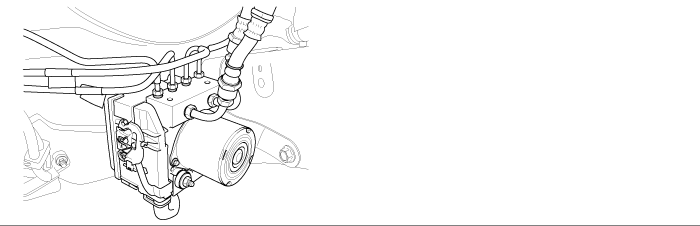
The HECU is composed of
an ECU (Electronic Control Unit ) and a HCU( Hydraulic Control Unit) , HCU
is composed of a source of hydraulic pressure and modulator valve block.
Increase and decrease of hydraulic pressure is operated by electronic
motor, According to a detected signal by wheel speed sensor, The hydraulic
pressure which is needed for control is supplied by pump. The HCU'
function which is composed of a accumulator, return pump, solenoid valve
is to increase, decrease or maintain the hydraulic pressure supplied to a
brake caliper by operating return pump according to HECU control signal
while ABS control is active.
The HECU monitors the
operation of the IC components such as memory, register, A/D converter and
so on. The ECU sets this code when the EEPROM data read by the master
processor is different than prior data writed, or when the master/slave
processor detects abnormal operation in RAM, Status Register, Interrupt,
Timer, A/D converter or cycle time.
Item
|
Detecting
Condition
|
Possible cause
|
DTC Strategy
|
|
|
Case 1
|
Monitoring
Period
|
|
Enable
Conditions
|
| •
|
If Internal control unit failures of the
master/slave processor or peripheral integrated circuits is
detected. | |
Case 2
|
Monitoring
Period
|
| •
|
Directly after ignition on, during
reading of
EEPROM-values | |
Enable
Conditions
|
| •
|
Failure is set if checksum not correct
or PSW-EEPROM-Handler reported unknown failure during
EEPROM-value reading. |
| •
|
If EEPROM reading sequence take longer
then 3 s, a failure is
set. | |
Fail Safe
|
| •
|
The ABS/EBD/ESC functions are
inhibited. |
| •
|
The ABS/EBD/ESC warning lamps are
activated. | |
| Terminal and Connector
Inspection |
| 1. |
Many malfunctions in the electrical system are
caused by poor harness(es) and terminals. Faults can also be caused
by interference from other electrical systems, and mechanical or
chemical damage. |
| 2. |
Thoroughly check connectors for looseness,
poor connection, bending, corrosion, contamination, deterioration,
or damage. |
| 3. |
Has a problem been found?
|

|
▶ Repair as
necessary and then go to "Verification Of Vehicle Repair"
procedure.
|
|

|
▶ Go to
"Component Inspection"
procedure.
|
|
| 3. |
Connect scantool and select "Diagnostic
Trouble Codes (DTCs)" mode. |
| 4. |
Using a scantool, Clear
DTC. |
| 5. |
Select "Diagnostic Trouble Codes (DTCs)" mode
again. |
| 6. |
Are any DTCs present ?
|
|
▶
Substitute with a known-good HECU and check for proper
operation. If problem is corrected, replace HECU and then go
to "Verification Of Vehicle Repair"
procedure.
|
|
|
▶ Fault is
intermittent caused by faulty HECU or was repaired and HECU
memory was not cleared. go to "Verification Of Vehicle Repair"
procedure.
|
|
| Verification of Vehicle
Repair |
After a repair, it is
essential to verify that the fault has been corrected.
| 1. |
Connect scantool and select "Diagnostic
Trouble Codes (DTCs)" mode |
| 2. |
Using a scantool, Clear
DTC. |
| 3. |
Operate the vehicle within DTC Detecting
Condition in General Information |
| 4. |
Are any DTCs present?
|
|
▶ Go to the
applicable troubleshooting procedure.
|
|
|
▶ System
performing to specification at this
time.
|
|