The Steering Angle
Sensor (SAS) is installed in EPS (Electric Power Steering) and it sends
messages to HECU through CAN communication line.
The SAS is used to
determine turning direction and speed of the steering wheel.
The HECU uses the
signals from the SAS when performing ESC-related
calculations.
Components (Steering
Angle Sensor, Torque Sensor, Failsafe relay, etc.) of the EPS system are
located inside the steering column & EPS unit assembly and the
steering column & EPS unit assembly must not be disassemble to inspect
or replace them. (Refer to “ST (Steering system) Gr.”)
Steering Angle Sensor (SAS) Calibration
| 1. |
PURPOSE OF calibration
| A. |
On vehicle control, an ESC analyzes the
intention of the driver. |
| B. |
An ESC recognizes a steering angle which
a driver rotates through the steering angle
sensor. |
| C. |
A steering angle sensor used in ESC
adjusts 0° setting of steering wheel through K-line or CAN
communication. | |
| 2. |
STEERING ANGLE SENSOR (SAS) CALIBRATION
METHOD
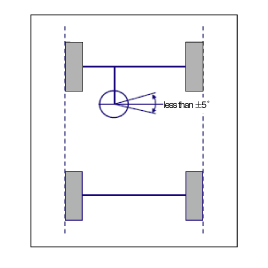
| (1) |
Align the wheel to the straight line.
(steering wheel < ± 5° )
ex) Perform the wheel alignment
first.
Align the wheel to the straight
line.
A driver moves the vehicle to the front
and back about 5 meters twice or three
times. |
| (2) |
Connect Scan tool to the
vehicle. |
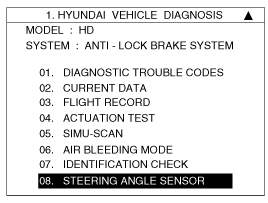
| (4) |
Select Steering angle sensor(SAS)
calibration.
|
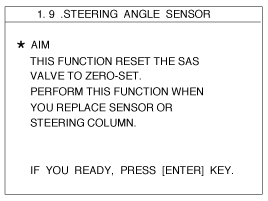
| (5) |
Perform the Steering angle sensor(SAS)
calibration.
|
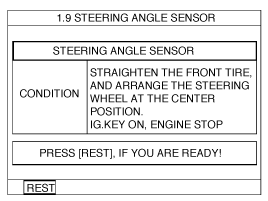
| (6) |
Perform the procedure
continuously.
|
| (7) |
The procedure is finished. Push the
"ESC" key.
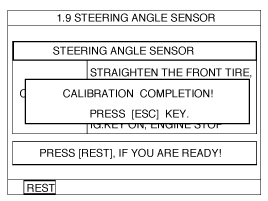
|
| (9) |
Remove the scanner from the
vehicle. |
| (10) |
Confirm the Steering angle sensor(SAS)
calibration as driving the vehicle.(turn left once, turn right
once) | |