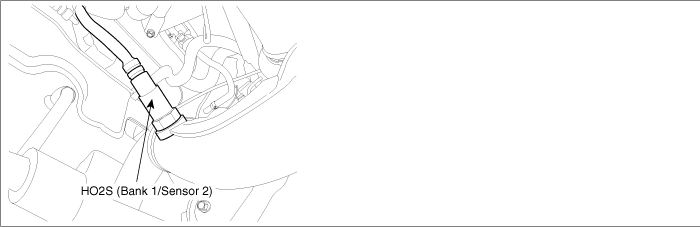
The normal operating
temperature of the HO2S(Heated Oxygen Sensor) ranges from 350 to 850°C(662
to 1562°F). The HO2S heater greatly decreases the amount of time required
for fuel control to become active. The ECM provides a pulse width
modulated control circuit to adjust current through the heater. When the
HO2S is cold, the value of the resistance is low and the current in the
circuit is high. On the contrary, if the temperature in the resistor of
the sensor rises, the current drops gradually.
ECM sets DTC P0137 if
the HO2S(B1S2) voltage remains excessively low for a predetermined
time.
Item
|
Detecting
Condition
|
Possible Cause
|
DTC
Strategy
|
|
| •
|
Short to ground in signal
harness |
| •
|
Poor connection or damaged
harness |
| •
|
Faulty Heated O2
Sensor(HO2S) | |
Enable
Conditions
|
| •
|
Catalyst temperature model > -33°C(
-27.4°F) |
| •
|
Lambda regulation
active |
| •
|
Lambda controller not on the
limit |
| •
|
Catalyst purge after Fuel Cut Off not
active |
| •
|
10V < Battery voltage <
16V | |
Threshold
Value
|
| •
|
Downstream O2 Sensor voltage < 0.02V
& sensor element resistance <
30Ω | |
Diagnostic
Time
|
|
MIL On
Condition
|
|
Test Condition
|
Scan Tool
Parameter
|
O2 SNSR
VOL.-B1/S1
|
O2 SNSR
VOL.-B1/S2
|
Normal Value
when circuit is normal
|
Idle after
warm up
|
Signal is
switching from rich(above 0.45V) to lean(below 0.45V) a minimum of 3
times in 10 seconds.
|
above
0.7V
|
HO2S(B1S1) signal circuit open
|
Approx.
0.43~0.45V
|
-
|
HO2S(B1S2) signal circuit open
|
-
|
Approx.
0.43~0.45V
|
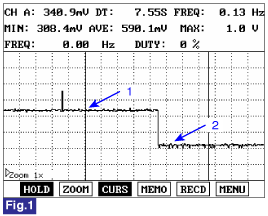
Fig.1) HO2S signal
waveform with idle after warm up :
1: Normal status(Approx.
above 0.7V), 2: Open in signal circuit(Approx. 0.4~0.5V)
| 1. |
Connect scan tool and select "Diagnostic
Trouble Codes(DTCs)" mode |
| 2. |
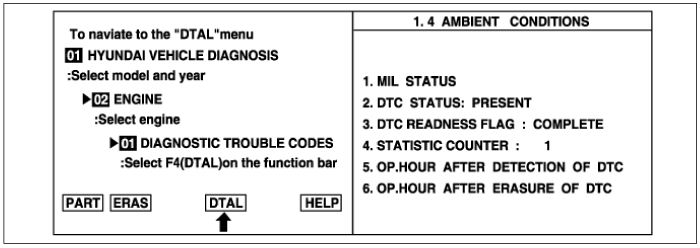
Press F4(DTAL) to select DTC information from
the DTCs menu. |
| 3. |
Confirm that "DTC Readiness Flag" indicates
"Complete". If not, drive the vehicle within conditions noted in the
freeze frame data or enable
conditions |
| 4. |
Read "DTC Status" parameter
|
| 5. |
Is parameter displayed "History(Not Present)
fault"?
|
- History (Not Present) fault : DTC
occurred but has been cleared.
- Present fault : DTC is occurring at
present time. |
|

|
▶ Fault is
intermittent caused by poor contact in the sensor’s and/or
ECM’s connector or was repaired and ECM memory was not
cleared. Thoroughly check connectors for loose or poor
connection, bending, corrosion, contamination, deterioration,
or damage. Repair or replace as necessary and go to
"Verification of Vehicle Repair" procedure
|
|

|
▶ Go to
next step as
below
|
|
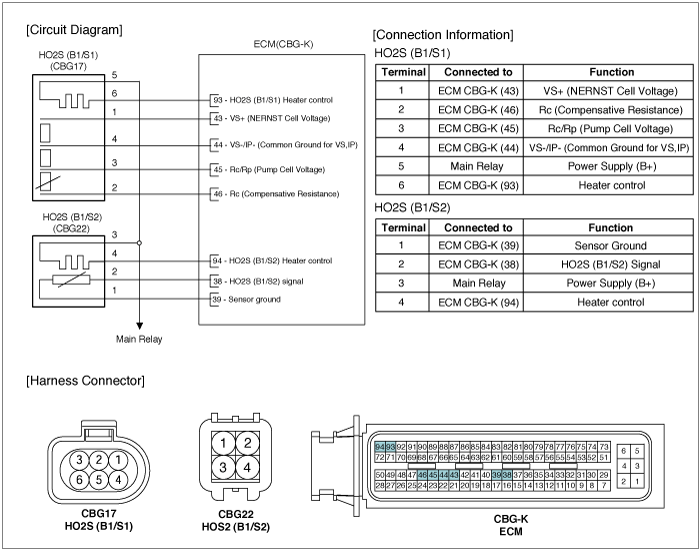
| Signal Circuit
Inspection |
| 2. |
Disconnect ECM and HO2S
connector |
| 3. |
Measure resistance between terminal 2 of the
sensor harness connector and chassis ground
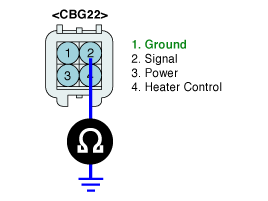
|
| 4. |
Is resistance within the
specification?
|
|
▶ Go to
next step as below
|
|
|
▶ Repair or
replace as necessary and go to "Verification of Vehicle
Repair" procedure
|
HO2S must have a clean air
reference to function properly. The air is obtained by
way of the sensor wire(s). Do not attempt to repair the
wire(s), connector, or the
terminals. | |
|
| Terminal and Connector
Inspection |
| 1. |
Many malfunctions in the electrical system are
caused by poor harness(es) and terminals. Faults can also be caused
by interference from other electrical systems, and mechanical or
chemical damage. |
| 2. |
Thoroughly check connectors for looseness,
poor connection, bending, corrosion, contamination, deterioration,
or damage. |
| 3. |
Has a problem been found?
|
|
▶ Repair as
necessary and go to "Verification of Vehicle Repair"
procedure
|
|
|
▶ Go to
next step as
below
|
|
| 1. |
With ignition "OFF", reconnect the HO2S
connector |
| 2. |
Warm up the engine to normal operating
temperature and let it idle. |
| 3. |
Connect Scantool and monitor the O2 SNSR
VOL.-B1/S2 parameter on the Scantool data list.
Specification
: Above 0.7V at
idle
| |
| 4. |
Is sensor data near the specified
value?
|
|
▶ Check for
poor connection between ECM and component: backed out
terminal, improper mating, broken locks or poor terminal to
wire connection. Repair as necessary and go to "Verification
of Vehicle Repair" procedure
|
|
|
▶ Check
HO2S for contamination, deterioration, or damage. Substitute
with a known-good HO2S and check for proper operation. If the
problem is corrected, replace HO2S and then go to
"Verification of Vehicle Repair"
procedure
|
|
| Verification of Vehicle
Repair |
After a repair, it is
essential to verify that the fault has been corrected.
| 1. |
Connect scan tool and select "Diagnostic
Trouble Codes(DTCs)" mode |
| 2. |
Press F4(DTAL) and confirm that "DTC Readiness
Flag" indicates "Complete". If not, drive the vehicle within
conditions noted in the freeze frame data or enable
conditions. |
| 3. |
Read "DTC Status"
parameter |
| 4. |
Is parameter displayed "History(Not Present)
fault"?
|
|
▶ System
performing to specification at this time. Clear the
DTC
|
|
|
▶ Go to the
applicable troubleshooting
procedure.
|
|
