| 1. |
The sequences of the PIN code storage are as
follows.
| (1) |
Input the PIN code into the scanner when
key teaching process.
The scanner transmits the Encrypted Code
to the ECM after converting the PIN code into Encrypted
Code. |
| (2) |
When the ECM gets the firtst key
learning command, it transmits the SMARTRA3 learnt command and
Encrypted Code to the
SMARTRA3 |
| (3) |
If the SMARTRA3 statue is
virgin/neutral, the SMARTRA3 stores Encrypted Code in EEPROM
and transmits the success message of the Encrypted Code
storage. (If the SMARTRA3 is learnt, the SMARTRA3 compares
Encrypted Code transmitted by the ECM with Encrypted Code
stored in EEPROM and transmits the (in)correct Encrypted Code
message to ECM) |
| (4) |
If the SMARTRA3 is learnted normally or
the Encrypted Code of the registered SMARTRA3 is the same as
the ECM, the ECM begins operation the Transponder
Learning. |
| (5) |
If the learning of the first
transponder, the ECM stores the Encrypted Code in its EEPROM
and converts state into learnt
state. | |
| 2. |
The SMARTRA3 learning :
| (1) |
starts with EMS request of PIN from
scanner through the key teaching
procedure. |
| (2) |
is possible in case that the status of
SMARTAR is "virgin" or "neutral ".
|
| (3) |
In case that the SMARTRA3 is "learnt",
the SMARTRA3 will transmits the information if PIN inputted
from scanner is same as the PIN in
SMARTRA3. |
| (4) |
is possible regardless of key
status. | |
| 3. |
The sequence of the SMARTRA3 confirms are as
follows.
| (1) |
After communication with the SMARTRA3,
the ECM transmits the random number with requirement of the TP
ID information. |
| (2) |
The SMARTRA3 encryptes the random number
and transmits the result(Encrypted Random Number) to the ECM
with TP ID information. |
| (3) |
The ECM compares the result transmitted
from the SMARTRA3 with the result calculated by ECM. And If
result are coincided with each other; the ECS concludes the
valid confirmation of the
SMARTRA3. | |
The PCM sets DTC P1676
if there's any fault in message from SMARTRA to PCM.
Item
|
Detecting
Condition
|
Possible Cause
|
DTC
Strategy
|
|
|
Enable
Conditions
|
|
Threshold
value
|
|
Detecting
time
|
|
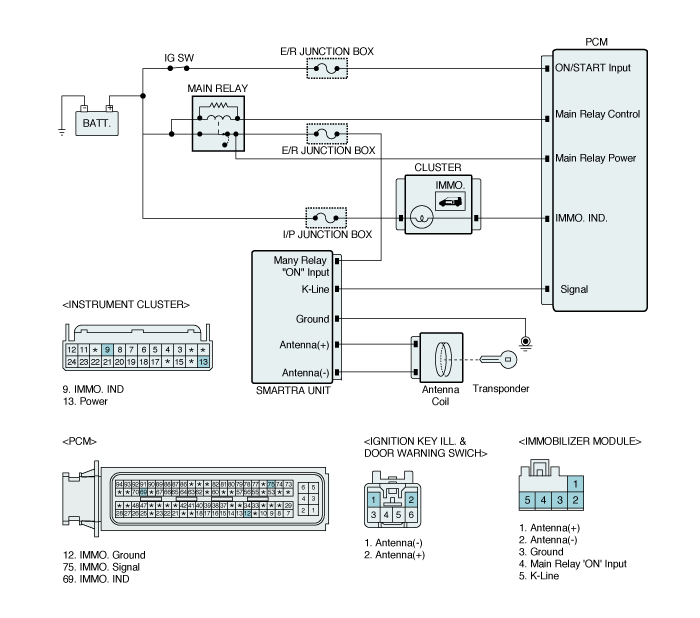
| Diagnostic Circuit
Diagram |
| 1. |
Check transponder and ECU status
| (1) |
IGN "ON" & Engine "OFF" with key
intended to register |
| (2) |
Monitor the "KEY STATUS", "SMARTRA
STATUS" and "ECU STATUS' Parameter on the
Scantool.
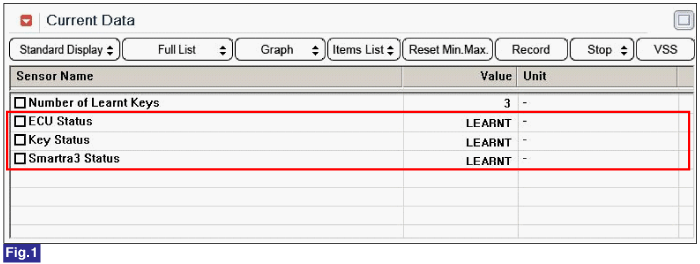
Fig.1) The current data in normal
state. |
| (3) |
Are "KEY STATUS", "SMARTRA STATUS" and
"ECU STATUS' Parameter within specifications?
|

|
▶
Check connectors for looseness, poor connection,
bending, corrosion, contamination, deterioration, or
damage. Repair or replace as necessary and then go to
"Verification of Vehicle Repair"
procedure.
|
|

|
▶ Go
to "Check SMARTRA"
procedure
|
| |
| 2. |
Check SMARTRA
| (1) |
IGN "ON" & Engine
"OFF" |
| (2) |
Neutralize PCM and Register transponder
key by scantool.
|
Pin code is requied to Neutralize
PCM and to Register transponder key
| |
| (3) |
Are Neutralizing and Registering
completed normally ?
|
|
▶
Check connectors for looseness, poor connection,
bending, corrosion, contamination, deterioration, or
damage. Repair or replace as necessary and then go to
"Verification of Vehicle Repair"
procedure.
|
|
|
▶
Substitute with a known-good SMARTRA and check for
proper operation. If the problem is corrected, replace
SMARTRA and then go to "Verification of Vehicle Repair"
procedure.
|
| |
| Verification of Vehicle
Repair |
After a repair, it is
essential to verify that the fault has been corrected.
| 1. |
Connect scantool and select "Diagnostic
Trouble Codes(DTCs)" mode and then clear
DTC. |
| 2. |
Operate the vehicle and monitor the DTC on the
scantool. |
| 3. |
Are any DTCs present?
|
|
▶ Go to the
applicable troubleshooting procedure.
|
|
|
▶ System is
performing to specification at this time.
|
|
