There is no hardware
difference of the HECU according to the vehicle's specification, just
software is changed by the vehicle parameter used for ESC control. The
HECU stores a classified variant code value according to the received
data(a kind of engine, engine displacement, a kind of T/M). After then the
HECU reads various parameters according to the stored variant value in the
memory to use for the ESC control.
The HECU checks the
varient code after ignition. If a inappropriate varient code is detected
or there is no varient code, a fault is detected.
Item
|
Detecting
Condition
|
Possible Cause
|
DTC
Strategy
|
|
| •
|
Replacement of PCM(ECM &
TCM) | |
Monitoring
Period
|
|
Enable
Conditions
|
| •
|
After power on, the HECU does not
receive a valid variant code information during the
configuration time. |
| •
|
HECU has no valid variant code stored in
the EEPROM. |
| •
|
The receieved CAN signals does not lead
to a defined and supported variant
code. |
| •
|
If an ECU, which has already memorized a
valid variant code information, receives a different variant
code information. (at a next Power on
cycle) | |
Fail-Safe
|
| •
|
The ABS/EBD/ESC functions are
inhibited. |
| •
|
The ABS/EBD/ESC warning lamps are
activated. | |
| Terminal and Connector
Inspection |
| 1. |
Many malfunctions in the electrical system are
caused by poor harness(es) and terminal condition.
Faults can also be caused by interference from
other electrical systems, and mechanical or chemical
damage. |
| 2. |
Thoroughly check connectors for looseness,
poor connection, bending, corrosion, contamination, deterioration,
or damage. |
| 3. |
Has a problem been found?
|

|
▶ Repair as
necessary and then go to "Verification of Vehicle Repair"
procedure.
|
|

|
▶ Go to
"Variant Coding"
procedure.
|
|
| 1. |
Check for improper installation of
EMS/TCU/ESC. |
| 2. |
Connect scantool to Data Link
Connector(DLC). |
| 3. |
Ignition "ON" & Engine "OFF".
|
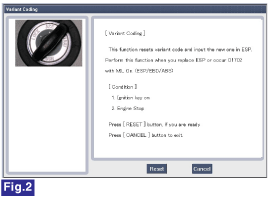
| 4. |
Perform variant coding. (Figure
1). |
| 6. |
Ignition "OFF" and then ignition "ON". Go to
"Component Inspection"Procedure.
|
| 2. |
Ignition "ON" & Engine
"OFF". |
| 3. |
Connect scantool and select "Diagnostic
Trouble Codes(DTCs)" mode |
| 4. |
Using a scantool, Clear
DTC. |
| 5. |
Select "Diagnostic Trouble Codes(DTCs)" mode
again. |
| 6. |
Are any DTCs present ?
|
|
▶
Substitute with a known-good HECU and check for proper
operation. If problem is corrected, replace HECU and then go
to "Verification of Vehicle Repair" procedure.
|
|
|
▶ Fault is
intermittent caused by faulty HECU or was repaired and HECU
memory was not cleared.
Go to
"Verification of Vehicle Repair" procedure.
|
|
| Verification of Vehicle
Repair |
After a repair, it is
essential to verify that the fault has been corrected.
| 1. |
Connect scantool and select "Diagnostic
Trouble Codes(DTCs)" mode. |
| 2. |
Using a scantool, Clear
DTC. |
| 3. |
Operate the vehicle within DTC Detecting
Condition in General Information. |
| 4. |
Are any DTCs present ?
|
|
▶ Go to the
applicable troubleshooting procedure.
|
|
|
▶ System
performing to specification at this
time.
|
|