The HECU is composed of
a ECU (Electronic Control Unit ) and an HCU(Hydraulic Control Unit), so
the HECU hardware includes all solenoid valves inside the unit as well as
the ECU.
Solenoid valves are
switched to ON, OFF by HECU when the ABS is activated. Solenoid valves
function is to increase, decrease or maintain the hydralic pressure
supplied to a wheel cylinder.
The HECU monitors the
operation of the valves by checking the drive circuit of the solenid
valves, and then sets this code when the unexpcted drive voltage is
detected.
For example, the HECU
sets the DTC if the electrical feedback signal does not match the
actuation signal for the corresconding valve.
Item
|
Detecting
Condition
|
Possible Cause
|
DTC Strategy
|
|
|
Case1
|
Monitoring
Period
|
| •
|
Once after ignition on at standstill if
the BLS is off. |
| •
|
At vehicle speed ≥ 15 km/h if the BLS is
on. | |
Enable
Conditions
|
| •
|
The test actuates all valves in series
to detect shorts or shunts between the valve lines. Faults are
detected if there is an error during the
test. | |
Case2
|
Monitoring
Period
|
| •
|
The drift test executes only once during
an ignition Cycle. The test is triggered if the following
conditions are fulfilled : 10min after power up or end of
control
1. No BLS is applied
2. Brake pressure is <
10bar
3. Vehicle speed >15km/h
4. Vehicle acceleration >
0.5m/s2
5. Supply voltage > 11
volts. | |
Enable
Conditions
|
| •
|
The drift test is executed only once
during an ignition Cycle.
If it detects partly shorted valve
coils,almost defective coils or malfunction of the valve
driver, a failure is reconized.
| |
Fail-Safe
|
| •
|
Valve cannot be actuated or valve is
incorrectly actuated. This may result in locked wheels or
wheels without pressure. |
| •
|
ABS/EBD/ESC function is
prohibited. |
| •
|
ABS/EBD/ESC warning lamp is turned
ON. | |
| 1. |
Connect scantool to Data Link
Connector(DLC) |
| 2. |
Ignition "ON" & Engine
"OFF". |
| 3. |
Select the "Actuation Test" mode on the
scantool. |
| 4. |
Inspect opearating status of TCS(USV) valve #2
with Actuation Test.
Specification
: It’s normal if operating sound is
heard.
|
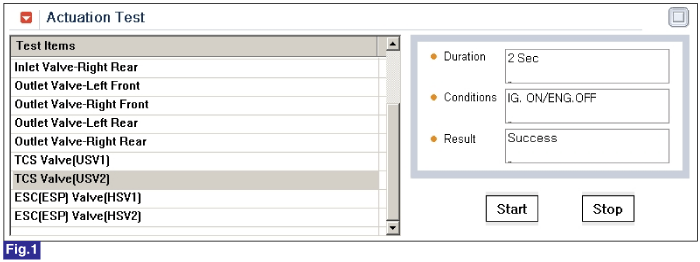
Fig.1) Test Condition : Ignition "ON" &
Engine "OFF".
Ex) Actuation Test on TCS(USV) valve
#2 |
| 5. |
Does a TCS(USV) valve #2 operate
normally?
|

|
▶ Fault is
intermittent caused by poor connection in power harness and/or
HECU's connector or was repaired and HECU memory was not
cleared. Thoroughly check connectors for looseness, poor
connection, bending, corrosion, contamination, deterioration,
or damage.
Repair or replace as
necessary and then go to "Verification of Vehicle Repair"
procedure.
|
|

|
▶ Go to
"Terminal and Connector Inspection"
procedure.
|
|
| Terminal and Connector
Inspection |
| 1. |
Many malfunctions in the electrical system are
caused by poor harness(es) and terminals. Faults can also be caused
by interference from other electrical systems, and mechanical or
chemical damage. |
| 2. |
Thoroughly check connectors for looseness,
poor connection, bending, corrosion, contamination, deterioration,
or damage. |
| 3. |
Has a problem been found?
|
|
▶ Repair as
necessary and then go to "Verification of Vehicle Repair"
procedure.
|
|
|
▶
Substitute with a known-good HECU and check for proper
operation. If problem is corrected, replace HECU and then go
to "Verification of Vehicle Repair"
procedure.
|
|
| Verification of Vehicle
Repair |
After a repair, it is
essential to verify that the fault has been corrected.
| 1. |
Connect scantool and select "Diagnostic
Trouble Codes(DTCs)" mode. |
| 2. |
Using a scantool, Clear
DTC. |
| 3. |
Operate the vehicle within DTC Detecting
Condition in General Information. (Start and drive vehicle in gear
and maintain vehicle speed at or above 15km/h.
(9mph) |
| 4. |
Are any DTCs present ?
|
|
▶ Go to the
applicable troubleshooting procedure.
|
|
|
▶ System
performing to specification at this
time.
|
|