| Description |
The charging system
includes a battery, an alternator with a built-in regulator, and the
charging indicator light and wire.
The alternator has six
built-in diodes (three positive and three negtive), each rectifying AC
current to DC current.
Therefore, DC curent
appears at alternator "B" terminal.
In addition, the
charging voltage of the alternator is regulated by the battery voltage
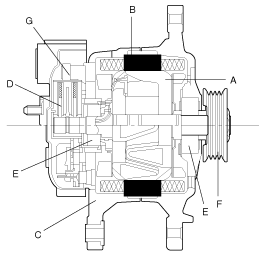
detection system. The main components of the alternator are the rotor(A),
stator(B), rectifier(C), brushes(D), bearings(E) V-ribbed belt pulley(F).
The brush holder contains a built-in electronic voltage
regulator(G).
Alternator Management System
Alternator management
system controls the charging voltage set point in order to improve fuel
economy, manage alternator load under various operating conditions, keep
the battery charged, and protect the battery from over-charging. ECM
controls generating voltage by duty cycle (charging control, discharging
control, normal control) based on the battery conditions and vehicle
operating conditions.
The system conducts
discharging control when accelerating a vehicle. Vehicle reduces an
alternator load and consumes an electric power form a
battery.
The system conducts
charging control when decelerating a vehicle. Vehicle increases an
alternator load and charges a
battery.