| Schematic Diagram |
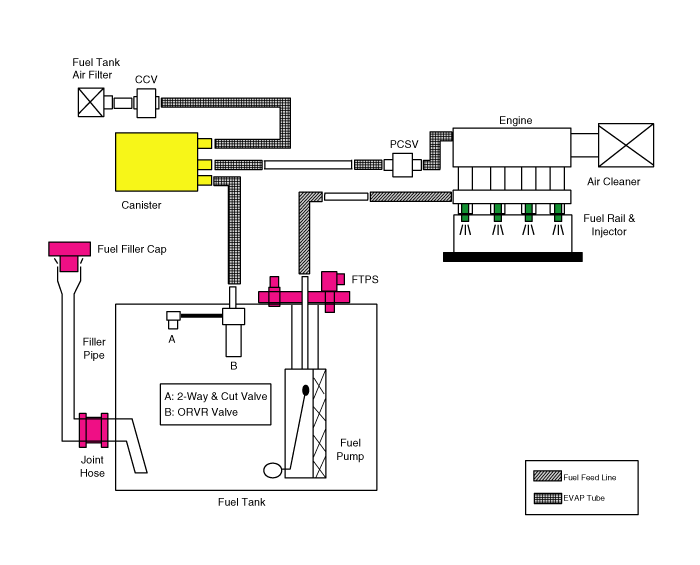
| Canister |
Canister is filled with
charcoal and absorbs evaporated vapor in fuel tank. The gathered fuel
vapor in canister isdrawn into the intake manifold by the ECM when
appropriate conditions are set.
| Purge Control Solenoid Valve (PCSV) |
Purge Control Solenoid
Valve (PCSV) is installed in the passage connecting canister and intake
manifold. It is aduty type solenoid valve and is operated by ECM signal.
To draw the absorbed vapor into the intake manifold, the ECM will open the
PCSV, otherwise the passage remains closed.
| Canister Close Valve (CCV) |
The Canister Close Valve
(CCV) is located between canister and fuel tank air filter. It closes off
the air inlet to the canister for the Evaporative Emissions System leak
detection inspection function and also prevents fuel vapors from escaping
from the Canister when the vehicle is not operating.
| Fuel Tank Pressure Sensor (FTPS) |
The Fuel Tank Pressure
Sensor (FTPS) is an integral part of the monitoring system. The FTPS.
checks Purge Control Solenoid Valve (PCSV) operation and leaks in the
Evaporative Emission Control System by monitoring pressure and vacuum
level in the fuel tank during PCSV operating cycles.
| Fuel Filler Cap |
A ratchet tightening
device on the threaded fuel filler cap reduces the chances of incorrect
installation, which would seal the fuel filler. After the gasket on the
fuel filler cap and the fill neck flange contact each other, the ratchet
produces a loud clicking noise indicating the seal has been
set.
| Evaporative System Monitoring |
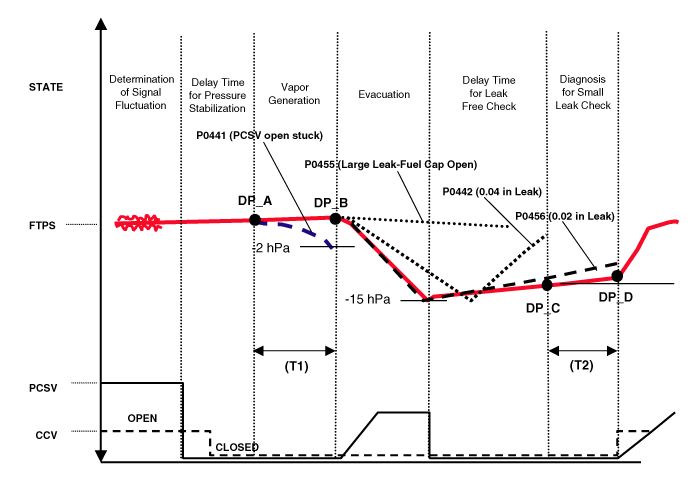
Evaporative Emission
Control Monitoring System consists of fuel vapor generation, evacuation,
and leakage check step. At first, the OBD-II system checks if vapor
generation due to fuel temperature is small enough to start monitoring,
and then it evacuates the evaporative system by means of PCSV with ramp in
order to maintain a certain vacuum level. The final step is to check if
there is vacuum loss by any leakage of the system.
| Vapor Generation Checking |
During stabilization
period, the PCSV and the CCV are closed, and the system pressure is
measured as starting pressure (DP_A). After a certain defined period (T1),
thesystem pressure (DP_B) is measured again and the difference from the
starting pressure is calculated. If this difference(DP_B - DP_A) is bigger
than a threshold, there should be excessive vapor and the monitor is
aborted for next checking. On the contrary, if the difference is lower
than another negative threshold, PCSV is regarded a smal function such as
clogged at open position.
| Evacuation |
PCSV is opened with a
certain ramp for the pressure to reach down to a certain level. If
pressure can’t be lowered below a threshold, the system is regarded as
fuel cap-opened or having a large leakage.
| Leakage Checking |
PCSV is closed and the
system waits for a period toget stabilized pressure. During checking
period (T2), the system measures the beginning and the end of the system
pressure(DP_C, DP_D). The diagnosis valueis the pressure difference
corrected by natural vapor generation(DP_B - DP_A) rate from the vapor
generation checking step.
| Evaporative System Monitoring |
| Evaporative And ORVR Emission Control System |
On-Board Refueling Vapor
Recovery (ORVR) system is designed to prevent fuel tank vapor (HC)
emissions during refueling at the gas station.
This system consists of
a fill vent valve, fuel shut-off valve, fuel cut valve (for roll over),
two way valve (pressure/vacuum relief), fuel liquid/vapor separator which
is installed beside the filler pipe, charcoal canister which is mounted
under the rear floor LH side member and protector, tubes and miscellaneous
connections.
While refueling, ambient
air is drawn into the filler pipe so as not to emit fuel vapors in the
air. The fuel vapor in the tank is then forced to flow into the canister
via the fill ventvalve. The fuel liquid/vapor separator is olates liquid
fueland passes the pure vapor to the charcoal canister.
While the engine is
operating, the trapped vapor in the canister is drawn into the intake
manifold and then into the engine combustion chamber. According to this
purge process, the charcoal canister is purged and recovers its absorbing
capability.
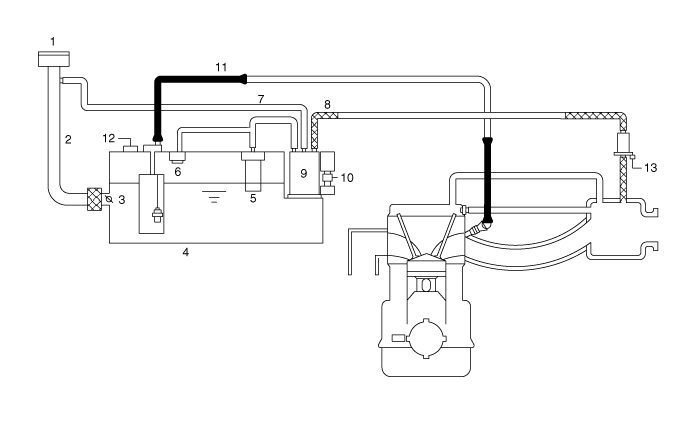
| 1. Fuel Filler
Cap 2. Fuel Filler Pipe 3. Fuel Shut-OFF Valve 4. Fuel Tank 5. ORVR Valve 6. 2-Way & Cut Valve 7. Evaporative Hose |
8. Evaporative
Hose 9. Canister 10. Canister Close Valve (CCV) 11. Fuel Feed Line 12. Fuel Tank Pressure Sensor (FTPS) 13. Purge Control Solenoid Valve (PCSV) |