| 1. |
Remove the rear wheel & tire.
Tightening
torque:
88.3 ~ 107.9 N.m (9.0 ~ 11.0 kgf.m, 65.1
~ 79.6 lb-ft)
| |
| 2. |
Release the parking brake lever and parking
brake cable is loose. |
| 3. |
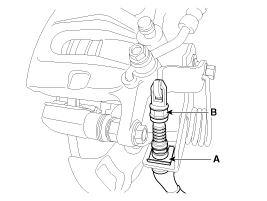
Remove the parking brake cable (B), after
removing the clip (A).
|
Parking brake lever in the car must be
in fully loosened position.
| |
| 4. |
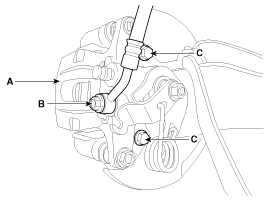
Remove the hose eyebolt (B).
Tightening
torque:
Brake hose to caliper:
24.5 ~ 29.4 N.m (2.5 ~ 3.0 kgf.m, 18.1 ~
21.7 lb-ft)
|
|
| 5. |
Loosen the caliper mounting bolts (C), then
remove the rear caliper assembly (A).
Tightening
torque:
Caliper assembly to carrier (C)
:
63.7 ~ 73.5 N.m (6.5 ~ 7.5 kgf.m, 47.0 ~
54.2 lb-ft)
| |
| 6. |
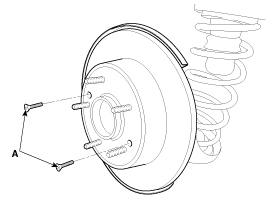
Remove the rear brake disc by loosening the
screws (A).
Tightening
torque:
4.9 ~ 5.9 N.m (0.5 ~ 0.6 kgf.m, 3.6 ~
4.3 lb-ft)
|
|
| 1. |
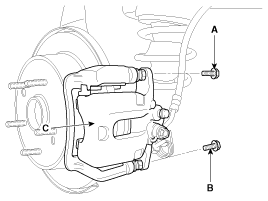
Loosen the guide rod bolt (A, B) and then
remove the rear caliper body (C).
Tightening
torque:
21.6 ~ 31.4 N.m (2.2 ~ 3.2 kgf.m, 15.9
~23.1 lb-ft)
|
| •
|
Where necessary prevent the guide
rods from rotating with an appropriate wrench.
|
| •
|
Be careful not to damage the dust
covers.
| | |
| 2. |
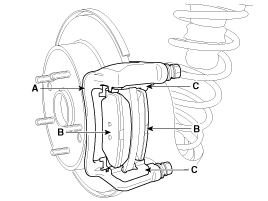
Replace pad retainers (C) and brake pads (B)
in the caliper carrier (A).
| •
|
Clean the pad retainer surface at
the caliper bracket. |
| •
|
Inspect the piston boots for
damage and replace if necessary.
|
| •
|
Check the smooth action of the
guide rods, and their dust covers for damage.
| | |
| Rear Brake Disc
Thickness Check |
| 1. |
Check the brake pads for wear and
fade. |
| 2. |
Check the brake disc for damage and
cracks. |
| 3. |
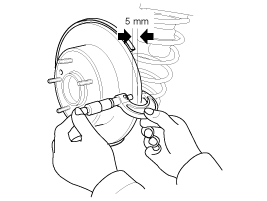
Remove all rust and contamination from the
surface, and measure the disc thickness at 8 points, at least, of
same distance (5mm) from the brake disc outer circle.
Brake disc
thickness
Standard: 10 mm (0.394 in)
Service limit: 8.4 mm (0.331
in)
Deviation: less than 0.005 mm (0.0002
in)
|
|
| 4. |
If wear exceeds the limit, replace the discs
and pad assembly left and right of the vehicle.
|
| 1. |
Check the pad wear. Measure the pad thickness
and replace it, if it is less than the specified value.
Pad
thickness
Standard value: 10 mm (0.394
in)
Service limit: 2.0 mm (0.0787
in)
| |
| 2. |
Check the damage of pad, backing metal and
contamination with grease.
|
| Rear Brake Disc Runout
Check |
| 1. |
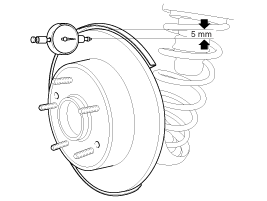
Place a dial gauge about 5mm (0.2 in.) from
the outer circumference of the brake disc, and measure the runout of
the disc.
Brake disc
runout
Limit: 0.04 mm (0.0016 in.) or less (new
one)
|
|
| 2. |
If the runout of the brake disc exceeds the
limit specification, replace the disc, and then measure the runout
again. |
| 3. |
If the runout exceeds the limit specification,
install the brake disc after turning it 180° and then check the
runout of the brake disc again. |
| 4. |
If the runout cannot be corrected by changing
the position of the brake disc, replace the brake
disc. |
| 1. |
Installation is the reverse of
removal. |
| 2. |
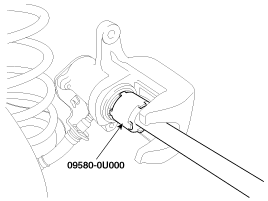
Use a SST (09580-0U000) when installing the
brake caliper assembly.
| •
|
Wind the piston into the caliper
body until it is fully retracted.
|
| •
|
Do not use any power assisted
tools for this task. |
| •
|
Manually insert new screws from
the brake pad and tighten the leading-pin bolt(A) first
with specified torque, following this tighten the
trailing-pin bolt(B) in the same manner.
| |
|
| 3. |
After installation, bleed the brake system.
(Refer to Brake system bleeding)
| •
|
Bring the brake pads in their
operating position by pressing the brake pedal down
(half of normal pedal travel) several times until there
is resistance. |
| •
|
In order to bed the brake pads to
the brake disc and ensure performance and endurance, the
vehicle user must be instructed to avoid heavy braking
or sustained periods with the brakes applied, for the
first 200km(124mile) after installing new pads.
|
| •
|
Re-setting of the parking brake is
necessary after overhauling the caliper body, or if the
brake calipers, caliper body, parking brake cable or
brake discs have been changed.
| | |
| •
|
Re-setting of the parking brake is
necessary after overhauling the caliper body, or if the brake
calipers, housing, parking brake cable or brake discs have
been changed.
| |
| 1. |
Remove the floor console to reach the
adjusting nut. |
| 2. |
Loosen the parking brake cable until both
operating levers rest in fully off position.
|
| 3. |
Bring the brake pads in their operating
position by pressing the brake pedal down several times until there
is resistance. |
| 4. |
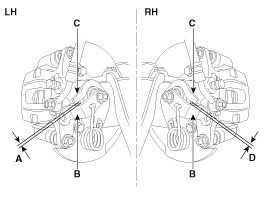
Tension the parking brake cable by tightening
the adjusting nut, until the operating levers on both calipers lift
from the stop, up to a distance of (A) and (D) between operating
lever (B) and stopper (C).
Distance
(A+D): Max. 3 mm (0.12 in)
|
|
| 5. |
Refit the floor console.
|
| 6. |
Parking brake lever in the car must be in
fully loosened position. |
| 7. |
If the handbrake cables where changed, actuate
the parking brake a few times with maximum force to stretch the
parking brake cables, and then control adjusting as above.
|
| 8. |
Check the wheels of their free operation.
|
|
