| •
|
Frequent inhalation of brake pad dust,
regardless of material composition, could be hazardous to your
health. |
| •
|
Avoid breathing dust particles.
|
| •
|
Never use an air hose or brush to clean
brake assemblies.
| |
| 1. |
Release the parking brake.
|
| 2. |
Remove the rear wheel & tire.
Tightening
torque:
88.3 ~ 107.9 N.m (9.0 ~ 11.0 kgf.m, 65.1
~ 79.6 lb-ft)
| |
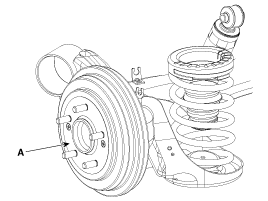
| 3. |
Remove the rear brake drum (A).
|
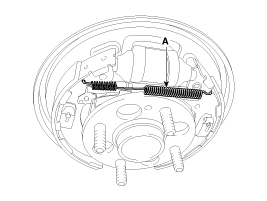
| 4. |
Remove the upper return spring
(A).
|
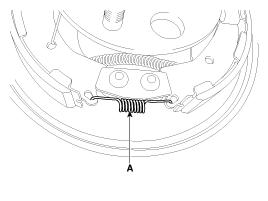
| 5. |
Remove the lower return spring (A).
|
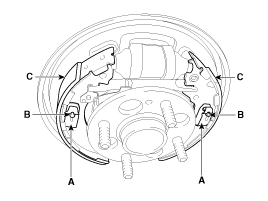
| 6. |
Remove the shoe hold springs (A) and shoe hold
pins (B) and then remove brake shoe (C). Make sure not to damage the
dust cover on the wheel cylinder.
|
| 7. |
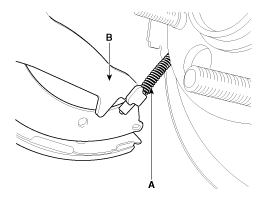
Remove the parking brake cable (A) and then
remove brake shoe (B).
|
| 8. |
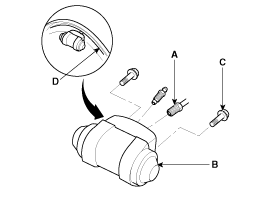
Disconnect brake tubes (A) from the wheel
cylinder (B).
|
| 9. |
Remove the bolts (C) and the wheel cylinder
(B) from the backing plate (D). |
| •
|
Do not spill brake fluid on the vehicle:
it may damage the paint; if brake fluid does contact the
paint. Wash it off immediately with water.
|
| •
|
To prevent spills, cover the hose joints
with rags or shop towels. |
| •
|
Use only a genuine wheel cylinder
special bolt.
| |
| 1. |
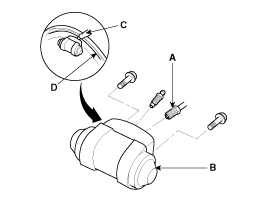
Apply sealant (C) between the wheel cylinder
(B) and backing plate (D), and install the wheel
cylinder.
|
| 2. |
Connect the brake tubes (A) to the wheel
cylinder.
Tightening
torque:
12.7 ~ 16.7 N.m (1.3 ~ 1.7 kgf.m, 9.4 ~
12.3 lb-ft)
| |
| 3. |
Connect the parking brake cable (A) to the
brake shoe.
|
| 4. |
Install the brake shoes (C) onto the backing
plate. Be careful not to damage the wheel cylinder dust covers.
|
| 5. |
Install the shoe hole down pins (B) and the
shoe hole down springs (A). |
| 6. |
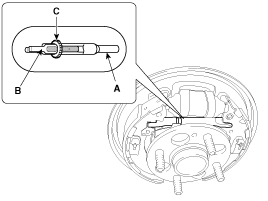
Clean the threaded portions of adjuster sleeve
(A) and push rod female (B). Coat the threads of the adjuster
assembly with grease. To shorten the clevises, turn the adjuster
bolt (C).
|
| 7. |
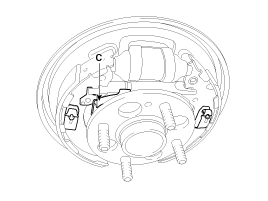
Hook the shoe adjuster lever (C), then install
it to the brake shoe.
|
| 8. |
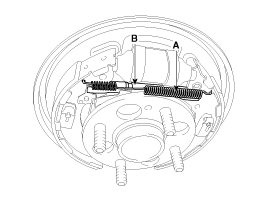
Install the adjuster assembly (B) and upper
return spring (A) as right direction. Be careful not to damage the
wheel cylinder dust covers.
|
| 9. |
Install the lower return spring (B).
|
| 10. |
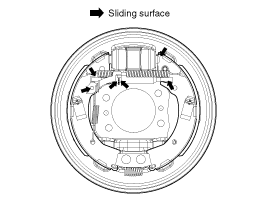
Apply brake cylinder grease or equivalent
rubber grease to the sliding surfaces shown. Don't get grease on the
brake linings.
|
| 11. |
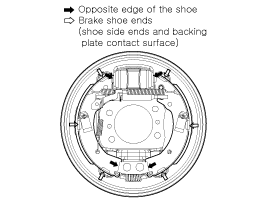
Apply brake cylinder grease or equivalent
rubber grease to the brake shoe ends and opposite edges of the shoes
shown. Don't get grease on the brake linings.
|
| 12. |
Install the rear brake drum (A).
Tightening
torque:
4.9 ~ 5.9 N.m (0.5 ~ 0.6 kgf.m, 3.6 ~
4.3 lb-ft)
|
|
| 13. |
If the wheel cylinder has been removed, bleed
the brake system. |
| 14. |
Depress the brake pedal several times to set
the self-adjusting brake. |
| 15. |
Adjust the parking brake.
|
| •
|
Frequent inhalation of brake pad dust,
regardless of material composition, could be hazardous to your
health. |
| •
|
Avoid breathing dust particles.
|
| •
|
Never use an air hose or brush to clean
brake assemblies.
| |
| •
|
Contaminated brake linings or drums
reduce stopping ability. |
| •
|
Block the front wheels before jacking up
the rear of the vehicle.
| |
| 1. |
Raise the rear of the vehicle, and make sure
it is securely supported. |
| 2. |
Release the parking brake, and remove the rear
brake drum. |
| 3. |
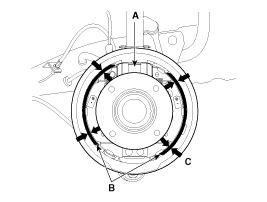
Check the wheel cylinder (A) for
leakage.
|
| 4. |
Check the brake linings (B) for cracking,
glazing, wear, and contamination. |
| 5. |
Measure the brake lining thickness
(C).Measurement does not include brake shoe thickness.
Brake lining
thickness
Standard: 4.5 mm (0.177 in)
Service limit: 1.0 mm (0.039
in)
| |
| 6. |
If the brake lining thickness is less than the
service limit, replace the brake shoes as a set.
|
| 7. |
Check the bearings in the hub unit for smooth
operation. If it requires servicing, replace it.
|
| 8. |
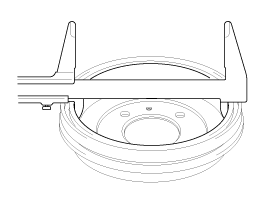
Measure the inside diameter of the brake drum
with inside vernier calipers.
Drum inside
diameter
Standard: 203.2 mm (8.0 in)
Service limit: 205.2 mm (8.079
in)
Drum
roundness
Service limit: 0.06 mm (0.00236
in)
|
|
| 9. |
If the inside diameter of the brake drum is
more than the service limit, replace the brake
drum. |
| 10. |
Check the brake drum for scoring, grooves, and
cracks. |
| 11. |
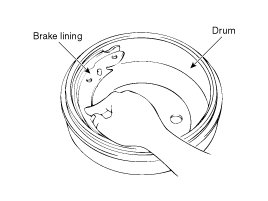
Inspect the brake lining and drum for proper
contact.
|
| 12. |
Inspect the wheel cylinder outside for
excessive wear and damage. |
| 13. |
Inspect the backing plate for wear or damage.
| |

