| Compression Pressure
Inspection |
|
If the there is lack of power, excessive oil
consumption or poor fuel economy, measure the compression
pressure. |
| 1. |
Warm up and stop engine.
Allow the engine to warm up to normal
operating temperature. |
| 2. |
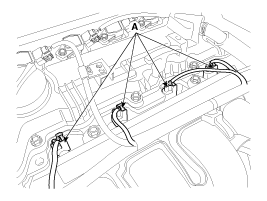
Disconnect the injector connectors
(A).
|
| 3. |
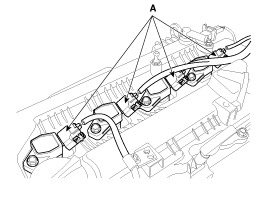
Disconnect the ignition coil connectors
(A).
|
| 4. |
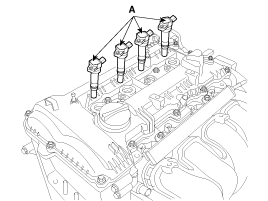
Remove ignition coils (A).
|
| 5. |
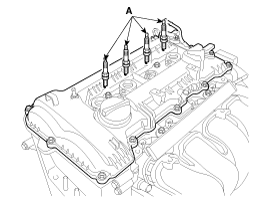
Remove spark plugs (A).
Using a 16mm plug wrench, remove the 4 spark
plugs.
|
| 6. |
Check cylinder compression
pressure.
| (1) |
Insert a compression gauge into the
spark plug hole.
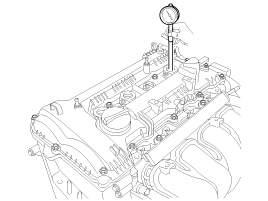
|
| (2) |
Fully open the
throttle. |
| (3) |
While cranking the engine, measure the
compression pressure.
|
Always use a fully charged battery
to obtain engine speed of 200 rpm or
more. | |
| (4) |
Repeat steps (1) through (3) for each
cylinder.
|
This measurement must be done in
as short a time as
possible. |
Compression pressure:
1,275 kPa (13.0 kgf/cm², 185 psi)
Minimum
pressure:
1,128 kPa (11.5 kgf/cm², 164
psi)
Difference between each
cylinder:
100 kPa (1.0 kgf/cm², 15 psi) or
less
| |
| (5) |
If the cylinder compression in 1 or more
cylinders is low, pour a small amount of engine oil into the
cylinder through the spark plug hole and repeat steps (1)
through (3) for cylinders with low compression.
| A. |
If adding oil helps the
compression, it is likely that the piston rings and/or
cylinder bore are worn or
damaged. |
| B. |
If pressure stays low, a valve may
be sticking or seating is improper, or there may be
leakage past the
gasket. | | |
| 7. |
Reinstall spark plugs.
Tightening
torque:
14.7 ~ 24.5 N.m (1.5 ~ 2.5 kgf.m, 10.8 ~
18.1 lb-ft)
| |
| 8. |
Install ignition coils.
Tightening
torque:
9.8 ~ 11.8 N.m (1.0 ~ 1.2 kgf.m, 7.2 ~
8.7 lb-ft)
| |
| 9. |
Connect the injector connectors and ignition
coil connectors. |
| 10. |
Some DTCs may exist after the inspection test
and may need to be manually cleared with
GDS. | |
