| Inspection |
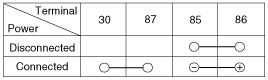
Power
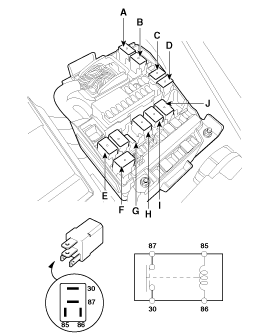
Relay Test (Type A)
|

Check for continuity
between the terminals.
| A.C/Fan(Low)
relay B.C/Fan(High) relay C.SSB 4(IG2) relay D.Blower relay E.Rear defogger relay |
F.Horn
relay G.Stop relay H.SSB2(ACC) relay I.Start 1 relay J.SSB3(IG1) relay |
| 1. |
There should be continuity between the No.30
and No.87 terminals when power and ground are connected to the No.85
and No.86 terminals. |
| 2. |
There should be no continuity between the
No.30 and No.87 terminals when power is disconnected.
|
Power
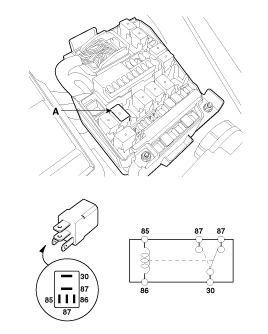
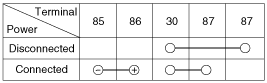
Relay Test (Type B)
Check for continuity
between the terminals.
A : Wiper
relay
| 1. |
There should be continuity between the No.30
and No.87 terminals when power and ground are connected to the No.85
and No.86 terminals. |
| 2. |
There should be continuity between the No.30
and No.87 terminals when power is disconnected.
|
Replacement
of EMS box
| 1. |
Disconnect the negative(-) battery
terminal. |
| 2. |
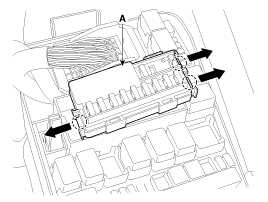
Push 3 hooks in the engine room relay box
out to the arrow direction and put up the EMS box
assembly(A).
|
| 3. |
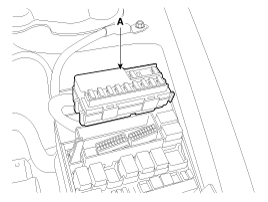
Disconnect the connector and remove the EMS
box assembly(A).
|
Fuse
Inspection
| 1. |
Be sure there is no play in the fuse
holders, and that the fuses are held
securely. |
| 2. |
Are the fuse capacities for each circuit
correct? |
| 3. |
Are there any blown fuses?
If a fuse is to be replaced, be sure to use
a new fuse of the same capacity. Always determine why the fuse blew
first and completely eliminate the problem before installing a new
fuse. |
Multi
Fuse
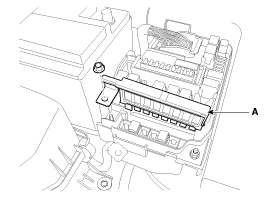
Multi Fuse is for
optimizing the engine room package.
|