Automatic transaxle
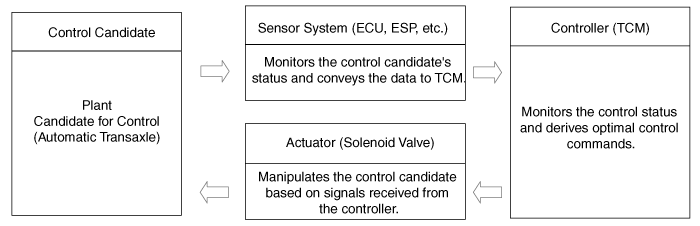
system relies on various measurement data to determine the current control
status and extrapolate the necessary compensation values. These values are
used to control the actuators and achieve the desired control output. If a
problem with the drivetrain, including the transaxle, has been identified,
perform self-diagnosis and basic transaxle inspection (oil and fluid
inspection) and then check the control system's components using the
diagnosis tool.
| Control System
Composition |
Fault Diagnosis
Features a fail-safe
mechanism that provides "limp-home" 4th gear hold to enable the vehicle to
be driven to the owner's home or dealer shop.
Fail-Safe: The TCM
provides 4th gear hold and Reverse gear in the event of a
malfunction.
Limp Home: Maintains
minimal functionality (Drive(4th gear hold), Reverse) in the event of a
malfunction, making it possible for the vehicle to reach the dealer
shop.
Self-diagnosis
TCM is in constant
communication with the control system's components (sensors and
solenoids). If an abnormal signal is received for longer than the
predefined duration, TCM recognizes a fault, stores the fault code in
memory, and then sends out a fault signal through the self-diagnosis
terminal. Such fault codes are independently backed up and will not be
cleared even if the ignition switch is turned off, the battery is
disconnected, or the TCM connector is disconnected.
|
Disconnecting a sensor or an actuator
connector while the ignition switch is in the "On" position
generates a diagnostic trouble code (DTC) and commits the code to
memory. In such event, disconnecting the battery will not clear the
fault diagnosis memory. The diagnosis tool must be used to clear the
fault diagnosis memory. |
| •
|
Before removing or installing any part,
read the diagnostic trouble codes and then disconnect the
battery negative (-) terminal.
|
| •
|
Before disconnecting the cable from
battery terminal, turn the ignition switch to OFF. Removal or
connection of the battery cable during engine operation or
while the ignition switch is ON could cause damage to the
TCM. |
| •
|
When checking the generator for the
charging state, do not disconnect the battery '+' terminal to
prevent the ECM from damage due to the
voltage. |
| •
|
When charging the battery with the
external charger, disconnect the vehicle side battery
terminals to prevent damage to the TCM.
| |
Checking Procedure (Self-diagnosis)
| •
|
When battery voltage is excessively low,
Diagnostic Trouble Codes(DTC) can not be read. Be sure to
check the battery for voltage and the charging system before
starting the test.
| |
Inspection Procedure (Using the GDS)
| 1. |
Turn OFF the ignition switch.
|
| 2. |
Connect the GDS to the data link connector on
the lower crash pad. |
| 3. |
Turn ON the ignition switch.
|
| 4. |
Use the GDS to check the diagnostic trouble
code. |
| 5. |
Repair the faulty part from the diagnosis
chart. |
| 6. |
Erase the diagnostic trouble code.
|
| •
|
After replacing the automatic transaxle,
use the GDS to reset (erase the TCM learning values). Then
perform Transaxle Control Module (TCM) learning to provide
optimum shift quality.
(Refer to Automatic Transaxle Control
System - "Repair procedures") |
| •
|
Adding automatic transaxle fluid.
(Refer to Hydraulic System - "Fluid")
|
| •
|
After servicing the automatic transaxle
or TCM, clear the Diagnostic Trouble Code (DTC) using the GDS
tool. Diagnostic Trouble Codes (DTC) cannot be cleared by
disconnecting the battery.
| |
