The EPB is an electronic
parking brake.
The EPB is different
from existing parking systems which operated with the brake pedal or the
lever type. The EPB system sends the signal to the ECU when a driver
operates the EPB switch. The ECU operates the EPB actuator composed with
motor gears.
EPB Function
| 1. |
Static Switch Apply
| A. |
Manual apply of EPB switch in stand
still condition. |
| B. |
Clamping force control; When parked on
less than 8% slope with engine running, it is applied with
Reduced Clamp Force(RCF); Except for RCF condition, it is
applied with full clamp
force. | |
| 2. |
Reduced Clamp Force on Flat (RCF)
| A. |
If EPB is applied on less than 8% slope,
it is applied with reduced clamp
force. |
| B. |
When switch is pulled for more than 3
sec, it is clamped to full clamp
force. | |
| 3. |
Static (Switch) Release
| A. |
Releasing EPB manually by
switch |
| B. |
To prevent danger situation, it can be
released only when ARC is
fulfilled. |
Additional Release Condition
(ARC)
| A. |
To prevent unintentional release of EPB,
there is condition to be met before releasing;
Example: IGN On + [Brake Pedal
pressed] |
Child Safe (Release Inhibit)
| A. |
With ignition switched off, EPB cannot
be
released. | |
| 4. |
Drive Away Assist (DAA)
The parking brake can be automatically
released by slowing depressing the accelerator pedal when all the
conditions below are satisfied. (A/T only)
| (2) |
Fasten the driver's seat
belt. |
| (3) |
Close the driver's door, engine hood and
tailgate. |
| (4) |
Depress the accelerator pedal while the
shift lever is in R (Rear), D
(Drive). |
The parking brake can be automatically
released by slowing depressing the accelerator pedal while removing
the foot from the clutch pedal when all the conditions below are
satisfied. (M/T only)
| (2) |
Fasten the driver's seat
belt. |
| (3) |
Close the driver's door, engine hood and
tailgate. |
| (4) |
Depress the clutch pedal with the gear
engaged. | |
| 5. |
Rear Wheel Unlocker (RWU)
| A. |
When EPB switch is pulled in dynamic
condition, dynamic deceleration is generated by EPB
actuator. |
| B. |
Clamp force will be controlled to avoid
locking of the rear wheels and ensure vehicle
stability. | |
| 6. |
Roll Away Reclamp (RAR)
| A. |
If vehicle rolls away, EPB gets
reapplied.
; Vehicle movement is monitored via
wheel speed.
; It can be active until CAN signal is
available (3
min) | |
| 7. |
High Temperature Reclamp (HTR)
| A. |
After detection of hot brakes, EPB will
reapply from closed brake state to compensate for loss of
clamp force during cooling of the
brakes. |
| B. |
Activation condition: over
350°C | |
| 8. |
Pad Change Mode
| A. |
Return the spindle nut fully for pad
replacement
; This mode can be entered via hand tool
connected to vehicle with OBD2 connector.
; Piston can be pushed in after entering
Pad change
mode | |
| 9. |
Dynamic Standstill Detection
(DSD)
This is how to operate the parking brake when
there is no wheel speed signal because of malfunction. Braking force
can be applied while the vehicle is in motion to slowly decelerate.
If the EPB switch is continuously pulled, then the parking brake can
be engaged with maximum force. |
| 10. |
P to X
EPB is automatically released when gear shift
lever is moved from P position;
Engine on + Brake pedal condition is
necessary. |
| 11. |
N to X
EPB is automatically released when gear shift
lever is moved from Neutral position to moving position. (D or
R)
; It does not get released if the gear shift
lever is moved to P or passes through N rapidly.
; Engine on + Brake pedal condition is
necessary. |
Parking Brake Emergency Release
| - |
The following procedure is for releasing the
parking brake when EPB failure
occurs. |
| - |
This is the last resort for releasing the EPB
when the parking brake cannot be released electrically or by using a
diagnosis scanner because of motor or EPB damage, or power line
disconnection. |
| - |
The task must be performed on a flat surface
and with safe surroundings. When you release the parking brake, be
sure to keep the vehicle stationary.
(Perform this task only after you make sure
that preventive measures are taken in case the vehicle moves when
the parking brake is released.) |
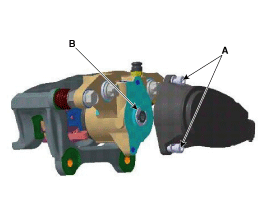
| 1. |
Use a standard hexagonal wrench to remove the
screw (A) on the back of the rear caliper (2 of
them) |
| 2. |
Using the same hexagonal wrench, turn the
hexagon part on the floor inside the spindle (B) clockwise by 0.5 -
1 complete turn. |
| 3. |
The parking brake is
released. |