|
Disassembly of the thermostat would have an
adverse effect, causing a lowering of cooling efficiency. Do not
remove the thermostat, even if the engine tends to overheat.
|
| 1. |
Drain engine coolant so its level is below
thermostat. |
| 2. |
Disconnect the radiator lower
hose.
(Refer to Cooling System – "Radiator
Hose") |
| 3. |
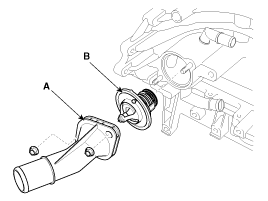
Remove the water inlet fitting (A) and
thermostat (B).
Tightening
torque :
18.6 ~ 23.5 N.m (1.9 ~ 2.4 kgf.m, 13.7 ~
17.4 lb-ft)
|
|
| 4. |
Install in the reverse order of
removal.
| •
|
Install the thermostat with the
jiggle valve upward. |
| •
|
When assembling the thermostat,
place the thermostat on the housing with a protrusion of
thermostat matching with a groove of the housing and
install the inlet fitting. Be careful the thermostat
doesn’t get out of the groove on the housing.
|
| •
|
Clean surface on the rubber
packing contact
surface. | | |
| 5. |
Fill the engine coolant.
|
| 6. |
Start the engine and check for leaks.
|
| 7. |
Recheck the coolant
level. |
| 1. |
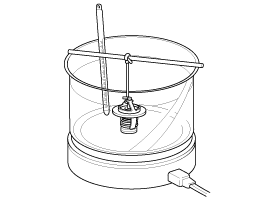
Immerse the thermostat in water and gradually
heat the water.
|
| 2. |
Check the valve opening
temperature.
If the valve opening temperature is not as
specified, replace the thermostat.
Valve opening
temperature:
88 ± 1.5°C (190.4 ± 34.7°F)
Full opening
temperature: 100°C (212°F)
| |
| 3. |
Check the valve lift.
If the valve lift is not as specified, replace
the thermostat.
Valve lift
: 8 mm (0.3 in.) or more at 100°C
(212°F)
| | |

