Vehicles have many
control units that consume electricity. These units control their own
system based on information from a variety of sensors. It is important to
have a stable power supply to assure the various sensors provide accurate
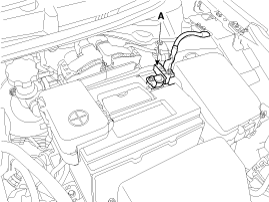
information. Battery sensor (A) is mounted on battery (-) terminal. It
transmits battery voltage, current, temperature information to ECM. ECM
controls generating voltage by duty cycle based on these
signals.
|
When battery sensor signal fault occurs,
inspect that the parasitic draw is not abnormal more than 100mA as
it will cause the sensor voltage to be abnormal. (Refer to vehicle
parasitic current inspection) |
|
It takes a few hours for a new battery sensor
to detect the battery state correctly.
Perform the following process after replacing
the battery sensor.
| 1. |
Ignition switch
ON/OFF. |
| 2. |
Park the vehicle about 4
hours. |
| 3. |
After 4 hours later, check that the SOC
(State of charge) of battery is displayed on GDS
properly. | |
|
For the vehicle equipped with a battery
sensor, be careful not to damage the battery sensor when the battery
is replaced or recharged.
| •
|
When replacing the battery, it should be
same (type, capacity and brand) as originally installed on
your vehicle. If a battery of a different type is installed,
the battery sensor may recognize the battery to be
abnormal. |
| •
|
When installing the ground cable on the
negative post of battery, tighten the clamp with specified
torque of 3.9~5.9N.m (0.4~0.6kgf.m, 3.0~4.4lb-ft). An
excessive tightening torque can damage the PCB internal
circuit and the battery
terminal. |
| •
|
When recharging the battery, ground the
negative terminal of the booster battery to the vehicle
body. | |

