| TROUBLESHOOTING |
| Vehicle inspection |
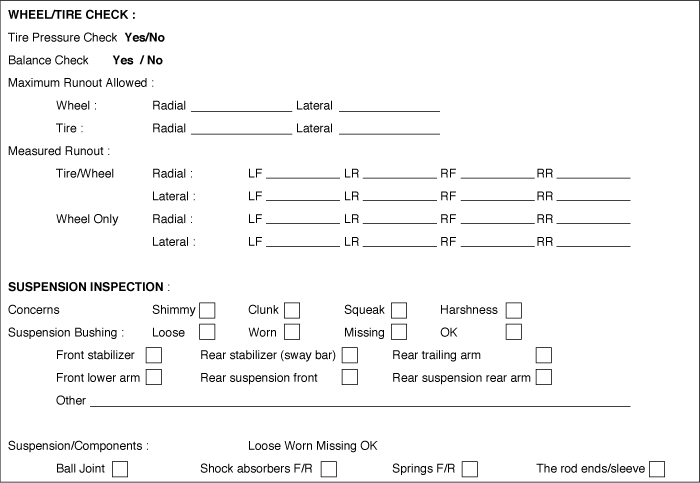
To assist the service
advisor and the technician, check the suspension and wheel/tire condition
with the questions listed below by filling them. It serves as a place to
record information as well as data from the testing to be carried out. To
begin a successful diagnosis, fill out the questions.
SYMPTOM CHART
| Symptom |
Suspect Area |
Remedy |
| Squeak or
grunt-noise from the front suspension, occurs more in cold ambient
temperatures - more noticeable over rough roads or when
turning |
Front
stabilizer bar |
Under these
conditions, the noise is acceptable. |
| Clunk -
noise from the front suspension, occurs in and out of
turns |
Loose front
struts or shocks |
Inspect for
loose nuts or bolts. Tighten to specifications. |
| Clunk - noise
from the rear suspension, occurs when shifting from reverse to
drive |
Loose rear
suspension components |
Inspect for
loose or damaged rear suspension components. Repair or install new components as necessary. |
| Click or
pop - noise from the front suspension - more noticeable over rough
roads or over bumps |
Worn or
damaged ball joints |
Install new
lower arm as necessary. |
| Click or
pop - noise occurs when vehicle is turning |
Worn or
damaged ball joints |
Install new
lower arm as necessary. |
| Click or snap
- occurs when accelerating around a corner |
Damaged or
worn Birfield joint |
Repair or
install a new Birfield joint as necessary. See DS group - driveshaft. |
| Front
suspension noise - A squeak, creak, or rattle noise - occurs mostly
over bumps or rough roads |
Steering
components Loose or bent front struts or shock absorbers Damaged spring or spring mounts Damaged or worn arm bushings Worn or damaged stabilizer bar bushing or links |
Go to detailed
test A. |
| Groaning or
grinding - noise from the front strut, occurs when driving on bumpy
roads or turning the vehicle |
Uneven seating
surface between the insulator and panel by the burrs around the
strut insulator mounting bolts and the insulator bolts mounting
holes |
Repair or
install a new parts as necessary. |
| Rear
suspension noise - a squeak, creak or rattle noise - occurs mostly
over bumps or rough roads |
Loose or bent
rear shock absorbers Damaged spring or spring mounts Damaged or worn control arm bushings |
Go to detailed
test B. |
| Shudder -
occurs during acceleration from a slow speed or stop |
Rear axle
assembly mis-positioned Damaged or worn front suspension components |
Check the
axle mounts and rear suspension for damage or wear. Repair as
necessary. Check for a loose stabilizer bar, damaged or loose strut/strut bushings or loose or worn ball joints. Inspect the steering linkage for wear or damage. Repair or Install new components as necessary. |
| Shimmy -
most noticeable on coast/deceleration - also hard steering
condition |
Excessive
positive caster |
Check the
caster alignment angle. Correct as necessary. |
| Tire noise -
hum/moan at constant speeds |
Abnormal wear
patterns |
Spin the
tire and Check for tire wear. Install a new tire as necessary. Inspect for damaged/worn suspension components. Perform wheel alignment. |
| Tire noise -
noise tone lowers as the vehicle speed is lowered |
Out-of-balance
tire |
Balance the
tire and road test. Install a new tire as necessary. |
| Tire noise
- ticking noise, change with speed |
Nail puncture
or stone in tire tread |
Inspect the
tire. Repair or replace as necessary. |
| Wheel and
tire - vibration and noise concern is directly related to vehicle
speed and is not affected by acceleration, coasting or
decelerating |
Damaged or
worn tire |
Go to detailed
test C. |
| Tire
wobble or shudder - occurs at lower speeds |
Damaged wheel
bearings |
Spin the
tire and check for abnormal wheel bearing play or roughness. Adjust
or Install new wheel bearings as necessary. See DS group - front/rear axle. |
| Damaged
wheel |
Inspect the
wheel for damage. Install a new wheel as necessary. | |
| Damaged or
worn suspension components |
Inspect the
suspension components for wear or damage. Repair as necessary. | |
| Loosen wheel
nuts |
Check the
wheel nuts. Tighten to specification. | |
| Damaged or
uneven tire wear |
Spin the
tire and Check for abnormal tire wear or damage. Install a new tire as necessary. | |
| Tire
shimmy or shake - occurs at lower speeds |
Wheel/tire
out of balance |
Check for
wheel balance. |
| Uneven tire
wear |
Check for
abnormal tire wear. Install a new tire as necessary. | |
| Excessive
radial runout of wheel or tire |
Perform a
radial runout test of the wheel and tire. Install a new tire as necessary. | |
| Worn or
damaged wheel studs or elongate stud holes |
Inspect the
wheel studs and wheels. Install new components as necessary. | |
| Excessive
lateral runout of the wheel or tire |
Perform a
lateral runout test of the wheel and tire. Check the wheel, tire and hub. Repair or Install new components as necessary. | |
| Foreign
materal between the brake disc and hub. |
Clean the
mounting surfaces of the brake disc and hub. See DS group - front/rear axle. | |
| High speed
shake or shimmy - occurs at high speeds |
Excessive
wheel hub runout Damaged or worn tires Damaged or worn wheel bearings Worn or damaged suspension or steering linkage Brake disc or drum imbalance |
Go to detailed
test D. |
| Drift left or
right |
Tires Steering linkage Alignment Base brake system |
Go to detailed
test E. |
| Steering
wheel |
Alignment Steering linkage Front lower arm ball joint |
Go to detailed
test F. |
| Tracks
incorrectly |
Rear
suspension Caster |
Go to detailed
test G. |
| Rough
ride |
Front strut
and spring assembly Rear shock absorber and spring assembly |
Go to detailed
test H. |
| Excessive
noise |
Front or
rear stabilizer bar components Springs Suspension components Shock absorbers |
Go to detailed
test I. |
| Incorrect tire
wear |
Tire or
unbalanced wheels Tire inflation Strut Alignment |
Go to detailed
test J. |
| Vibration |
Wheel/tire Front wheel driveshaft(s) Steering system Strut and spring assembly Spring and strut mounting Front lower arm ball joint Front lower arm mounting bolt bushing Stabilizer bar bushings Wheel hubs and bearing Rear suspension arms and bushings |
Go to detailed
test K. |
| Vehicle
leans |
Tire/wheel Vehicle load Suspension components Incorrect ride height |
Inflate
tires to specification. Redistribute the load as necessary. Visually inspect the suspention system. Correct the ride height as necessary. |
| Poor steering
returnability |
High
knuckle rotating torque Alignment |
Go to detailed
test E. |
DETAILED TEST A : FRONT SUSPENSION
NOISE
| CONDITIONS |
DETAILS/RESULTS/ACTIONS | ||||||
| ROAD
TEST THE VEHICLE | |||||||
| |||||||
| INSPECT THE STEERING SYSTEM | |||||||
| |||||||
| FRONT SHOCK ABSORBER/STRUT CHECK | |||||||
| |||||||
| CHECK THE FRONT SPRINGS | |||||||
| Check the
front spring and front spring mounts/brackets for wear or
damage. ● Are the front springs or spring mounts/brackets worn or damaged ? → YES Repair or Install new components as necessary. Test the system for normal operation. → NO Go toA5. | |||||||
| CHECK THE STABILIZER BAR | |||||||
| |||||||
DETAILED TEST B : REAR SUSPENSION
NOISE
| CONDITIONS |
DETAILS/RESULTS/ACTIONS | ||||||
| ROAD
TEST THE VEHICLE | |||||||
| |||||||
| REAR
SHOCK ABSORBER/STRUT CHECK | |||||||
| |||||||
| CHECK THE REAR SPRINGS | |||||||
| Check the rear
springs and rear spring mounts/brackets for wear or
damage. ● Are the rear springs or spring mounts/brackets worn or damaged ? → YES Repair or Install new components as necessary. Test the system for normal operation. → NO Go toB4. | |||||||
| CHECK THE TRAILING ARMS | |||||||
| |||||||
DETAILED TEST C : WHEEL AND
TIRE
| CONDITIONS |
DETAILS/RESULTS/ACTIONS | ||||||
| ROAD
TEST THE VEHICLE | |||||||
● Is there a vibration and noise ? → YES Go toC2. → NO The wheel and tires are OK. Conduct a diagnosis on other suspect systems. | |||||||
| CHECK THE FRONT WHEEL BEARINGS | |||||||
| Check the
front wheel bearings. Refer to Wheel Bearing Check (See DS group - front axle). ● Are the wheel bearings OK ? → YES Go toC3. → NO Inspect the wheel bearings. Adjust or Repair as necessary. Test the system for normal operation. | |||||||
| INSPECT THE TIRES | |||||||
| |||||||
| TIRE
ROTATION DIAGNOSIS | |||||||
| |||||||
| RADIAL RUNOUT CHECK ON THE TIRE | |||||||
| Measure the
radial runout of the wheel and tire assembly. A typical
specification for total radial runout is 1.15mm (0.059
inch). ● Is the radial runout within specifications ? → YES Go toC8. → NO Go toC6. | |||||||
| RADIAL RUNOUT CHECK ON THE WHEEL | |||||||
| Measure the
radial runout of the wheel. A typical specification for total radial
runout is 1.14mm (0.045 inch.). ● Is the radial runout within specifications ? → YES Install a new tire. Test the system for normal operation. → NO Go toC7. | |||||||
| CHECK THE HUB/BRAKE DISC OR DRUM PILOT RUNOUT OR BOLT
CIRCLE RUNOUT | |||||||
| Measure the
pilot or bolt circle runout. A typical specification for radial
runout is : ● pilot runout - less than 0.15mm (0.006 inch.) ● bolt circle runout - less than 0.38 mm (0.015 inch.) ● Is the radial runout within specification ? → YES Install a new wheel. Test the system for normal operation. → NO Repair or Install new components as necessary. | |||||||
| LATERAL RUNOUT CHECK ON THE TIRE | |||||||
| Measure the
lateral runout of the wheel and tire assembly. A typical
specification for total lateral runout is 2.5mm (0.098
inch). ● Is the lateral runout within specifications ? → YES Wheel and tires are OK. Conduct diagnosis on other suspect systems. → NO Go toC9. | |||||||
| LATERAL RUNOUT CHECK ON THE WHEEL | |||||||
| Measure the
lateral runout of the wheel. A typical specification for total
radial runout is 1.2mm (0.047 inch.) ● Is the lateral runout within specifications ? → YES Install a new tire. Test the system for normal operation. → NO Go toC10. | |||||||
| CHECK THE FLANGE FACE LATERAL RUNOUT | |||||||
| Measure the
flange face lateral runout. A typical specification for lateral
runout is : ● hub/brake disc - less than 0.13mm (0.005 inch) ● Is the lateral runout within specifications ? → YES Install a new wheel. Test the system for normal operation. → NO Repair or Install new components as necessary. | |||||||

DETAILED TEST D : HIGH SPEED SHAKE OR
SHIMMY
| CONDITIONS |
DETAILS/RESULTS/ACTIONS | ||||
| CHECK FOR FRONT WHEEL BEARING ROUGHNESS | |||||
| |||||
| CHECK THE END PLAY OF THE FRONT WHEEL
BEARINGS | |||||
| Check the end
play of the front wheel bearings. ● Is the end play OK ? → YES Go toD3. → NO Adjust or Repair as necessary. Test the system for normal operation. | |||||
| MEASURE THE LATERAL RUNOUT AND THE RADIAL RUNOUT OF THE
FRONT WHEELS ON THE VEHICLE | |||||
| Measure the
lateral runout and the radial runout of the front wheels on the
vehicle. Go to detailed test C. ● Are the measurements within specifications ? → YES Go toD4. → NO Install new wheels as necessary and Balance the assembly. Test the system for normal operation. | |||||
| MEASURE THE LATERAL RUNOUT OF THE FRONT TIRES ON THE
VEHICLE | |||||
| Measure the
lateral runout of the front tires on the vehicle. Go to detailed
test C. ● Is the runout within specifications ? → YES Go toD5. → NO Install new tires as necessary and Balance the assembly. Test the system for normal operation. | |||||
| MEASURE THE RADIAL RUNOUT OF THE FRONT TIRES ON THE
VEHICLE | |||||
| Measure the
radial runout of the front tires on the vehicle. Go to detailed test
C. ● Is the runout within specifications ? → YES Balance the front wheel and tire assemblies. If any tire cannot be balanced, Install a new tire. Test the system for normal operation. → NO Go toD6. | |||||
| MATCH MOUNT THE TIRE AND WHEEL ASSEMBLY | |||||
| Mark the high
runout location on the tire and also on the wheel. Break the
assembly down and rotate the tire 180 degrees (halfway around) on
the wheel. Inflate the tire and measure the radial
runout. ● Is the runout within specifications ? → YES Balance the assembly. Test the system for normal operation. → NO If the high spot is not within 101.6mm (4 inches) of the first high spot on the tire, Go toD7. | |||||
| MEASURE THE WHEEL FLANGE RUNOUT | |||||
| Dismount the
tire and mount the wheel on a wheel balancer. Measure the runout on
both wheel flanges. Go to detailed test C ● Is the runout within specifications ? → YES Locate and Mark the low spot on the wheel. Install the tire, matching the high spot on the tire with the low spot on the wheel. Balance the assembly. Test the system for normal operation. If the condition persists, Go toD8. → NO Install a new wheel. Check the runout on the new wheel. If the new wheel is within limits, locate and Mark the low spot. Install the tire, matching the high spot on the tire with the low spot on the wheel. Balance the assembly. Test the system for normal operation. If the condition persists, Go toD8. | |||||
| CHECK FOR VIBRATION FROM THE FRONT OF THE
VEHICLE | |||||
| Spin the front
wheel and tire assemblies with a wheel balancer while the vehicle is
raised on a hoist. Feel for vibration in the front fender or while
seated in the vehicle. ● Is the vibration present ? → YES Substitute known good wheel and tire assemblies as necessary. Test the system for normal operation. → NO Check the driveline components. Test the system for normal operation. | |||||
DETAILED TEST E : DRIFT LEFT OR
RIGHT
| CONDITIONS |
DETAILS/RESULTS/ACTIONS | ||||
| CHECK THE TIRES | |||||
| Inspect the
tires for excessive wear or damage. ● Are the tires excessively worn or damaged ? → YES Install new tires. → NO Go toE2. | |||||
| CHECK THE STEERING LINKAGE | |||||
| |||||
| CHECK THE VEHICLE ALIGNMENT | |||||
| |||||
| BRAKE DRAG DIAGNOSIS | |||||
| Apply the
brakes while driving. ● Does drift or pull occur when the brakes are applied ? → YES See BR group - specification. → NO If the steering wheel is in the center, the vehicle is OK. If the steering wheel is off-center, Go to Detailed TestF. | |||||
DETAILED TEST F : STEERING WHEEL
OFF-CENTER
| CONDITIONS |
DETAILS/RESULTS/ACTIONS | ||||
| CHECK THE CLEAR VISION | |||||
| Place the
vehicle on an alignment rack. ● Is the clear vision within specification ? → YES Go toF2. → NO Adjust the clear vision to specification. | |||||
| INSPECT THE STEERING COMPONENTS | |||||
| |||||
DETAILED TEST G : TRACKS
INCORRECTLY
| CONDITIONS |
DETAILS/RESULTS/ACTIONS | ||||
| CHECK THE CASTER | |||||
| Place the
vehicle on an alignment rack. ● Is the caster within specification ? → YES Go toG2. →NO Replace bent or damaged parts. | |||||
| CHECK THE REAR SUSPENSION | |||||
| |||||
DETAILED TEST H : ROUGH RIDE
| CONDITIONS |
DETAILS/RESULTS/ACTIONS | ||||
| CHECK THE FRONT SHOCK ABSORBER | |||||
| |||||
| CHECK THE REAR SHOCK ABSORBERS | |||||
| Inspect the
rear shock absorbers for oil leaks or damage. ● Are the rear shock absorbers leaking ? → YES Install new rear shock absorbers. → NO The vehicle is OK. Go toTROUBLESHOOTING. | |||||
DETAILED TEST I : EXCESSIVE
NOISE
| CONDITIONS |
DETAILS/RESULTS/ACTIONS | ||||
| INSPECT THE SUSPENSION | |||||
| |||||
| INSPECT THE SPRING AND TORSION BARS | |||||
| Inspect the
springs and stabilizer bars for damage. ● Are the spring or stabilizer bars damaged ? → YES Install new spring and/or stabilizer bars. → NO Go toI3. | |||||
| INSPECT THE FRONT SUSPENSION | |||||
| Inspect the
front suspension components for excessive wear or
damage. ● Are the front suspension components worn or damaged ? → YES Install new front suspension components. → NO The vehicle is OK. Go toTROUBLESHOOTING. | |||||
DETAILED TEST J : INCORRECT TIRE
WEAR
| CONDITIONS |
DETAILS/RESULTS/ACTIONS | ||||
| INSPECT THE TIRES | |||||
| |||||
| UNEVEN TIRE WEAR | |||||
| Inspect the
tires for a feathering pattern. ● Do the tires have a feathering pattern ? → YES Align the vehicle. Install new tires if badly worn. → NO Go toJ3. | |||||
| CHECK FOR CUPPED TIRE | |||||
| Inspect the
tires for cupping or dishing. ● Are the tires cupped or dished ? → YES Balance and Rotate the tires. → NO The vehicle is OK. Go toTROUBLESHOOTING. | |||||
DETAILED TEST K : VIBRATION
| CONDITIONS |
DETAILS/RESULTS/ACTIONS | ||||||
| ROAD
TEST | |||||||
| Accelerate the
vehicle to the speed at which the customer indicated the vibration
occured. ● Is the vibration present ? → YES Go toK2. → NO The vehicle is OK. Go toTROUBLESHOOTING. | |||||||
| INSPECT THE TIRES | |||||||
| |||||||
| INSPECT THE WHEEL BEARINGS | |||||||
| Spin the tires
by hand to check for wheel bearing rougness. ● Is the front wheel bearing OK ? → YES Go toK4. → NO Install new front wheel bearings as necessary. See Ds group - front axle. | |||||||
| TIRE/WHEEL BALANCE | |||||||
| Check the
tire/wheel balance. ● Are the tires balanced ? → YES Go toK5. → NO Balance the tires and wheels as necessary. | |||||||
| MEASURE THE RUNOUTS | |||||||
| For each wheel
position measure, locate and mark the following
items. - High point of the tire/wheel assembly total radial runout - High point of the wheel radial runout - High point of the wheel lateral runout ● Are the runouts as specified ? → YES Go toK7. → NO Go toK6. | |||||||
| SUBSTITUTE THE WHEELS AND TIRE | |||||||
| |||||||
Wheel /tire noise,
vibration and harshness concerns are directly related to vehicle speed and
are not generally affected by acceleration, coasting or decelerating.
Also, out-of-balance wheel and tires can vibrate at more than one speed. A
vibration that is affected by the engine rpm, or is eliminated by placing
the transmission in Neutral is not related to the tire and wheel. As a
general rule, tire and wheel vibrations felt in the steering wheel are
related to the front tire and wheel assemblies. Vibrations felt in the
seat or floor are related to the rear tire and wheel assemblies. This can
initially isolate a concern to the front or rear.
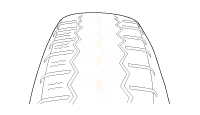
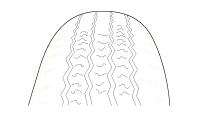
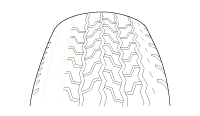
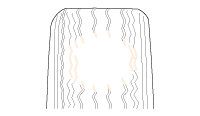
Careful attention must
be paid to the tire and wheels. There are several symptoms that can be
caused by damaged or worn tire and wheels. Perform a careful visual
inspection of the tires and wheel assemblies. Spin the tires slowly and
watch for signs of lateral or radial runout. Refer to the tire wear chart
to determine the tire wear conditions and actions
| WHEEL AND TIRE
DIAGNOSIS | ||||||||||||||||||||||||||
| Rapid wear
at the center |
Rapid wear
at both shoulders |
Wear at one
shoulder | ||||||||||||||||||||||||
|
|
|
| ||||||||||||||||||||||||
|
|
| ||||||||||||||||||||||||
| Partial
wear |
Feathered
edge |
Wear
pattern | ||||||||||||||||||||||||
|
|
|
| ||||||||||||||||||||||||
|
|
| ||||||||||||||||||||||||