|
When disconnecting the vacuum hose, make an
identification mark on it so that it can be reconnected to its
original position. |
| 1. |
Disconnect the vacuum hose from the solenoid
valve. |
| 2. |
Detach the harness
connector. |
| 3. |
Connect a vacuum pump to the nipple which is
connected to intake manifold. |
| 4. |
Apply vacuum and check when voltage is applied
to the PCSV and when the voltage is discontinued.
Battery
voltage
|
Normal
condition
|
When
applied
|
Vacuum
is released
|
When
discontinued
|
Vacuum
is
maintained
|
|
| 5. |
Measure the resistance between the terminals
of the solenoid valve.
PCSV coil resistance(Ω) :
14.0 ~ 18.0Ω at 20°C (68°F) [2.7
V6]
19.0 ~ 22.0Ω at 20°C (68°F) [3.3
V6]
| |
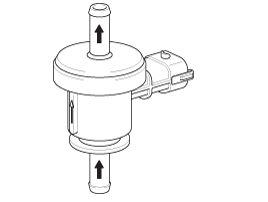
Purge Control Solenoid
Valve (PCSV) is installed on the surge tank and controls the passage
between the canister and the intake manifold. It is a solenoid valve and
is open when the PCM grounds the valve control line. When the passage is
open (PCSV ON), fuel vapors stored in the canister is transferred to the
intake manifold.
SPECIFICATION
Item
|
Specification
|
Coil
Resistance (Ω)
|
14.0 ~ 18.0Ω
at 20°C (68°F)
|
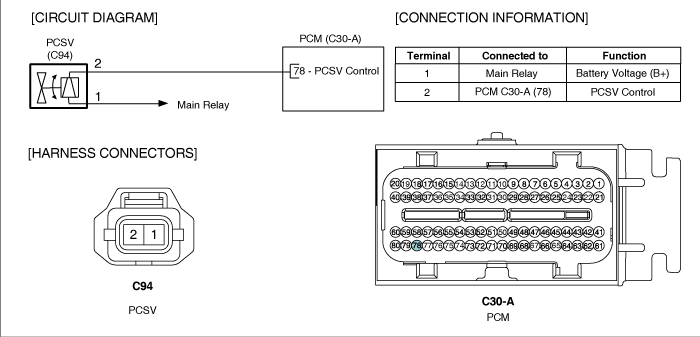
COMPONENT INSPECTION
| 1. |
Turn ignition switch
OFF. |
| 2. |
Disconnect PCSV
connector. |
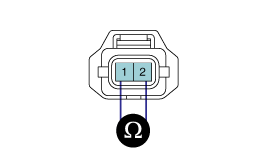
| 3. |
Measure resistance between PCSV terminals 1
and 2.
|
| 4. |
Check that the resistance is within the
specification.
Specification: Refer to
SPECIFICATION.
| |
