Front Impact
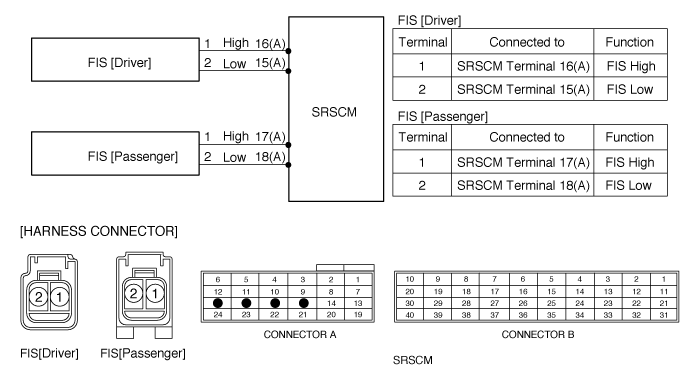
Sensor(FIS)located at both sides of the front of engine room detects
head-on collision. When FIS delivers collision signal to SRSCM, SRSCM
checks if safing sensor located in SRSCM detects collusion. and if both
FIS and safing sensor detects collision simultaneously, SRSCM operates
front air bag.
The SRSCM sets DTC B1334
if there is any error in communication between PFIS and SRSCM
Item
|
Detecting
Condition
|
Possible cause
|
DTC Strategy
|
| •
|
Check current(PWM
type) | |
| •
|
Poor connection of connected
part. |
|
Enable Conditions
|
|
Threshold Value
|
| •
|
SIS/FIS no acceleration data, and line
voltage is ok (between 3V and
11V) | |
Diagnostic
Time
|
Qualification
|
|
De-Qualification
|
|
| 1. |
Ignition "OFF", connect
scantool. |
| 2. |
Ignition "ON"& Engine "OFF", select
"Diagnostic Trouble Codes(DTC)"
mode. |
| 3. |
Monitor diagnostic trouble code and present of
trouble code. |
| 4. |
Using a scan tool, clear the DTC.
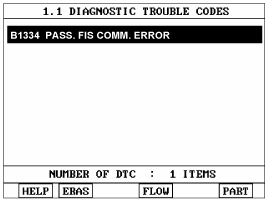
|
- H : Historical fault
- P : Present
fault | |
| 5. |
Is DTC present problem ?
|

|
▶ Go to
"W/Harness Inspection" procedure.
|
|

|
▶
Displaying nothing(no DTC) or DTC with label "H"(historical)
shows that Fault is intermittent caused by poor contact in the
part’s and/or SRSCM connector or was repaired and SRSCM memory
was not cleared.
Thoroughly check
connectors for looseness, poor connection, bending, corrosion,
contamination, deterioration, or damage.
▶ Repair or replace as necessary and then go to
"Verification of Vehicle Repair"
procedure.
|
|
| Terminal and Connector
Inspection |
| 1. |
Many malfunctions in the electrical system are
caused by poor harness and terminals.
Faults can also be caused by interference from
other electrical systems, and mechanical or chemical
damage. |
| 2. |
Thoroughly check shorting connectors for
looseness, poor connection, bending, corrosion, contamination,
deterioration, or damage. |
| 3. |
Has a problem been found?
|
|
▶ Repair as
necessary and then go to "Verification of Vehicle Repair"
procedure.
|
|
|
▶ Go to
"Component Inspection"
procedure.
|
|
| 1. |
Ignition "ON" & Engine "OFF" and Using a
scan tool, clear the DTC. |
| 3. |
Disconnect the battery (-) terminal cable from
the battery, and wait at least one
minutes. |
| 4. |
Disconnect PFIS connector
. |
| 5. |
Substitute the PFIS and check for proper
operation. |
| 6. |
Is DTC present problem ?
|
|
▶
Substitute a known-good SRSCM, and check for proper operation.
If the problem is corrected,
replace SRSCM and then go to "Verification of Vehicle Repair"
procedure.
▶ Substitute the SRSCM
main harness and check for proper operation.
If the problem is corrected, replace SRSCM main
harness and then go to "Verification of Vehicle Repair"
procedure.
|
|
|
▶
Substitute a known-good PFIS, and check for proper operation.
If the problem is corrected,
replace PFIS and then go to "Verification of Vehicle Repair"
procedure.
|
|
| Verification of Vehicle
Repair |
After a repair, it is
essential to verify that the fault has been corrected.
| 1. |
Connect scan tool and select "Diagnostic
Trouble Codes(DTC)" mode. |
| 2. |
Using a scan tool, clear the
DTC. |
| 3. |
Operate the vehicle within DTC Enable
conditions in General information. |
| 4. |
Are any DTC present ?
|
|
▶ Go to the
applicable troubleshooting procedure.
|
|
|
▶ System is
performing to specification at this
time.
|
|
