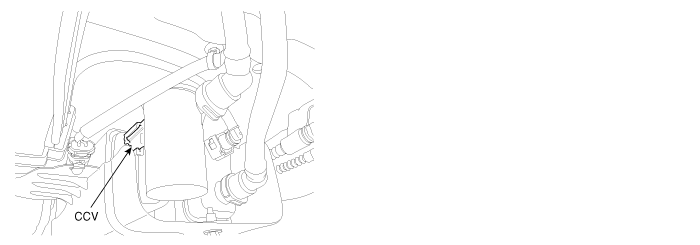
The evaporative
emissions system prevents hydrocarbon (HC) vapors from the fuel tank from
escaping into the atmosphere where they could form photochemical smog.
Gasoline vapors are collected in the charcoal canister. The Canister
Closing Valve (CCV) closes off the air inlet into the canister for leak
detection of the evaporative emission system. The CCV also prevents fuel
vapors from escaping from the canister. When the engine purges the HC
vapors from the canister, the clean air comes into the canister through
the canister air-filter and the CCV.
Checking output signals
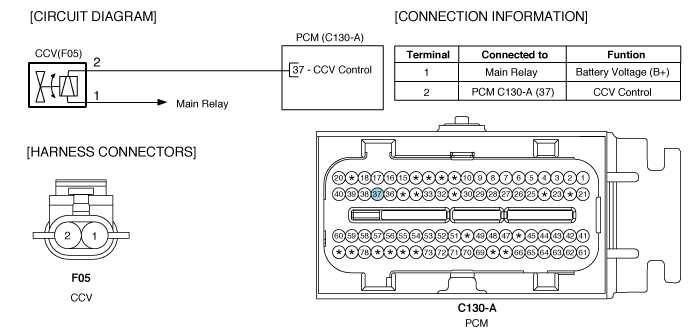
from fuel tank pressure sensor at purging, if fuel tank’s vacuum is higher
than prescribed threshold, PCM sets P2422.
Item
|
Detecting
Condition
|
Possible Cause
|
DTC
Strategy
|
| •
|
Monitor the fuel tank's
vacuum | |
| •
|
Faulty Canister Close
Valve |
| •
|
Clogging of canister air
filter | |
Enable
Conditions
|
| •
|
10 V < Battery voltage < 16
V |
| •
|
Barometric pressure > 72 kPa (0.72
bar) |
| •
|
Engine coolant temperature at startup -
Intake air temperature at startup < 6.7°C(12
°F) |
| •
|
Engine coolant temperature at startup:
4.5 ~ 35°C(40 ~ 95 °F) |
| •
|
Intake air temperature at startup: 4.5 ~
35°C(40 ~ 95 °F) |
|
Threshold
value
|
| •
|
Fuel tank's vacuum at purging > a
prescribed threshold | |
Diagnosis
Time
|
|
MIL On
Condition
|
|
| 1. |
Check DTC Status
| (1) |
Connect scantool to Data Link
Connector(DLC). |
| (3) |
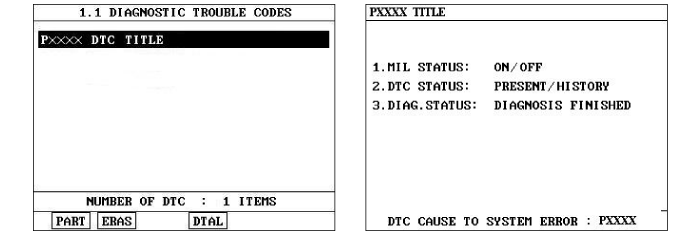
Select "Diagnostic Trouble Codes(DTCs)"
mode, and then Press F4(DTAL) to check DTC's information from
the DTCs menu. |
| (4) |
Read "DTC Status"
parameter.
|
| (5) |
Is parameter displayed "Present
fault"?
|

|
▶ Go
to "Component Inspection" procedure.
|
|

|
▶ Go
to "Evap.Leakage Test" as below with scan
tool.
|
| |
| 2. |
Evap. Leakage Test
| (1) |
Cool the vehicle down for about two
hours to prevent
misdiagnosis. |
| (2) |
Install scan tool and IG "ON" and then
clear DTC. |
| (3) |
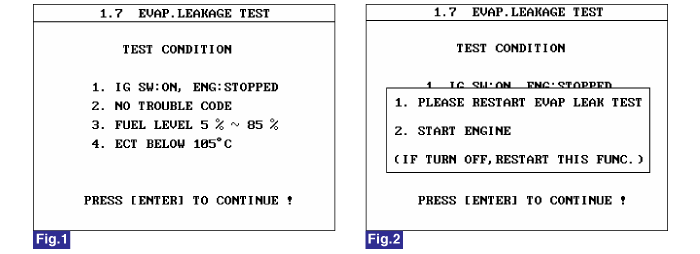
Select and press "EVAP.LEAKAGE TEST"
mode in the scan tool. |
| (4) |
Check if the vehicle is under test
conditions as below [Fig 1]. |
| (5) |
If OK, Start engine and restart
Evap.Leakage Test again[Fig 2].
|
| (6) |
Is the same DTC set after the
Evap.leakage test with scan tool ?
|
|
▶ Go
to "Component Inspection" procedure.
|
|
|
▶
Repeat "Evap.leakage test" with scan tool after cool the
vehicle down sufficiently. If the same DTC isn't
displayed after the test, it was intermittent fault. Go
to "Verification of vehicle Repair"
procedure.
|
| |
| 1. |
Check Canister air filter and CCV
| (1) |
Visually inspect air filter is
clogged. |
| (2) |
Visually inspect duck between air filter
and CCV is clogged. |
| (3) |
Check that Canister is deformed or
clogged by foreign materials. |
| (4) |
Has a problem been found ?
|
|
▶
Repair or replace as necessary and then, go to
"Verification of Vehicle Repair"
procedure.
|
|
|
▶
Carefully perform this troubleshooting procedures all
over again from the
beginning.
|
| |
| Verification of Vehicle
Repair |
| 1. |
Connect scan tool and select "Diagnostic
Trouble Codes(DTCs)" mode |
| 2. |
Press F4(DTAL) and confirm that "DTC Readiness
Flag" indicates "Complete". If not, drive the vehicle within
conditions noted in the freeze frame data or enable
conditions |
| 3. |
Read "DTC Status"
parameter |
| 4. |
Is parameter displayed "History(Not Present)
fault"?
|
|
▶ System
performing to specification at this time. Clear the
DTC
|
|
|
▶ Go to the
applicable troubleshooting
procedure.
|
|