| Wheel Alignment |
When using
commercially available computerized four wheel alignment equipment
(caster, camber, toe) to inspect the front wheel alignment, always
position the car on a level surface with the front wheels facing straight
ahead.Prior to inspection, make sure that the front suspension and
steering system are in normal operating condition and that the wheels and
tires face straight ahead and the tires are inflated to the specified
pressure.
Toe
Toe is a measurement
of how much the front of the wheels are turned in or out from the
straight-ahead position.
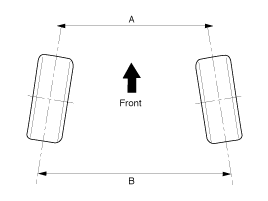
| Item |
Description |
| A-B<0 |
Positive (+) toe (toe in) |
| A-B>0 |
Negative (-) toe (toe
out) |
When the wheels are
turned in toward the front of the vehicle, toe is positive (+) (toe in).
When the wheels are turned out toward the front of the vehicle, toe is
negative (-) (toe out). Toe is measured in degrees, from side to side, and
totaled.
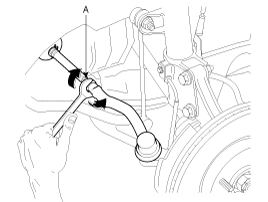
Toe
[Front]
Toe-in (B-A) is
adjusted by turning the tie rod turnbuckles. Toe-in on the left front
wheel can be reduced by turning the tie rod toward the rear of the car.
Toe- in change is adjusted by turning the tie rods for the right and left
heels simultaneously at the same amount as follows.
|
Standard value
:
Toe-in
Total : 0°±0.2°
Individual : 0°±0.1°
|
|

|
Tightening torque
:
Tie rod adjusting nut (A) :
49.0~53.9N.m (5.0~5.5kgf.m,
36.2~39.8lb-ft)
|
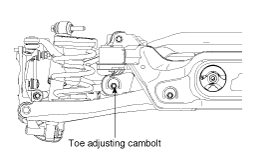
Toe
[Rear]
|
Standard value
:
Toe-in
Total : 0.2°±0.2°
Individual : 0.1°± 0.1°
|
Adjust the toe-in by
turning the cambolt of the rear assist arm.
|
Left cambolt : Clockwise → toe-
out
Right cambolt : Clockwise → toe-
in
The variation of toe by a rotation of the
cambolt :
About 0.4°
|
|

|
Tightening torque
:
137.3~156.9N.m (14~16kgf.m,
101.3~115.7lb-ft)
|
Camber
Camber is the inward
or outward tilting of the wheels at the top.
Camber
[Front]
|
Standard value
:
Camber angle (A) :
-0.5°±0.5°
|
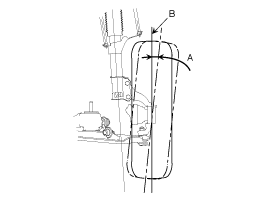
| Item |
Description |
| A |
Positive camber angle |
| B |
True vertical |
When the wheel tilts
out at the top, then the camber is positive (+).
When the wheel tilts
in at the top, then the camber is negative(-).
Camber is pre-set at the factory and doesn't
need to be adjusted. If the camber is not within the standard value,
replace the bent or damaged parts. |
Camber
[Rear]
|
Standard value
:
Camber angle (A) : -1°±0.5°
Difference between right and left angle is
within 0.5°
|
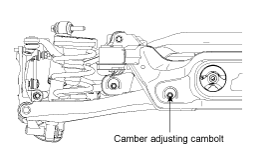
Adjust the camber by
turning the cambolt of the rear lower arm.
|
Left cambolt : Clockwise →
camber(-)
Right cambolt : Clockwise
→camber(+)
The variation of camber by a rotation of the
cambolt : About 0°0.9´
|
After adjusting the
cambolt, tighten the nut to the specified torque.
|
Tightening torque
:
137.3~156.9N.m (14~16kgf.m,
101.3~115.7lb-ft)
|
Caster
[Front]
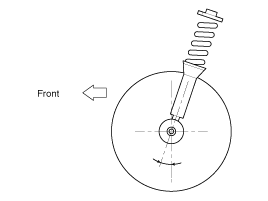
Caster is the tilting
of the strut axis either forward or backward from vertical. A backward
tilt is positive (+) and a forward tilt is negative (-).
Caster is pre-set at
the factory and doesn't need to be adjusted. If the caster is not within
the standard value, replace the bent or damaged parts.
|
Standard value
:
Caster : 4.5°±0.5°
|
|
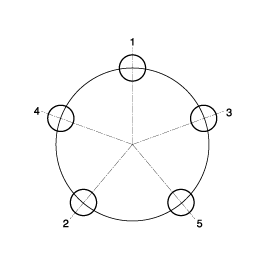
Wheel
Nut Tightening
| 1. |
Tightening torque.
|
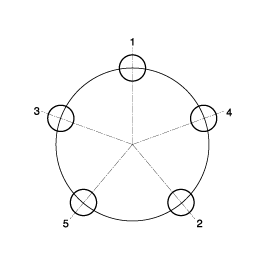
| 2. |
Tightening order.
Check the torque again after tightening the
wheel nuts diagonally.
|
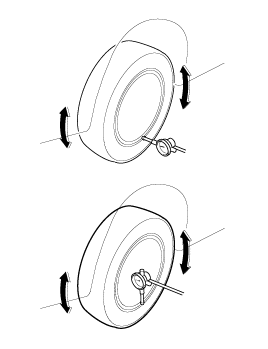
Wheel
Runout
| 1. |
Jack up the vehicle and support it with jack
stands. |
| 2. |
Measure the wheel runout with a dial
indicator as illustrated. |
| 3. |
Replace the wheel if the wheel runout
exceeds the limit.
| |||||||||||