| 1. |
Disconnect the battery negative cable and
wait for at least three minutes before beginning
work. |
| 2. |
Remove the glove box. (Refer to Body group
- crash pad) |
| 3. |
Disconnect the PAB connector and remove the
PAB mounting bolts (2EA).
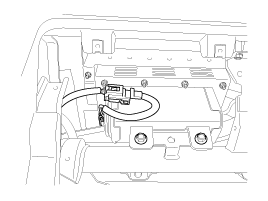
|
| 4. |
Remove the crash pad. (Refer to Body group
- crash pad)
|
If the crash pad is damaged when the
PAB is deployed, replace the damaged crash pad and PAB
together. | |
| 5. |
Remove the heater duct from the crash
pad. |
| 6. |
Remove the mounting nuts(4EA) from the crash
pad. Then remove the passenger airbag.
|
The removed airbag module should be
stored in a clean and dry place with the pad cover face
up. | |
| 1. |
Remove the ignition key from the
vehicle. |
| 2. |
Disconnect the battery negative cable from
battery and wait for at least three minutes before beginning
work. |
| 3. |
Place a Passenger Airbag (PAB) on the crash
pad and tighten the Passenger Airbag (PAB) mounting
nuts.
Tightening
torque
: 0.9 ~ 1.4 kgf.m (8.8 ~ 13.7 N.m, 6.5
~ 10.1 lb.ft)
| |
| 4. |
Install the heater duct to the crash
pad. |
| 5. |
Install the crash pad. (Refer to Body group
- crash pad) |
| 6. |
Tighten the PAB mounting bolt.
Tightening
torque
: 1.9 ~ 2.7 kgf.m (18.6 ~ 26.5 N.m,
13.7 ~ 19.5 lb.ft)
| |
| 7. |
Connect the Passenger Airbag (PAB) harness
connector to the SRS main harness
connector. |
| 8. |
Reinstall the glove box. (Refer to Body
group - crash pad) |
| 9. |
Reconnect the battery negative
cable. |
| 10. |
After installing the Passenger Airbag (PAB),
confirm proper system operation:
| A. |
Turn the ignition switch ON; the SRS
indicator light should be turned on for about six seconds and
then go
off. | | |

