| Schematic Diagram |
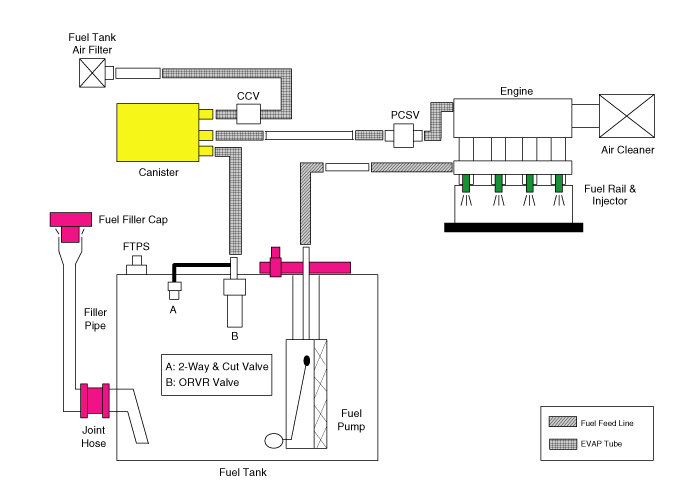
Canister
Canister is filled with
charcoal and absorbs evaporated vapor in fuel tank. The gathered fuel
vapor in canister is drawn into the intake manifold by the ECM/PCM when
appropriate conditions are set.
Purge Control Solenoid Valve (PCSV)
Purge Control Solenoid
Valve (PCSV) is installed in the passage connecting canister and intake
manifold. It is a duty type solenoid valve and is operated by ECM/PCM
signal.
To draw the absorbed
vapor into the intake manifold, the ECM/PCM will open the PCSV, otherwise
the passage remains closed.
Fuel Filler Cap
A ratchet tightening
device on the threaded fuel filler cap reduces the chances of incorrect
installation, seals the fuel filler. After the gasket on the fuel filler
cap and the fill neck flange make contact, the ratchet produces a loud
clicking noise indicating the seal has been set.
Fuel Tank Pressure Sensor (FTPS)
The Fuel Tank Pressure
Sensor (FTPS) is an integral part of the monitoring system. The FTPS
checks Purge Control Solenoid Valve (PCSV) operation and leaks in the
Evaporative Emission Control System by monitoring pressure and vacuum
level in the fuel tank during PCSV operating cycles.
Canister Close Valve (CCV)
The Canister Close Valve
(CCV) is located between the canister and the fuel tank air filter. It
closes off the air inlet to the canister for the Evaporative Emissions
System and also prevents fuel vapors from escaping from the Canister when
the vehicle is not operating.
Evaporative System Monitoring
Evaporative Emission
Control Monitoring System consists of fuel vapor generation, evacuation,
and leakage check step. At first, the OBD-II system checks if vapor
generation due to fuel temperature is small enough to start monitoring.
Then it evacuates the evaporative system by means of PCSV with ramp in
order to maintain a certain vacuum level. The final step is to check if
there is vacuum loss by any leakage of the system.
Vapor Generation Checking
During stabilization
period, the PCSV and the CCV are closed. The system pressure is measured
as starting pressure (DP_A). After a certain defined period (T1), the
system pressure (DP_B) is measured again and the difference from the
starting pressure is calculated. If this difference (DP_B - DP_A) is
bigger than a threshold, there should be excessive vapor and the monitor
is aborted for next checking. On the contrary, if the difference is lower
than another negative threshold, PCSV is regarded as malfunction such as
clogged at open position.
Evacuation
PCSV is opened with a
certain ramp for the pressure to reach down to a certain level. If
pressure can’t be lowered below a threshold, the system is regarded as
fuel cap-opened or having a large leakage.
Leaking Checking
PCSV is closed and the
system waits for a period to get stabilized pressure. During checking
period (T2), the system measures the beginning and the end of the system
pressure (DP_C, DP_D). The diagnosis value is the pressure difference
corrected by natural vapor generation (DP_B - DP_A) rate from the vapor
generation checking step.