| INSPECTION PROCEDURES FOR DIAGNOSTIC
TROUBLE CODES |
|
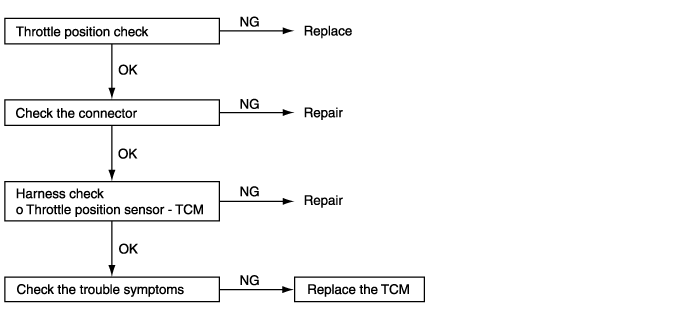
Code No. P1704,
P1703, P1702 throttle position sensor system |
Probable
cause |
|
If the TPS output voltage is 4.8 V or higher
when the engine is idling, the output is judged to be too high and
diagnostic trouble code No.P1704 is set. If the TPS output voltage
is 0.2 V or lower at times other than when the engine is idling, the
output is judged to be too low and diagnostic trouble code No.P1703
is set. If the TPS output voltage is 0.2 V or lower or if it is 1.2
V or higher when the engine is idling, the TPS adjustment is judged
to be incorrect and diagnostic trouble code No.P1702is
set. |
| •
|
Malfunction of the throttle position
sensor |
| •
|
Malfunction of
connector |
|
|
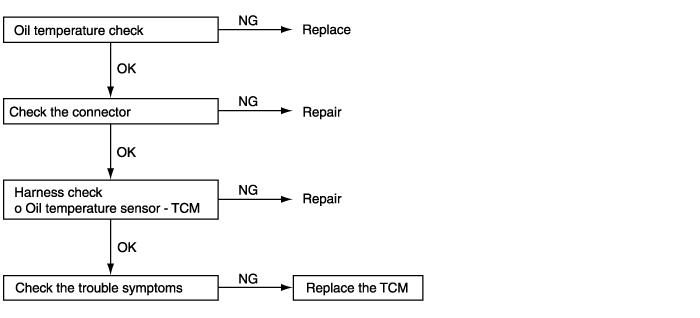
Code No. P0713,
P0712, Oil temperature sensor system |
Probable
cause |
|
If the oil temperature sensor output voltage
is 2.6 V or more even after driving for 10 minutes or more (If the
oil temperature does not increase), it is judged that there is an
open circuit in the oil temperature sensor and diagnostic trouble
code No.P0713, P0712 are set. If the oil temperature sensor output
detects the voltage which corresponds to 200°C(392°F) or more for
more than one second, it is judged that there is an open circuit in
oil temperature sensor and diagnostic troublecode No. P0713, P0712
are set. |
| •
|
Malfunction of the oil temperature
sensor |
| •
|
Malfunction of
connector |
|
|
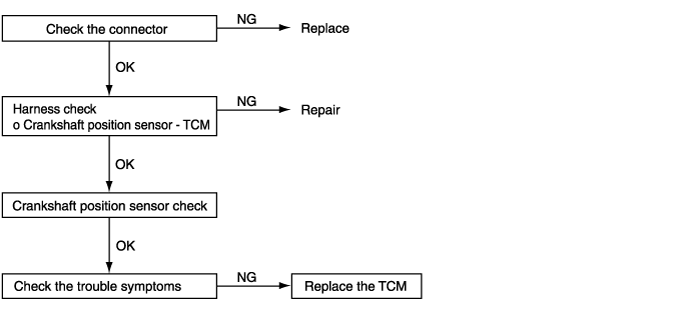
Code No. P0725
Crankshaft position sensor system |
Probable
cause |
|
If no output pulse is detected from the
crankshaft position sensor for 5 seconds or more while driving
output shaft speed at 1000 rpm, it is judged that there is an open
or short circuit in the engine rpm signal line and diagnostic
trouble code P0725 is output.
Damper clutch is disengaged and engine rpm is
regarded as 3000 rpm. |
| •
|
Malfunction of
connector |
| •
|
No engine rpm signal from
ECM | |
|
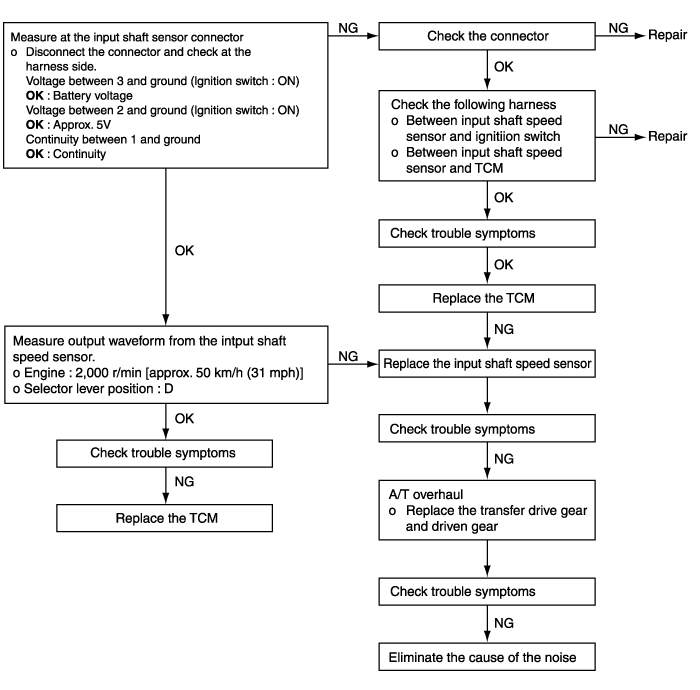
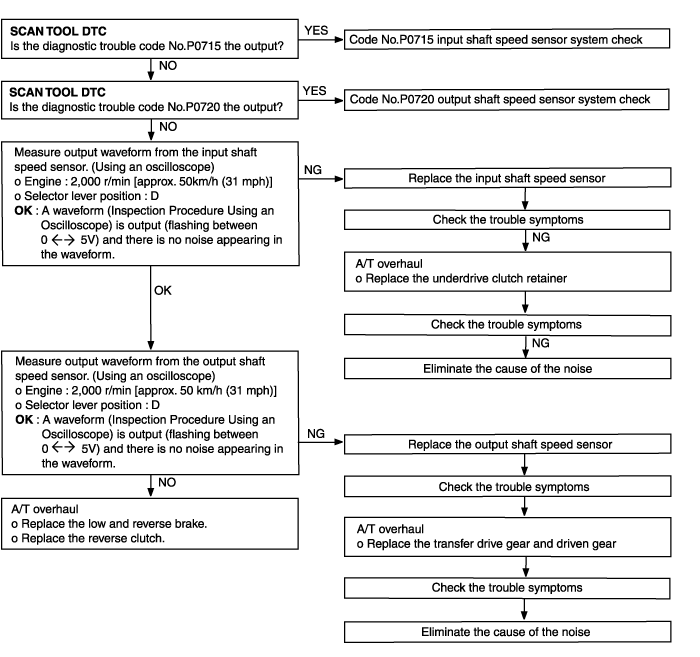
Code No. P0715 Input
shaft speed sensor system |
Probable
cause |
|
If no output pulse is detected from the input
shaft speed sensor for 1 seconds or more while driving in 3rd or 4th
gear at a speed of 30 km/h (19 mph) or more, it is judged to be an
open circuit or short circuit in the input shaft speed sensor and
diagnostic trouble code No.P0715 is set. If diagnostic trouble code
P0715 is set four times, the transaxle is locked into 3rd gear or
2nd gear as a fail-safe measure. |
| •
|
Malfunction of the input shaft speed
sensor |
| •
|
Malfunction of underdrive clutch
retainer |
| •
|
Malfunction of
connector |
|
|
Code No. P0720
Output shaft sensor system |
Probable
cause |
|
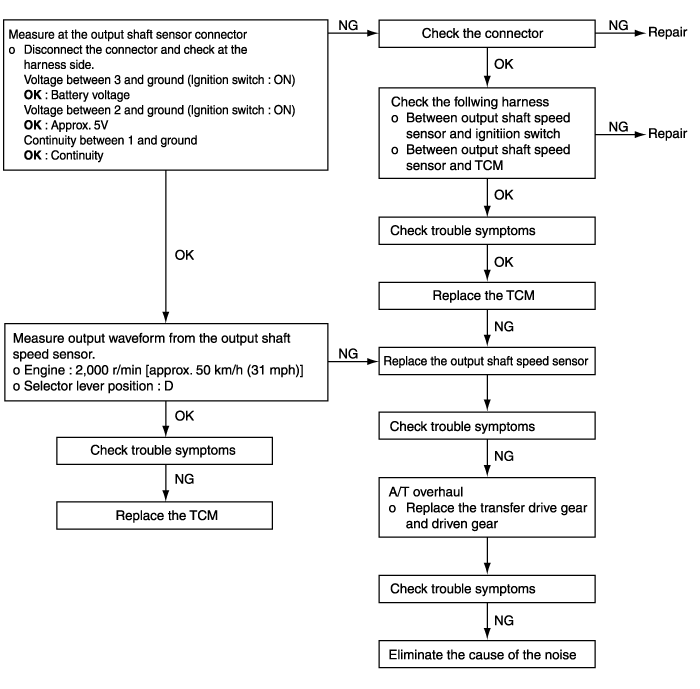
If the output from the output shaft speed
sensor is continuously 50% lower than the vehicle speed for 1 second
or more, it is judged to be an open circuit or short circuit in the
outputshaft speed sensor and diagnostic trouble code No.P0720 is
set. |
| •
|
Malfunction of the throttle position
sensor |
| •
|
Malfunction of
connector |
|
|
Code No.P0703 Stop
light switch system |
Probable
cause |
|
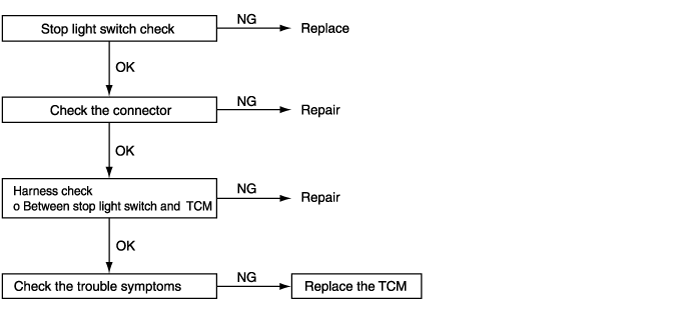
If the stop light switch is on for 5 minutes
or more while driving, it is judged that there is a short circuitin
the stop light switch and diagnostic trouble code P0703 is
set. |
| •
|
Malfunction of the stop light
switch |
| •
|
Malfunction of
connector |
|
|
Code No.P0750 Low
and reverse solenoid valve system |
Probable
cause |
|
Code No.P0755
Underdrive solenoid valve system |
|
Code No.P0760 Second
solenoid valve system |
|
Code No.P0765
Overdrive solenoid valve system |
|
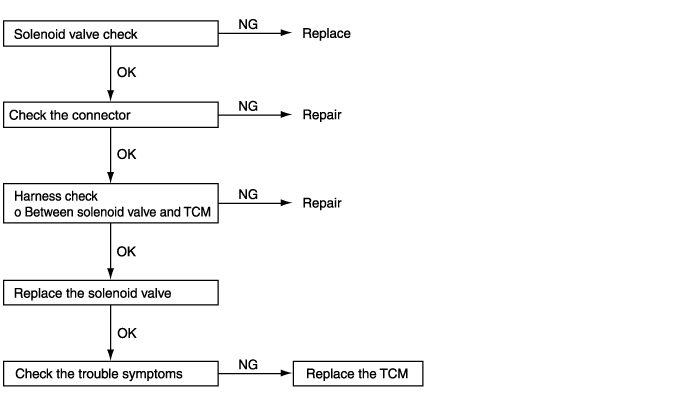
If the resistance value for a solenoid valve
is too large or too small, it is judged that there is a short
circuit or an open circuit in the solenoid valve and the respective
diagnostic trouble code is set. The transaxle is locked into 3rd
gear as a fail-safe measure. |
| •
|
Malfunction of the solenoid
valve |
| •
|
Malfunction of
connector |
|
|
Code No.P0743 /P0740
Torque converter clutch solenoid system |
Probable
cause |
|
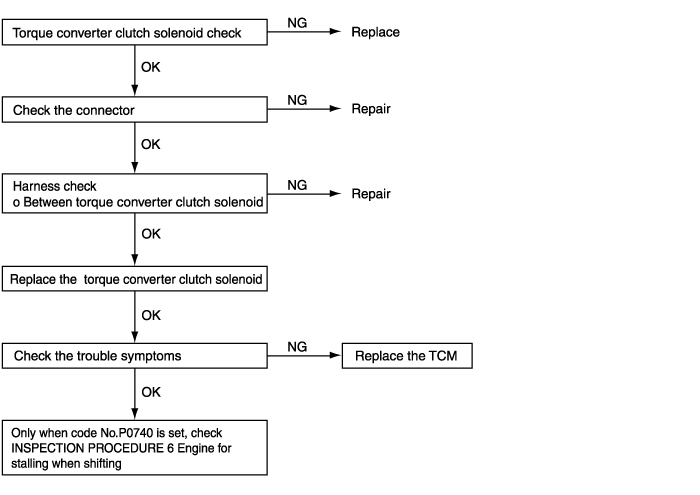
If the resistance value for the torque
converter clutch solenoid is too large or too small, it is judged
that there is a short-circuit or an open circuit in the torque
converter clutch solenoid and diagnostic trouble code No.P0743 is
set. If the drive duty rate for the torque converter clutch solenoid
is 100% for a continuous period of 4 seconds or more, it is judged
that there is an abnormality in the torque converter clutch system
and diagnostic trouble code No.P0740 is set. When diagnostic trouble
code No.P0743 is set, the transaxle is locked into 3rd gear as a
fail-safemeasure.
If the lock-up clutch remains engaged for a
continuous period of 10 seconds when the TCM is attempting to
disengage the lock-up clutch, it is judged that the torque converter
clutch is stuck on and diagnostic troublecode P0740 is
set. |
| •
|
Malfunction of the torque converter
clutch solenoid |
| •
|
Malfunction of
connector |
|
|
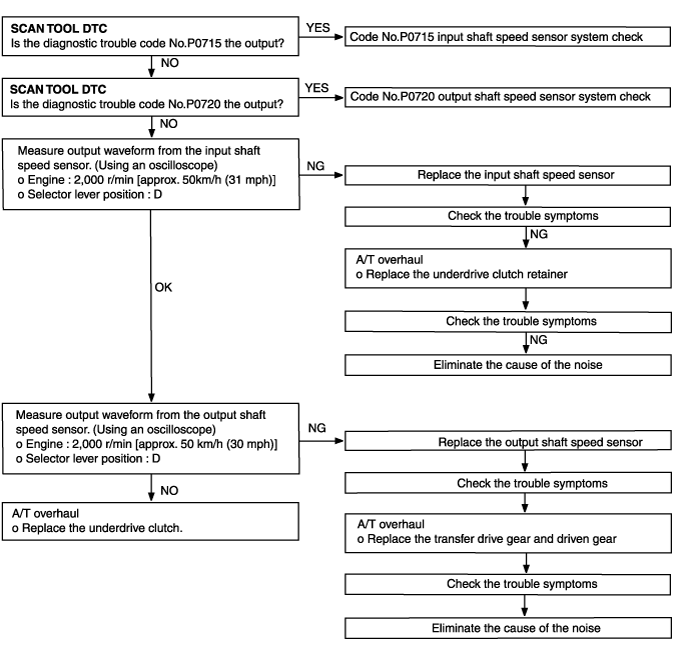
Code No.P0731 1st
gear incorrect ratio |
Probable
cause |
|
If the output from the output shaft speed
sensor multiplied by the 1st gear ratio is not the same as the
output from the input shaft speed sensor after the shifting to 1st
gear has been completed, diagnostic trouble code No.P0731 is set
four times, and the transaxleis locked into 3rd gear as a fail-safe
measure. |
| •
|
Malfunction of the input shaft speed
sensor |
| •
|
Malfunction of the output shaft speed
sensor |
| •
|
Malfunction of the underdrive clutch
retainer |
| •
|
Malfunction of the transfer drive gear
or driven gear |
| •
|
Malfunction of the second brake
system |
| •
|
Malfunction of the underdrive clutch
system |
|
|
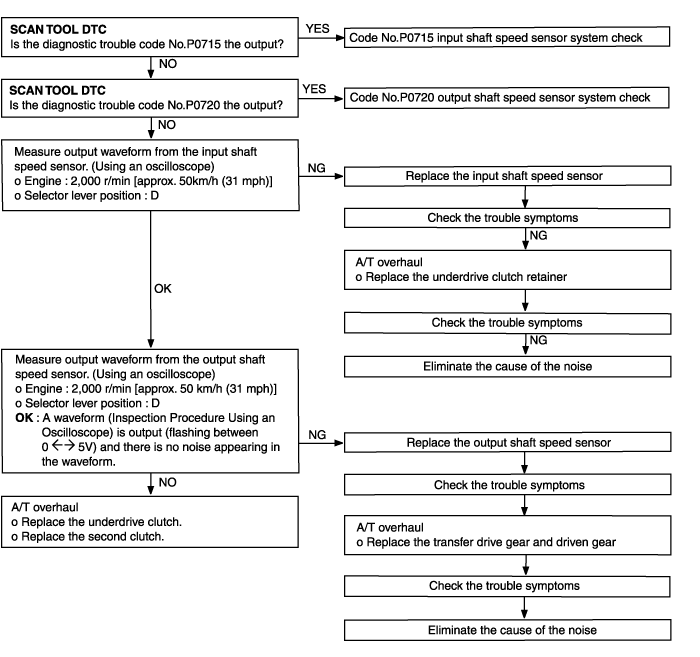
Code No.P0732 2nd
gear incorrect ratio |
Probable
cause |
|
If the output from the output shaft speed
sensor multiplied by the 2nd gear ratio is not the same as the
output from the input shaft speed sensor after the shifting to 2nd
gear has been completed, diagnostic trouble code No.P0732 is set. If
diagnostic trouble code No.P0732 is set four times, the transaxle is
locked into 3rd gear asa fail-safe measure. |
| •
|
Malfunction of the input shaft speed
sensor |
| •
|
Malfunction of the output shaft speed
sensor |
| •
|
Malfunction of the underdrive clutch
retainer |
| •
|
Malfunction of the transfer drive gear
or driven gear |
| •
|
Malfunction of the second brake
system |
| •
|
Malfunction of the underdrive clutch
system |
|
|
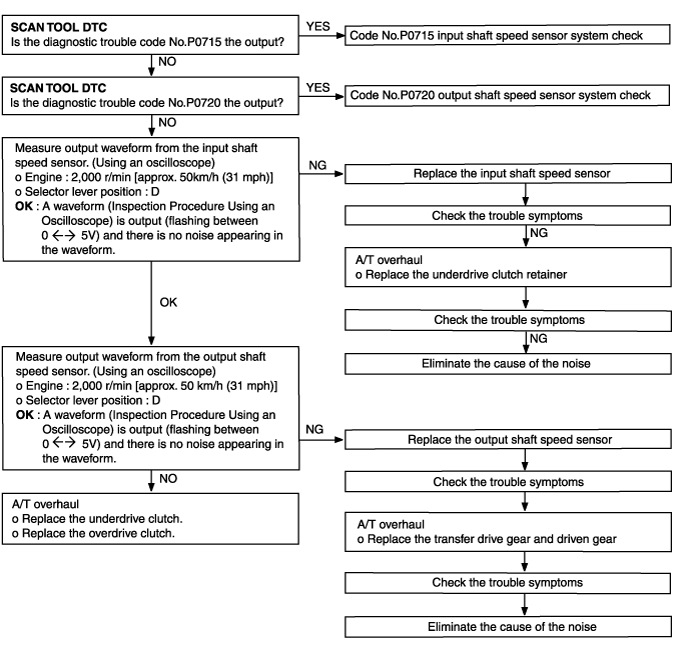
Code No.P0733 3rd
gear incorrect ratio |
Probable
cause |
|
If the output from the output shaft speed
sensor multiplied by the 3rd gear ratio is not the same as the
output from the input shaft speed sensor after the shifting to 3rd
gear has been completed, diagnostic trouble code No.P0733 is set. If
diagnostic trouble code No.P0733 is set four times, the transaxle is
locked into 3rd gear asa fail-safe measure. |
| •
|
Malfunction of the input shaft speed
sensor |
| •
|
Malfunction of the output shaft speed
sensor |
| •
|
Malfunction of the underdrive clutch
retainer |
| •
|
Malfunction of the transfer drive gear
or driven gear |
| •
|
Malfunction of the low and reverse brake
system |
| •
|
Malfunction of the underdrive clutch
system |
|
|
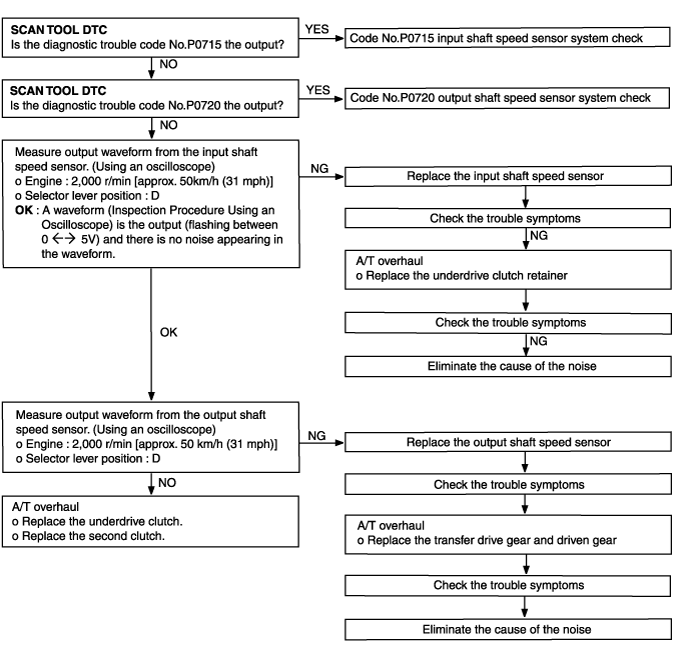
Code No.P0734 4th
gear incorrect ratio |
Probable
cause |
|
If the output from the output shaft speed
sensor multiplied by the 4th gear ratio is not the same as the
output from the input shaft speed sensor after the shifting to 4th
gear has been completed, diagnostic trouble code No.P0734 is set. If
diagnostic trouble code No.P0734 is set four times, the transaxle is
locked into 3rd gear asa fail-safe measure. |
| •
|
Malfunction of the input shaft speed
sensor |
| •
|
Malfunction of the output shaft speed
sensor |
| •
|
Malfunction of the underdrive clutch
retainer |
| •
|
Malfunction of the transfer drive gear
or driven gear |
| •
|
Malfunction of the low and reverse brake
system |
| •
|
Malfunction of the underdrive clutch
systme |
|
|
Code No.P0736
reverse gear incorrect ratio |
Probable
cause |
|
If the output from the output shaft speed
sensor multiplied by the reverse gear ratio is not the same as the
output from the input shaft speed sensor after the shifting to
reverse gear has been completed, diagnostic trouble code No.P0736 is
set. If diagnostic trouble code No.P0736 is set four times, the
transaxle is locked into 3rd gear asa fail-safe
measure |
| •
|
Malfunction of the input shaft speed
sensor |
| •
|
Malfunction of the output shaft speed
sensor |
| •
|
Malfunction of the underdrive clutch
retainer |
| •
|
Malfunction of the transfer drive gear
or driven gear |
| •
|
Malfunction of the low and reverse brake
system |
| •
|
Malfunction of the underdrive clutch
systme |
|
|
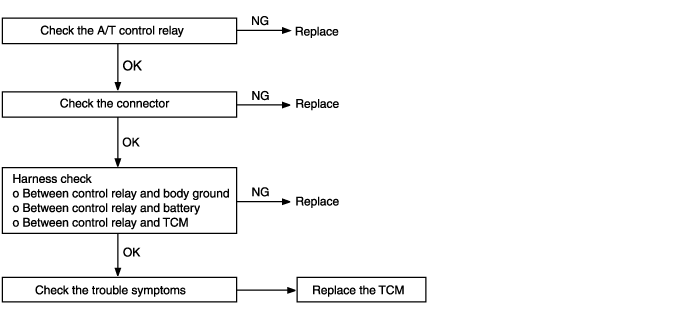
Code No.P1723 A/T
Control relay system |
Probable
cause |
|
If the relay voltage is less than 7 V after
the ignition switch has been turned to ON, it is judged that there
is an open circuit or a short circuit in the A/T control relay
ground and diagnostic trouble code P1723 is set. The transaxle is
locked into 3rd gearas a fail-safe measure. |
| •
|
Malfunction of the A/T control
relay |
| •
|
Malfunction of
connector |
|
| INSPECTION PROCEDURE FOR TROUBLE
SYMPTOMS |
INSPECTION PROCEDURE 1
|
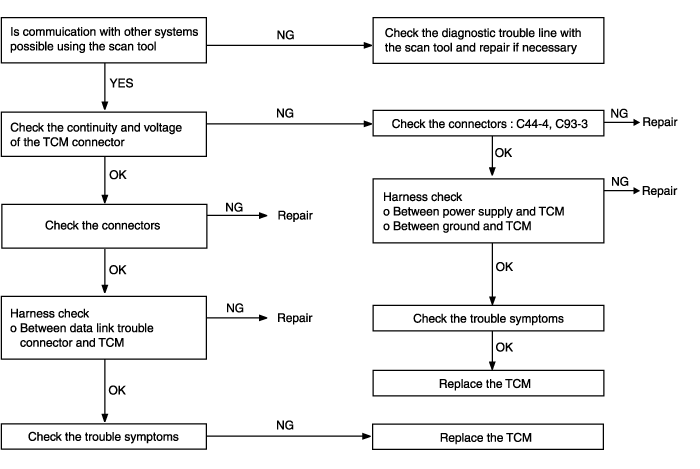
Communication with
the scan tool |
Probable
cause |
|
If communication with a known good scan tool
is not possible, the cause is probably a defective diagnostic
trouble line or the TCM is not functioning. |
| •
|
Malfunction of diagnostic trouble
line |
| •
|
Malfunction of
connector |
|
INSPECTION PROCEDURE 2
|
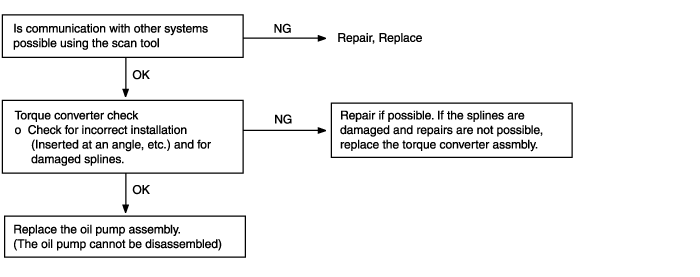
Starting
impossible |
Probable
cause |
|
Starting is not possible when the selector
lever is in P or N range. In such cases, the cause is possibly a
defective engine system, torque converter or oil
pump. |
| •
|
Malfunction of the engine
system |
| •
|
Malfunction of the torque
converter |
| •
|
Malfunction of the oil
pump | |
INSPECTION PROCEDURE 3
|
Does not
move |
Probable
cause |
|
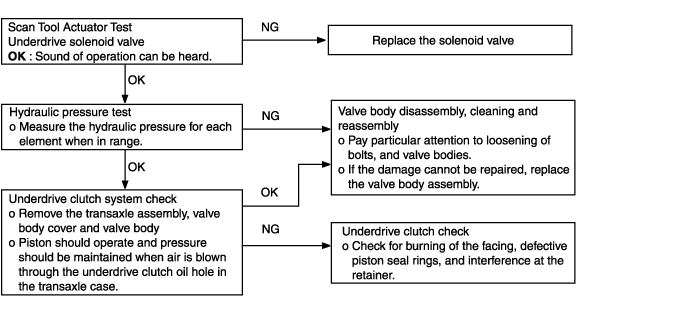
If the vehicle does not move forward when the
selector lever is shifted from N to D range while the engine is
idling, the cause is probably abnormal line pressure or a
malfunction of the underdrive clutch or valve body. |
| •
|
Malfunction of the underdrive solenoid
valve |
| •
|
Malfunction of the underdrive
clutch |
| •
|
Malfunction of the valve
body | |
INSPECTION PROCEDURE 4
|
Does not
reverse |
Probable
cause |
|
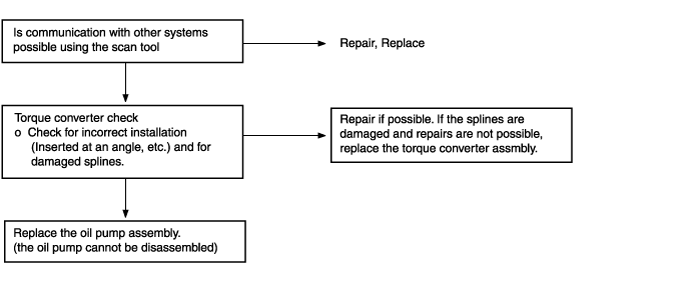
If the vehicle does not reverse when the
selector lever is shifted from N to R range while the engine is
idling, the cause is probably abnormal pressure in the reverse
clutch or low and reverse brake or a malfunction of the reverse
clutch, low and reverse brake or valve body. |
| •
|
Abnormal reverse clutch
pressure |
| •
|
Abnormal low and reverse brake
pressure |
| •
|
Malfunction of the low and reverse
solenoid valve |
| •
|
Malfunction of the reverse
clutch |
| •
|
Malfunction of the low and reverse
brake |
| •
|
Malfunction of the valve
body | |
INSPECTION PROCEDURE 5
|
Does not move
(forward or reverse) |
Probable
cause |
|
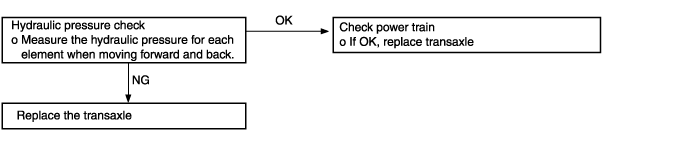
If the vehicle does not move forward or
reverse when the selector lever is shifted to any position while the
engine is idling, the cause is probably abnormal line pressure, or a
malfunction of the power train, oil pump or valve
body. |
| •
|
Abonormal line
pressure |
| •
|
Malfunction of the underdrive solenoid
valve |
| •
|
Malfunction of the underdrive
clutch |
| •
|
Malfunction of the valve
body | |
INSPECTION PROCEDURE 6
|
Engine stalling when
shifting |
Probable
cause |
|
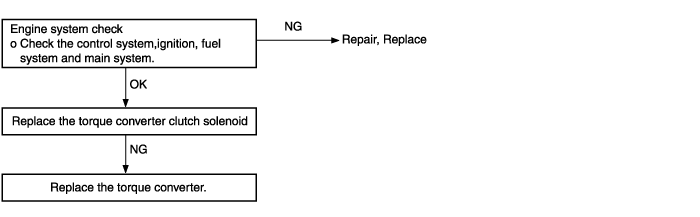
If the engine stalls when the selector lever
is shifted from N to D or R range while the engine is idling, the
cause is possibly a malfunction of the engine system, torque
converter clutch solenoid, valve body or torque converter (torque
converter clutch malfunction). |
| •
|
Malfunction of the engine
system |
| •
|
Malfunction of the torque converter
clutch solenoid |
| •
|
Malfunction of the valve
body |
| •
|
Malfunction of the torque converter
(Malfunction of the torque converter
clutch) | |
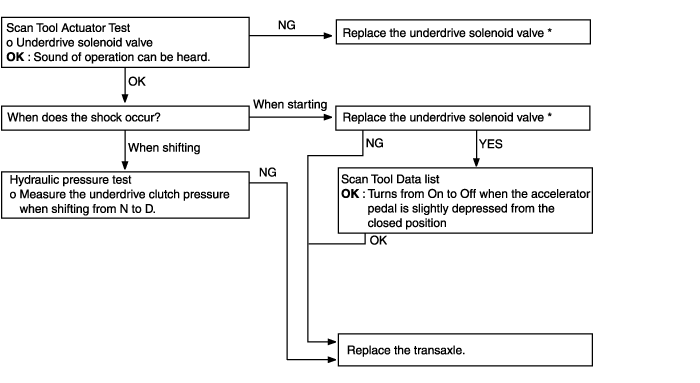
INSPECTION PROCEDURE 7
|
Shocks when changing
from N to D range and time lag |
Probable
cause |
|
If abnormal shocks or a time lag of 2 second
or more occur when the selector lever is shifted from N to D range
while the engine is idling, the cause is probably abnormal
underdrive clutch pressure or a malfunction of the underdrive
clutch, valve body. |
| •
|
Malfunction of the underdrive solenoid
valve |
| •
|
Malfunction of the underdrive
clutch |
| •
|
Malfunction of the valve
body | |
INSPECTION PROCEDURE 8
|
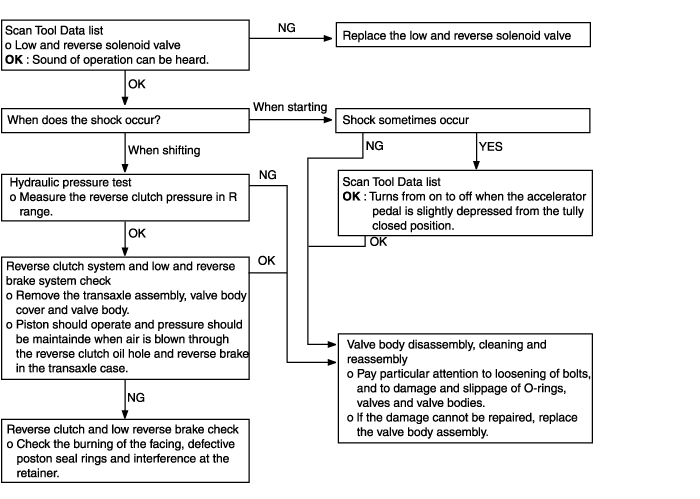
Shock when changing
from N to R and large time lag |
Probable
cause |
|
If abnormal shocks or a time lag of 2 seconds
or more occurs when the selector lever is shifted from N to R range
while the engine is idling, the cause is probably abnormal reverse
clutch pressure or low and reverse brake pressure, or a malfunction
or the reverse clutch, low and reverse brake. |
| •
|
Abnormal reverse clutch
pressure |
| •
|
Abnormal low and reverse brake
pressure |
| •
|
Malfunction of the low and reverse
solenoid valve |
| •
|
Malfunction of the reverse
clutch |
| •
|
Malfunction of the low and reverse
brake |
| •
|
Malfunction of the valve
body | |
INSPECTION PROCEDURE 9
|
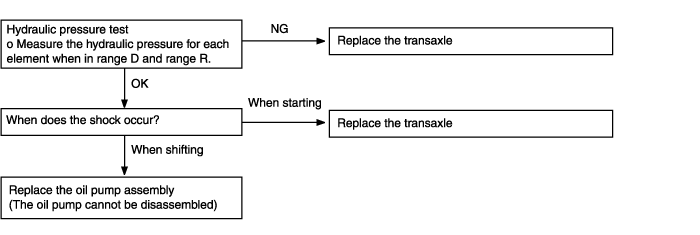
Shocks when changing
from N to R, N to D and large time lag |
Probable
cause |
|
If abnormal shocks or a time lag of 2seconds
or more occurs when the selector lever is shifted from N to R range
while the engine is idling, the cause is probably abnormal line
pressure or a malfunction of the oil pump or valve
body. |
| •
|
Malfunction of the oil
pump |
| •
|
Malfunction of the valve
body | |
INSPECTION PROCEDURE 10
|
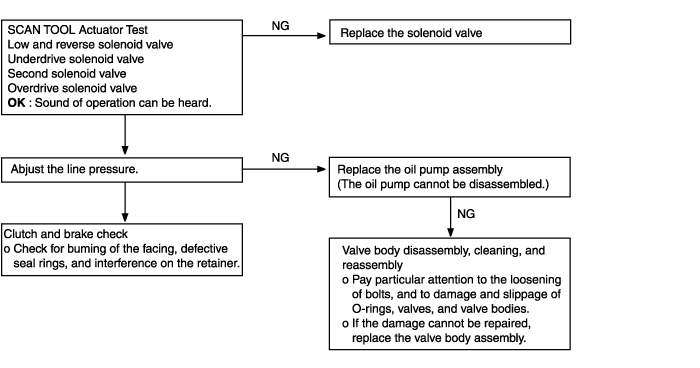
Shocks and running
up |
Probable
cause |
|
If shocks occur when driving due to upshifting
or downshifting and the transaxle speed becomes higher than the
engine speed, the cause is probably abnormal line pressure or a
malfunction of a solenoid valve, oil pump, valve body, brake or
clutch. |
| •
|
Malfunction of each solenoid
valve |
| •
|
Malfunction of the oil
pump |
| •
|
Malfunction of the valve
body |
| •
|
Malfunction of brake or
clutch | |
INSPECTION PROCEDURE 11
|
All points
(Displaced shifting points) |
Probable
cause |
|
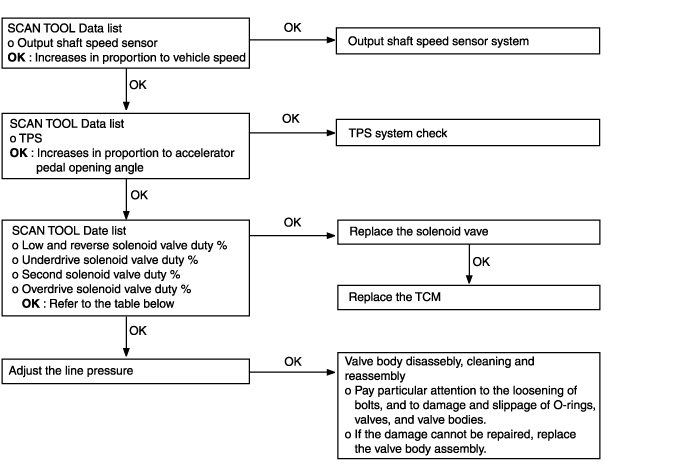
If all shift points are displaced while
driving, the cause is probably a malfunction of the output shaft
speed sensor, TPS or a solenoid valve. |
| •
|
Malfunction of the output shaft speed
sensor |
| •
|
Malfunction of the throttle position
sensor |
| •
|
Malfunction of each solenoid
valve |
| •
|
Malfunction of the valve
body |
|
INSPECTION PROCEDURE 12
|
Some points
(Displaced shifting points) |
Probable
cause |
|
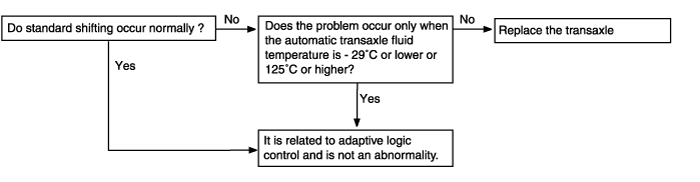
If some of the shift points are displaced
while driving, the cause is probably a malfunction of the valve
body, or it is related to control and is not an
abnormality. |
| •
|
Malfunction of the valve
body | |
INSPECTION PROCEDURE 13
|
No diagnostic
trouble codes (Does not shift) |
Probable
cause |
|
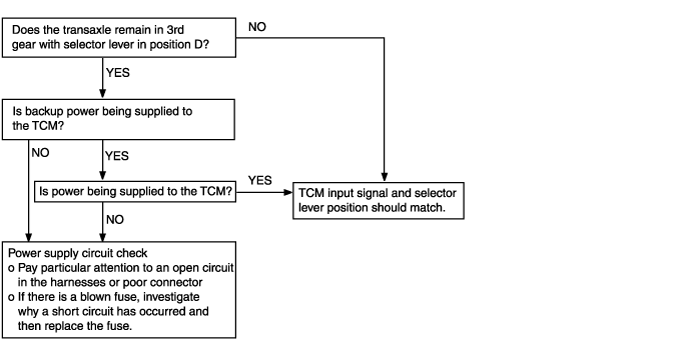
If shifting does not occur while driving and
no diagnostic trouble codes are output, the cause is probably a
malfunction of the Park/Neutral position switch, or
TCM. |
| •
|
Malfunction of the Park/Neutral position
switch |
|
INSPECTION PROCEDURE 14
|
Poor
acceleration |
Probable
cause |
|
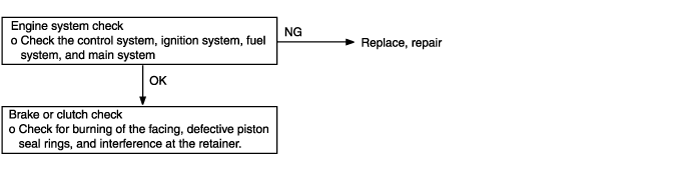
If acceleration is poor even if downshifting
occurs while driving, the cause is probably a malfunction of the
engine system, brake or clutch. |
| •
|
Malfunction of the engine
system |
| •
|
Malfunction of brake or
clutch | |
INSPECTION PROCEDURE 15
|
Vibration |
Probable
cause |
|
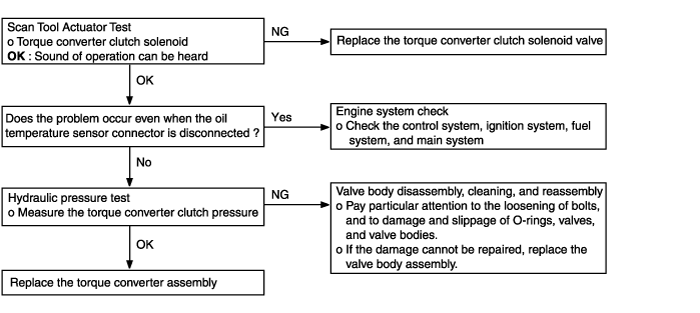
If vibration occurs when driving at constant
speed or when accelerating in top range, the cause is probably
abnormal torque converter clutch pressure or a malfunction of the
engine system, torque converter clutch solenoid, torque converter or
valve body. |
| •
|
Abnormal torque converter clutch
pressure |
| •
|
Malfunction of the engine
system |
| •
|
Malfunction of the torque converter
clutch solenoid |
| •
|
Malfunction of the torque
converter |
| •
|
Malfunction of the valve
body | |
|