|
DTC |
B1352 PAB resistance too high (R ≥ 4.2
Ω)
B1353 PAB resistance too low (R ≤ 1.0
Ω) |
CIRCUIT
DESCRIPTION
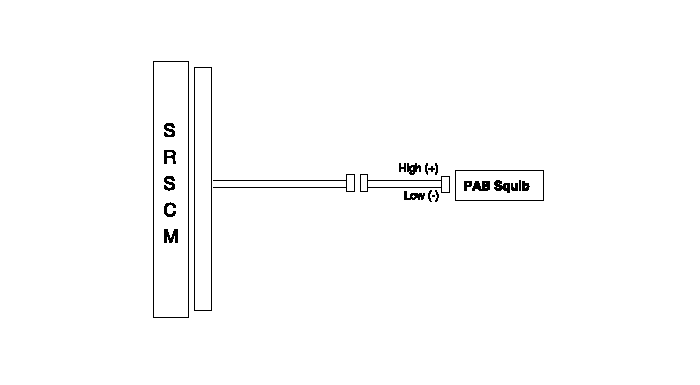
The PAB squib
circuit consists of the SRSCM and PAB. It causes the airbag to deploy when
the airbag deployment conditions are satisfied. The above DTCs are
recorded when the PAB resistance is too high or low.
|
DTC Detecting
Condition |
Trouble
Area |
| •
|
Too high or low resistance between PAB
high (+) wiring harness and the PAB low (-) wiring harness of
squib. |
|
|
WIRING DIAGRAM
INSPECTION PROCEDURE
| 1. |
Preparation
|
(1) |
Disconnect negative (-) terminal cable
from the battery, and wait at least 30
seconds. |
|
(2) |
Remove the DAB
module. |
|
(3) |
Disconnect the connectors of the PAB,
left and right side airbag,belt pretensioner and satellite
sensor. |
|
(4) |
Disconnect the connector of the
SRSCM.
|
Place the DAB with the front
surface facing
upward. | | |
| 2. |
Check the PAB resistance.
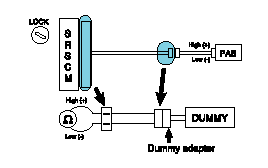
[PREPARATION]
Release the on the SRSCM side of the airbag
squib side. Connect the dummy (0957A-38200) and dummy adapter
(0957A-38300) to the PAB connector of the SRSCM connector
side.
|
Before checking the resistance, you must
insert the shorting bar into the SRSCM connector.
|
[CHECK]
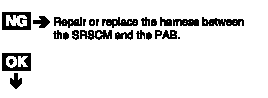
Measure the resistance between the PAB high
(+) and PAB low (-) circuits.
1.8 Ω ≤ R ≤ 2.8
Ω
|
| 3. |
Check the PAB squib.
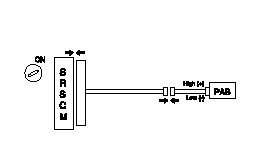
[PREPARATION]
| A. |
Turn the ignition switch to
LOCK. |
| B. |
Disconnect the negative (-) terminal
cable from the battery, and wait for 30
seconds. |
| C. |
Connect the PAB
connector. |
| D. |
Connect the negative (-) terminal cable
to the battery, and wait for 30 seconds.
|
[CHECK]
| A. |
Turn the ignition switch to ON, and wait
for at least 30 seconds. |
| B. |
Clear the malfunction code stored in the
memory of the Hi-Scan Pro. |
| C. |
Turn the ignition switch to LOCK, and
wait for 30 seconds. |
| D. |
Turn the ignition switch to ON, and wait
for 30 seconds. |
| E. |
Using the Hi-Scan Pro, check for
DTCs.
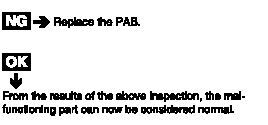
There is no
DTC. |
[HINT]
Codes other than these may be output at this
time, but they are not relevant to this procedure.
|
