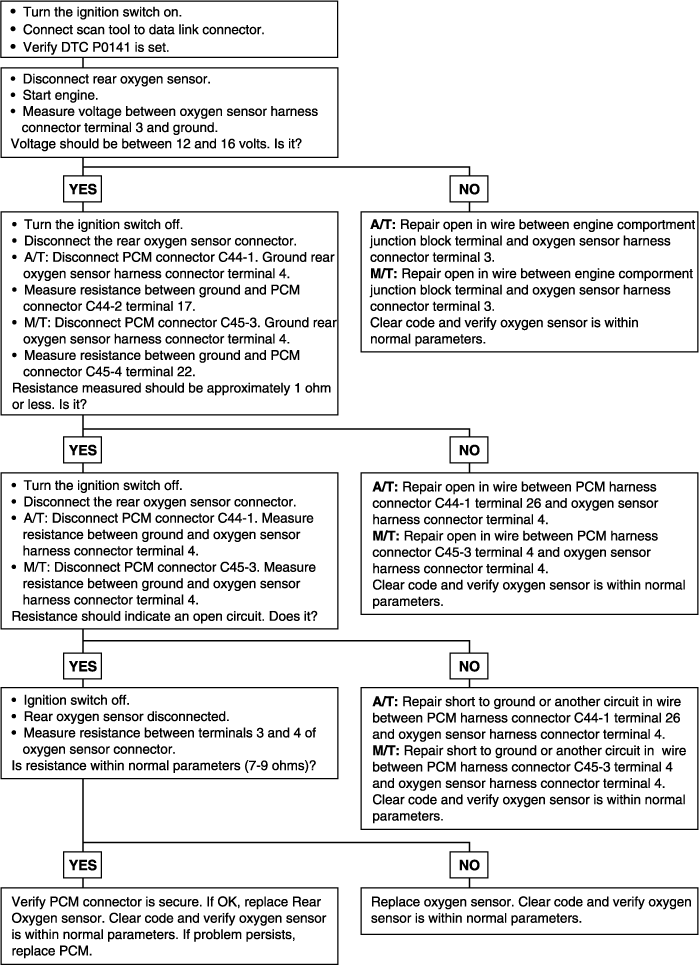
| p |
|
DTC |
Diagnostic
item |
|
P0141
P0161 |
Oxygen Sensor Heater Circuit Malfunction (Bank
1, Sensor 2)
Oxygen Sensor Heater Circuit Malfunction (Bank
2, Sensor 2) |
DESCRIPTION
To obtain a
high purification rate for the CO, HC and NOx components of theexhaust
gas, a three way catalytic converter is used, but for the most
efficientuse of the three-way catalytic inverter, the ratio of the air
must be preciselycontrolled so that it is always close to the
stoichiometric air-fuel ratio.The oxygen sensor has the characteristic
whereby its output voltage changessuddenly in the vicinity of the
stoichiometric air-fuel ratio. This characteristicis used to detect the
oxygen concentration in the exhaust gas and providefeedback to the
computer for control of the air-fuel ratio. When the air-fuelratio becomes
LEAN, the oxygen concentration in the exhaust increases andthe oxygen
sensor informs the PCM of the LEAN condition. When the air-fuelratio is
RICHER than the stoichiometric air-fuel ratio the oxygen concentrationin
the exhaust gas is reduced and the oxygen sensor informs the PCM of
theRICH condition. The PCM uses the voltage from the oxygen sensor whether
the air-fuel ratiois RICH or LEAN and controls the injection time
accordingly. However, if amalfunctioning oxygen sensor causes an abnormal
output voltage, the PCM isunable to perform an accurate air-fuel ratio
control. The heated oxygen sensorsinclude a heater which heats the sensing
element. The heater is controlledby the PCM. When the intake air volume is
low (the temperature of the exhaustgas is low), current flows to the
heater to heat the sensor for accurate oxygenconcentration
detection.
TROUBLESHOOTING GUIDE
|
DTC detection
condition |
Probable
cause |
|
Background
The Powertrain Control Module checks whether
the heater current is withina specified range when the heater is
energized.
Check Area
Battery voltage is between 12 and
16V.
Judgment Criteria
The front oxygen sensor heater (Bank 1 Sensor
1 and Bank 2 Sensor 1) has continuedto be 0.2 A or less, or 3.5 A or
higher for 6 sec.
Monitored only once per trip. |
Open or shorted oxygen sensor heater
circuit
Open circuit in oxygen sensor
heater
Powertrain control module
failed |
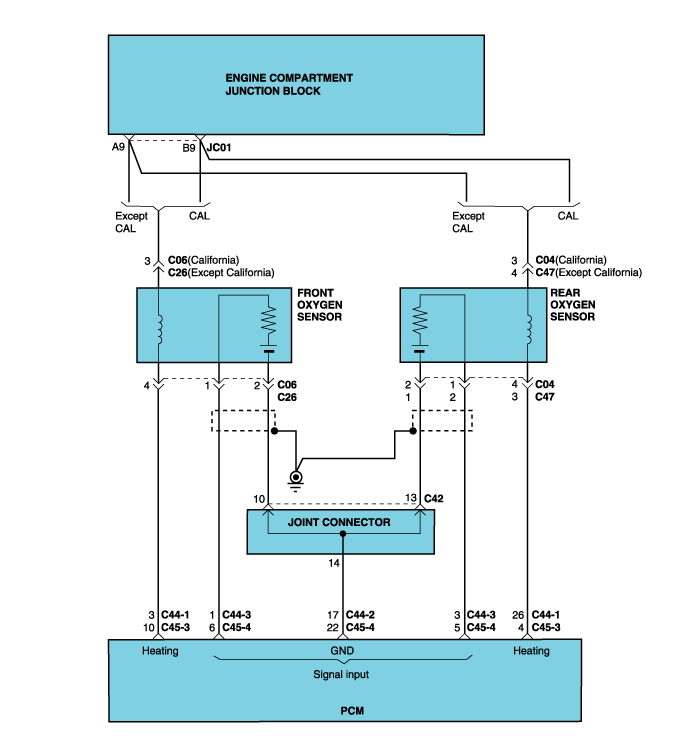
CIRCUIT DIAGRAM
TEST PROCEDURE