| SYSTEM FUNCTION |
ABS OPERATION
| 1. |
NORMAL BRAKING
|
| 2. |
DUMP MODE
|
| 3. |
HOLD MODE
|
| 4. |
INCREASE MODE
|
EBD (ELECTRONIC BRAKE-FORCE
DISTRIBUTION)
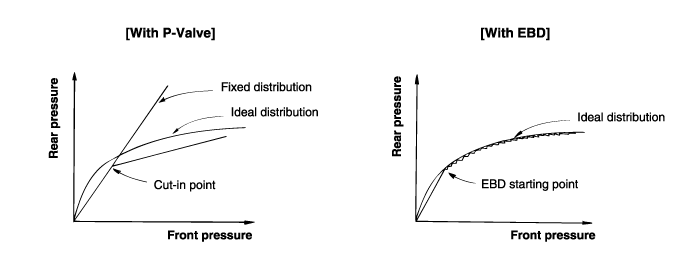
The EBD system
(Electronic Brake force Distribution) as a sub-system of the ABS system is
to control the effective adhesion utilization by therear wheels.
It further
utilizes the efficiency of highly developed ABS equipment by controlling
the slip of the rear wheels in the partial braking range.
The brake
force is moved even closer to the optimum and controlled electronically,
thus dispensing with the need for the proportioning valve.
The
proportioning valve, because of a mechanical device, has limitations to
achieve an ideal brake force distribution to the rear wheels as Well as to
carry out the flexible brake force distribution proportioning to the
vehicle load or weight increasing. And in the event of malfunctioning,
driver cannotnotice whether it fails or not.
EBD controlled
by the ABS Control Module, calculates the slip ratio of each wheel at all
times and controls the brake pressure of the rearwheels not to exceed that
of the front wheels.
If the EBD
fails, the EBD warning lamp (Parking brake lamp) lights up.
ADVANTAGES
| - |
Function improvement of the base-brake
system. |
| - |
Compensation for the different friction
coefficients. |
| - |
Elimination of the proportioning
valve. |
| - |
Failure recognition by the warning
lamp. |
COMPARISON BETWEEN PROPORTIONING VALVE AND
EBD
FAIL SAFE
|
FAIL CAUSE |
SYSTEM |
WARNING
LAMP | ||
|
ABS |
EBD |
ABS |
EBD | |
|
None |
ON |
ON |
OFF |
OFF |
|
Stop lamp switch failure |
ON |
ON |
OFF |
OFF |
|
One wheel speed sensor failure |
OFF |
ON |
ON |
OFF |
|
Pump malfunction |
OFF |
ON |
ON |
OFF |
|
Low voltage |
OFF |
ON |
ON |
OFF |
|
Two or more wheel speed sensor
failure
Solenoid valve failure
HECU malfunction
Over voltage
Valve relay failure
Other failure |
OFF |
OFF |
ON |
ON |
TCS INTRODUCTION
The Traction
Control System (TCS) incorporate with two independent control algorithms,
drive moment control (AMR) and brake moment control (BMR), that can be
applied simultaneously to improves tractionand keeps the vehicle in line
and it apply on all road surface with the whole speed range. TCS is
developing on the basis of ABS in order to ensure the wheels neither
lock-up during braking, nor should they spin when driving off.
CAN INTERFACE
During TCS
operation, TCS system need communicate with different system control unit
such as EMS (Engine Management System) and TCU (Transmission Control Unit)
to share the important message as list below in order to ensure TCS
performance and comfort.
| 1. |
CAN Interface:
|
| 2. |
Mainly signals from TCU:
|
| 3. |
Mainly signals from EMS:
|
| 4. |
Mainly signal from TCS:
|
CONTROL ALGORITHM
The TCS control
algorithm has two independent control algorithms, drive moment control
(AMR) and brake moment control (BMR). TCS evaluated the filtered wheel
speed signal from ABS speed processing to recognizes when a wheel is going
to start slipping. As soon as wheel(s) spin was detected, BMR will
intervene automatically in the brake system to increase traction and AMR
intervenes in the engine function to reduce engine torque and keep vehicle
stable via connected to ECM by CAN data bus.
The BMR increases the
pressure actively in the brakes either to generate a brake differential
effect by means of pressure increase in one wheel on split-μ situation or
on homogeneous μ, to reduce quicklythe wheel spin and stabilize the car by
increase pressure in both rear wheels simultaneously. In order to
compensate the clearance of the brake, BMR control starts with a filling
pulse.
The following control
algorithm is on the basis of comparison between slip threshold and control
deviation (RA), the slip difference of driven wheel. The slip threshold is
calculated depends on the vehicle speed, acceleration, driving condition
such as driving straight or in the curve, split μ or homogeneous μ road
surface. Pressure modulation will be applied by pressure increase or
decrease pulse to satisfy the different control condition that dependence
of control deviations, wheel acceleration and driving
condition.
The AMR controls the
engine torque by means of spark retard and ignition cut off. The control
concept and the calculation of slip threshold of AMR is similar to that of
BMR. However, the threshold values of AMR and BMR are different, but tuned
to each other. Whenever the wheel slip is higher than the slip threshold
value then AMR calculated the optimal engine torque reduce value and
transmitted it via CAN bus to the EMS. Then EMS will response to reduce
engine torque accordingly by spark retard and/or ignition cutoff. AMR will
request EMS to increase torque as long as the wheel slip value is lower
than slip threshold.
ABS WARNING LAMP CONTROL
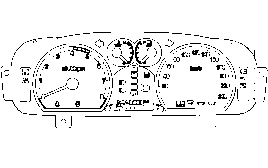
| 1. |
ABS warning lamp module
The active ABS warning lamp module indicates
the operating condition of the ABS.
The ABS warning lamp is turned on under the
following conditions.
|
| 2. |
EBD warning lamp module
The active EBD warning lamp module indicates
the operating condition of the EBD.
However, in case the parking brake switch is
turned on, the EBD warning lamp is always turned on regardless of
EBD functions.
The EBD warning lamp is turned on under the
following conditions.
|
| 3. |
TCS lamp module
TCS warning lamp module indicates the
operating condition of the TCS.
The TCS warning lamp is turned on under the
following conditions.
|