| p |
|
DTC |
P0442 |
EVAP Emission
Control System - Small Leak Detected (1.0
mm) |
DESCRIPTION
Due to
increasing ambient temperature of the fuel and the return of unused hot
fuel from the engine, fuel vapor gas is generated in the tank. In order to
control the release of these emissions to the atmosphere, the evaporative
emissions control system is used. The evaporative system reduces
hydrocarbon (HC) emissions by trapping fuel tank vapors until they can be
burned in the combustion process. Evaporating fuel is stored in a charcoal
canister until it can be flushed into the intake manifold.The evaporative
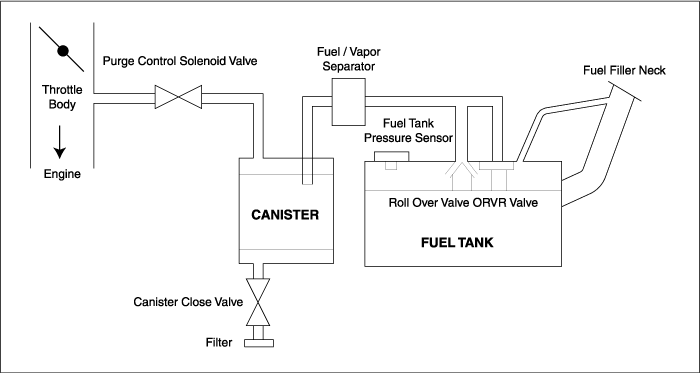
control system is made up of fuel tank that can be completely sealed from
outside air, Fuel Tank Pressure Sensor (FTPS), fuel/vapor separator (FLS)
that only allows vapor to enter the canister, Canister Close Valve (CCV)
that seals the canister from the outside air, canister filled with
activated charcoal granules, Purge Control Solenoid Valve (PCSV). The
evaporative system can be checked for a leak by closing the system off
from the outside air, creating a vacuum, and monitoring if the system can
hold that vacuum sufficiently for a set amount of time. If it cannot, a
leak exists in the system somewhere.
DTC DETECTING CONDITION
|
DTC
No |
Detecting Condition
& Limp Home |
Suspect
area |
|
P0442 |
Detecting
Condition
The leakage diameter within certain limits is
estimated.
Enable Condition
- Engine coolant temperature > 75°C
(167°F)
- Minimum modeled ambient temperature >
-10°C (14°F)
- Estimated altitude < 2440 m (8000
ft)
- Vehicle speed < 5 km/h
- Idle state
- Differential fuel tank pressure: - 0.8 ~
0.55 kPa
- Minimum purge time: 250 seconds
Limp
Home
None |
- EVAP system
- ECM |
SCHEMATIC DIAGRAM
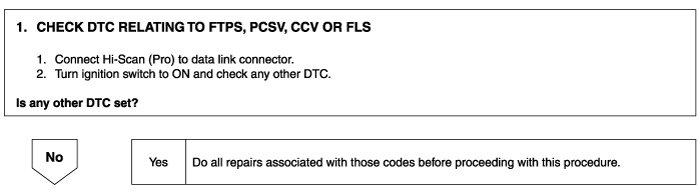
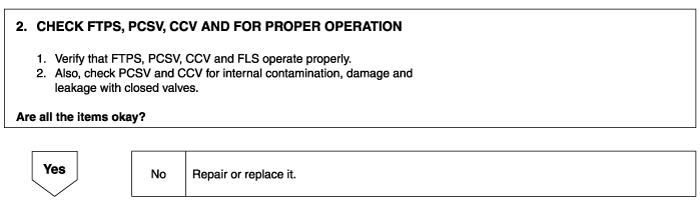
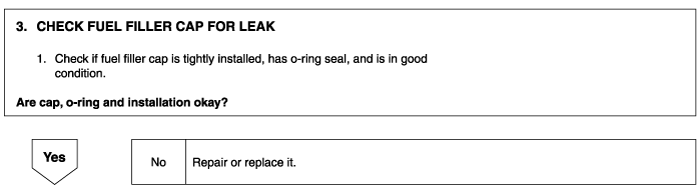
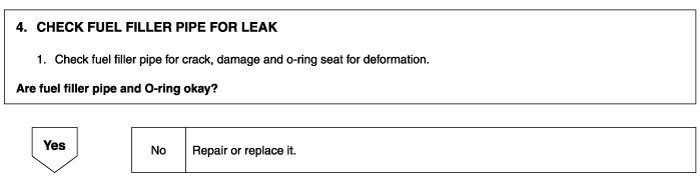
INSPECTION PROCEDURES